Within 10 years, Core Transit will get more riders where they want to go in Eagle County
Transit authority plans for 45% bus service increase, with new Highway 6 and Valley routes

Chris Dillmann/Vail Daily archive
Within three years, most Core Transit riders on the U.S. Highway 6 route will be able to do away with their schedules, with buses arriving every 20 minutes.
Within 10 years, Eagle riders will be able to do the same, even those who live in Eagle Ranch.
Dave Levy, Core Transit’s planning manager, presented the final 10-year Transit Development and Capital Plan to the Core Transit board of directors during its Sept. 10 meeting.
The entire Core Transit team pitched in to make the plan a reality, from administrative to operators. “We are really excited about this plan,” Levy said.
While for most transit agencies, creating a 10-year plan would be an all-consuming effort, Core Transit built its plan while increasing service and staff, going fare-free and adding housing and office space.

Support Local Journalism
Since the ballot measure passed establishing the Eagle Valley Transportation Authority, which became Core Transit, in November 2022, ridership has increased by 60% and transit service has increased by 45% in the winter and 73% in the summer.
Core Transit‘s board unanimously approved adopting the plan, which will guide the authority’s service and infrastructure improvements through 2035.
Taking public feedback
Core Transit staff and consultants conducted 14 months of public outreach and technical analysis to assemble the 10-year plan. “Our decision-making was community-led and data-backed,” Levy said.
“From the public, we learned that fast and frequent service was the most important thing from a service standpoint,” Levy said. “We also heard that we need to improve customer service and customer communications. You never want to hear that, but we needed to hear it.”
Members of the public also said infrastructure improvements were their top capital priority, particularly well-lit crosswalks and comfortable bus shelters. “This was a little bit of a surprise to us. We knew it was a bit of a problem, but we didn’t know how important it was to address it right away,” Levy said.
Fifty-three of Core Transit’s 95 bus stops currently lack bus shelters. Twenty-four bus stops also lack safe crossings. The 10-year plan ranks all 53 stops by the need for a bus shelter, with the Sunny Avenue stop in Gypsum and the Bear Lot stop in Avon topping the list.
A bus shelter costs between $6,300 and $24,000 according to the plan, which does not say that all stops will receive a shelter by 2035. Rather, the plan allocates $125,000 per year to bus stops and shelters.
Service increases
Core Transit’s preferred alternative will take three phases to implement.
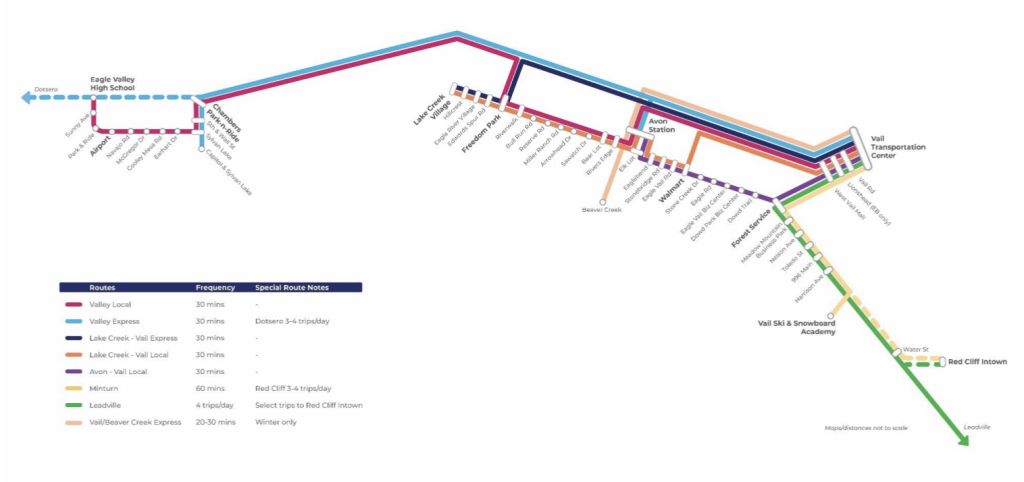
“The most significant change to the system is the breakup of Highway 6 into three distinct segments. This will give 75% of our ridership faster and more frequent service between the most commonly used origins and designations in the system,” Levy said.
Most Highway 6 riders will see a 20-minute headway, or time between buses, with these changes.
Phase II will include splitting the Valley route into two, with one line extending deeper into Eagle to capture Eagle Ranch riders and stopping at the Riverwalk in Edwards and a Beaver Creek ski lot in Avon.
In Phase III, service frequency on the Valley route will be increased to every 30 minutes, causing 15-minute headways for many passengers.
Across all phases, service will be added to Minturn until the town sees all-day service.
There will also be more trips to Leadville and Dotsero.
How Core Transit will fund the increase in service
“This is an excellent piece of work. Phase I and Phase II are absolutely brilliant,” said Dave Eickholt, Core Transit board member. “I still have the same concerns about Phase III, the bang for the buck that we’re getting is marginal improvement for an enormous increase in cost.”
According to Core Transit’s 2025 budget, the authority will take in nearly $26 million in revenue this year and spend $22 million before capital fund expenditures.
As the 10-year plan moves into Phase I, revenue is expected to grow to $29 million with greater anticipated sales tax revenue. Phase I will require annual expenditures between $23.5 million and $25 million, well within budget.
During Phase II, Core Transit expects revenues to grow to close to $33 million with higher sales tax funding and more grants, while annual expenditures will climb to $31 million.
In Phase III, the project’s most expensive phase, Core Transit will lose money if no additional revenue sources are found and the plan is implemented as currently written. Phase III revenues are forecast to reach $36 million by 2035, while expenditures are expected to hit $40 million that same year.
This substantial increase has two causes: One, increasing service on the Valley route is substantially more expensive than other routes. To reach the preferred amount of service for the Valley route will cost 77% more than the current service costs in day-to-day expenses. The closest comparator is the Minturn/Red Cliff route, which will cost 47% more for its planned service increase.
Second, Core Transit will need more buses to run more service, and more buses mean the authority will outgrow its current bus housing capacity. A new bus facility will cost approximately $63 to $73 million, though funding is expected to come mostly from sources outside of the general fund.