Skier gets justice in Aspen Mountain hit-and-run case 2 years later
The Aspen Times
Austin Colbert/The Aspen Times
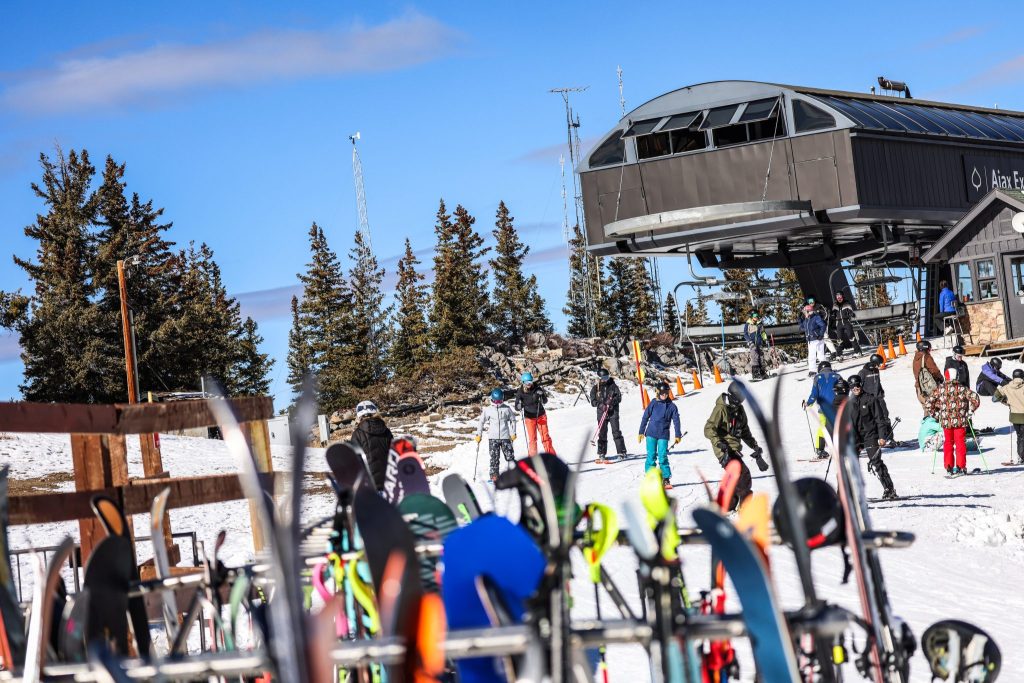
Anne Cassidy had just unloaded from Gent’s Ridge lift on Aspen Mountain in February 2024 when she felt a jolt from behind that caused her knees to “crumble like a lawn chair.”
She had been hit by a snowboarder, who quickly fled the scene, according to court documents at the time.
More than two years later, Eric “Riku” Banushi, a snowboarder from New Jersey, was sentenced to 45 days in jail on Friday after a Pitkin County jury convicted him of third-degree assault, reckless endangerment and violating the Colorado Ski Safety Act.
“It’s a pretty big deal that he got sentenced,” said Sheriff Michael Buglione, who added that an outcome of this type is rare.
For Cassidy, an Aspen local, the sentencing comes at the end of long recovery. Court documents lay out her extensive list of injuries: an ACL tear in both knees, an MCL tear in her knee, a medial root injury in her right knee, a torn meniscus in her right knee, a shoulder injury and an injury to her right hand.

Support Local Journalism
“The collision upended my life and my family’s life for two years,” she wrote in an email to The Aspen Times.
Cassidy, an avid athlete who used to frequently ski, play tennis, mountain bike, hike and more, has struggled to do any of these sports since the accident.
“Every part of my athleticism has been impacted,” she said.
But beyond her physical injuries, Banushi’s sentencing is the result of a complex investigation and trial stemming from his decision to leave the site of the accident immediately.
“The reason why this case particularly came forward to court is because the defendant, Banushi, didn’t stay on the scene,” said District Attorney Megan Machak, the prosecutor who handled the case for the 9th Judicial District Attorney’s Office.
Under the Colorado Ski Safety Act, leaving the scene of a collision without exchanging identifying information is illegal.
After hitting Cassidy, Banushi quickly continued down the mountain. Katy Frisch, a friend of Cassidy’s, chased after him, alleges the original complaint.
“I couldn’t stop; I was on a snowboard,” Banushi allegedly said to Frisch before continuing down the mountain.
“Well, maybe you shouldn’t be on the mountain,” Frisch allegedly replied.
A separate witness, Howie Hatanka, took a photo of Banushi, which later became essential to the investigation.
Cassidy’s effort to get justice then began in civil court in March 2024.
With the snowboarder’s identity unknown, Attorney Michael Fox used subpoenas to obtain surveillance footage and ticketing records from Aspen One. These records, along with social media posts, ultimately led them to identify Banushi.
“Aspen One fully cooperated with law enforcement, providing information and assistance in response to all requests as appropriate and required by law,” wrote a representative from Aspen One in an email to The Aspen Times. “We will continue to support the efforts of law enforcement and are committed to maintaining a safe environment across our properties.”
Then, a criminal case for Banushi began. The Pitkin County Sheriff’s Office investigated the accident and referred the case to the 9th Judicial District Attorney’s Office. Prosecutors ultimately charged Banushi with reckless endangerment, assault in the 3rd degree and violating the Colorado Ski Safety Act.
“The Pitkin County Sheriff’s Office, when they reviewed the case, saw that it was a violation of the Ski Hit and Run Act, but it was also reckless endangerment and assault because of the defendant’s reckless actions on the mountain that day,” said Machak.
On Friday, a jury convicted Banushi on all counts.
Cassidy said she was, “overwhelmed with feelings of gratitude for my community, including my family, friends and lawyer who supported me all along, the jurors and the judge who listened to all the evidence with grace and diligence, and the articulate, thoughtful witnesses who shared their expertise and truth.”
Banushi’s attorney, William Palmer, declined to comment on the case or the verdict.
But Cassidy’s work to ensure skier safety isn’t finished.
“I am eager to continue my work with the state legislature to revise the Skier Protection Act to be more punitive against skiers who hit-and-run, ski beyond their abilities, and ski under the influence,” she shared.
There is no centralized database for skier-on-skier collisions, like there is for vehicles, making it hard to quantify how many happen each year and how many are prosecuted.
“Criminal charges arising from ski collisions are uncommon, though not unprecedented in Colorado,” wrote Cassidy’s attorney, Michael Fox, in an email to The Aspen Times.
Still, for Machak, Banushi’s sentence is a reminder that, while a recreational sport, skiing always requires responsibility and accountability.
“If you are incapable of maintaining safety on the mountain and you truly can’t stop, you shouldn’t be putting other people’s lives at risk for your fun day on the mountain,” said Machak. “If you are reckless on a mountain, there are real consequences if you hurt someone.”
Cassidy was able to return to skiing on a limited basis last winter.