The Thoreau in Clay Jenkinson: Deeply personal Vail Symposium lecture carries audience into transcendence

When Clay Jenkinson interviewed America’s premier presidential historian, Doris Kearns Goodwin, at a Vail Symposium event in August, Goodwin talked about an op-ed she had co-authored with Sanford Levinson in 1967, and what a critical moment it was in her career.
What was remarkable about that reflection, at least for local audiences in Eagle County, was the fact that Jenkinson had also interviewed Levinson at a Vail Symposium event a few months earlier.
And in between those two discussions, Jenkinson interviewed legendary newscaster Judy Woodruff at a Vail Symposium event, as well.
With those three discussions in the rearview, one might assume Jenkinson had nowhere to go but down in terms of the quality of the event he was to host for his final Vail Symposium appearance of the season on Thursday, Aug. 27.
But in a solo lecture about Henry David Thoreau’s masterpiece “Walden,” fans of Jenkinson enjoyed what might have been his most personal and moving Vail Symposium appearance yet.

Support Local Journalism
Jenkinson was one of the stars of Ken Burns’ recent PBS documentary on Thoreau, a role which gave him the impressive distinction of being the most-featured person in all of Burns’ films. At the Vail Symposium lecture, Jenkinson shared with the audience what it feels like to be interviewed by Burns, giving insight into the master documentarian’s process.
“He doesn’t send you any questions in advance, no outline, he just says it’s about Thoreau,” Jenkinson said. “They put a mic on you, and a little makeup, and suddenly a door swings open and in walks Ken Burns … he sits less than two feet from you, and the camera is over his shoulder, and he says ‘So, who was Henry David Thoreau?’ And you go ‘aahhh, daaaa, ummmm,’ and then you’re off and running for the next two-and-a-half hours.”
The nervousness and anticipation that follows, Jenkinson said, can be overwhelming.
“For the next two weeks you think ‘what an idiot I am, I muffed that up, I should have said this or that … and then I call him up and I say ‘I want another interview, I’ll pay for the flights, I’ll do anything, I’m begging you.'”
But Burns doesn’t get down like that. There’s no practice round, no rehearsals. The magic is in the spontaneity. Burns then spends months upon months applying a meticulous edit to his material, Jenkinson said, and it could take another 18 months before the program airs.
And unlike Thoreau, Jenkinson isn’t present in the moment enough to wait it out without thinking about how it will turn out. He knows he shouldn’t allow himself to fixate on the future — he’s read Walden some 50 times, after all, so he well knows Thoreau’s suggestion that a life well lived requires focusing on the present as often as possible — yet he admitted to the audience that he rarely achieves that ideal himself.
“I’m almost never present,” he said. “How can we be?”
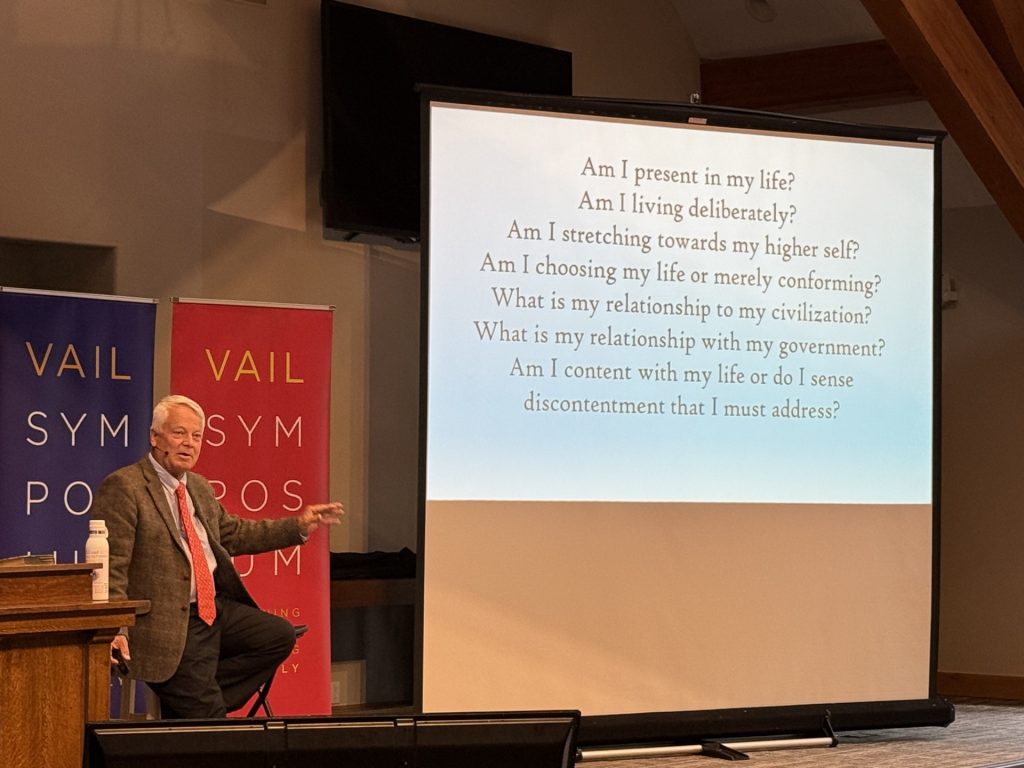
That admission was one of several deeply personal reflections Jenkinson shared with his listeners in Vail. Now in his eighth year of presenting at Vail Symposium events, Jenkinson has slowly introduced his audience to who he is — not the Rhodes scholar and esteemed historian, orator, Chautauqua performer and author — but the vulnerable human being who can make mistakes, embody contradictions and let his emotions interrupt him.
Jenkinson said he is haunted by Thoreau’s line “I went to the woods because I wished to live deliberately, to front only the essential facts of life, and see if I could not learn what it had to teach, and not, when I came to die, discover that I had not lived.”
Jenkinson has spent much of his life wondering what it means to live deliberately, and he said now that he is a senior citizen, he is haunted by the possibility that he hasn’t “stretched enough, lifted myself enough, wrestled with things enough, taken enough risks, said what I really think, and not, when I came to die, discover that I had not lived.”
Every time Jenkinson travels these days, “now that I’m no longer 40, or 50, or 60,” he said, “I think, ‘Will I ever see this again? Will I ever go to Europe again? Will I ever see Stonehenge again? Will I ever be at the Rijksmuseum again?”
Jenkinson shared other places and things that move him, including architectural works like the Golden Gate and the Verrazzano bridges, sculptures like Michelangelo’s “David” and Bernini’s “Apollo and Daphne,” paintings of great people like those found at the National Portrait Gallery in London, works of poetry like John Donne’s “No Man Is An Island,” and natural settings like Devil’s Tower in Wyoming.
“There are just some things that are so beautiful that if you let yourself let them in, they occupy a place in your heart forever,” he said.
In addition to beauty, Jenkinson used Thoreau to comment on the ugliness of humanity, as well. Jenkinson referenced Thoreau’s ability to discern where mankind’s failings might lead, including the United States’ reluctance to abolish slavery and the Civil War it ushered in. Quoting from Thoreau’s “A Plea for Captain John Brown,” Jenkinson shared a passage in which Thoreau said “Some eighteen hundred years ago Christ was crucified; this morning, perchance, Captain Brown was hung. These are the two ends of a chain which is not without its links.”
On the destruction of great forests and the wildlife habitat they created — also underway at the time — Jenkinson quoted from Thoreau’s Dec. 30, 1851 journal entry: “When the fish hawk in the spring revisits the banks of the Musketaquid, he will circle in vain to find his accustomed perch, and the hen-hawk will mourn for the pines lofty enough to protect her brood.”
Jenkinson described it as one of the great passages in the history of conservation.
“You can’t read it without just saying this guy had it,” Jenkinson said. “He had it. He had the capacity to find the expression.”
The audience got to see pictures of the inside of Jenkinson’s home, and a piece of wood mounted to his wall that’s engraved with a quote from Thoreau. Listeners were treated to stories about his travels with his daughter, and heard the anxiety he feels about her getting married, expressed through an uncharacteristic crack in his voice.
Jenkinson said there are places he still needs to visit, as well, places that don’t celebrate the triumph of humans, but our terrible mistakes.
“Now that I can see the end of my life,” Jenkinson said — eschewing the term “bucket list,” which he says he hates — “there’s a list of things I want to see … I think that every human being who has the wherewithal should go to Auschwitz and Dachau” to face the uncomfortable truth that “this, too, is humanity.”
Jenkinson’s decision to get personal with the audience may have been both a function of the growing familiarity he has developed with his Eagle County fans and the subject matter he discussed. In other words, Jenkinson now appears to feel comfortable enough in Vail to share details about himself, and Thoreau had a way of bringing it out of him.
From “Walden”
Sometimes, after staying in a village parlor till the family had all retired, I have returned to the woods, and, partly with a view to the next day’s dinner, spent the hours of midnight fishing from a boat by moonlight, serenaded by owls and foxes, and hearing, from time to time, the creaking note of some unknown bird close at hand. These experiences were very memorable and valuable to me, — anchored in forty feet of water, and twenty or thirty rods from the shore, surrounded sometimes by thousands of small perch and shiners, dimpling the surface with their tails in the moonlight, and communicating by a long flaxen line with mysterious nocturnal fishes which had their dwelling forty feet below, or sometimes dragging sixty feet of line about the pond as I drifted in the gentle night breeze, now and then feeling a slight vibration along it, indicative of some life prowling about its extremity, of dull uncertain blundering purpose there, and slow to make up its mind. At length you slowly raise, pulling hand over hand, some horned pout squeaking and squirming to the upper air. It was very queer, especially in dark nights, when your thoughts had wandered to vast and cosmogonal themes in other spheres, to feel this faint jerk, which came to interrupt your dreams and link you to Nature again. It seemed as if I might next cast my line upward into the air, as well as downward into this element which was scarcely more dense. Thus I caught two fishes as it were with one hook.
At the end of his lecture, Jenkinson shared a passage from “Walden” about a night spent on the pond, when the jerk of a fish on Thoreau’s line interrupted a moment of deep contemplation, reconnecting him with the physical world.
Jenkinson used the passage to define transcendentalism — the philosophical movement with which Thoreau is often associated — explaining how the personal freedom and space for spiritual reflection that individuals often find in nature can allow them to draw deeper meaning from everyday experiences. When time spent alone in the outdoors allows one’s thoughts to move beyond an ordinary moment into “vast and cosmogonal themes in other spheres,” as Thoreau put it, one experiences a moment of transcendence.
But as Jenkinson struggled to get through the passage, moved by the beauty of such a description, his audience experienced a moment of transcendence, as well. In sharing that moment with Jenkinson, and witnessing his display of emotion, listeners sensed that those words contained something beyond the ordinary.
Jenkinson, despite — or perhaps due to — his decades of familiarity with “Walden,” had managed to bring both himself and his audience to a state of profound emotion, thereby catching, in Thoreau’s words, two fishes with one hook.