Analysis | Taylor: If you were running Vail Resorts, what changes would you make?
Screenshot
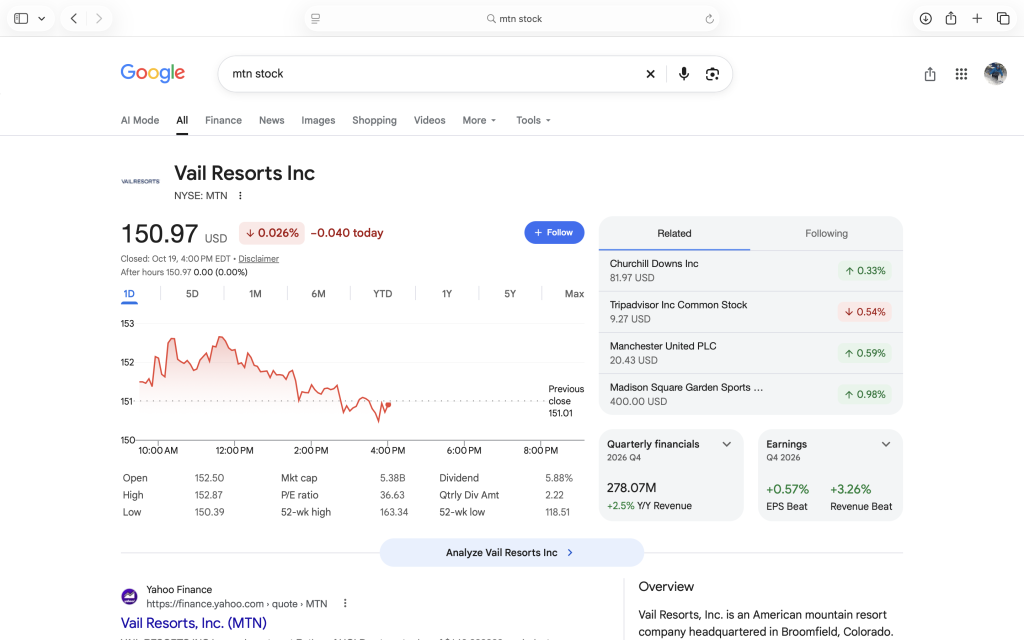
If you own Vail Resorts stock, the last two weeks have likely been among the happiest times for you since you bought the stock. The shares have skyrocketed by around 13% since the beginning of October.
That’s the good news.
The bad news is that nothing fundamentally has changed in terms of the operation or management of the company. The stock movement reflects nothing more than that Oasis Management, the Hong Kong-based investor that own 9.6% of VR stock, is running a slate of four candidates led by former Disney CEO Bob Chapek and Olympic gold medalist Picabo Street to replace four of the nine current members of the board and pressing VR CEO Rob Katz to make meaningful changes in the way the company is run.
On Wall Street, a place where hope often exceeds logic when it comes to determining what a stock is worth, that’s often enough to propel the stock upward.
Is that realistic?

Support Local Journalism
I worked on Wall Street for more than 20 years, and one thing I know is that nothing is ever certain when it comes to buying or selling stocks. And that’s surely the case here.
There’s no certainty that Oasis will stick around even if it won a seat or two. Or that Katz & Crew will either listen or implement its suggestions for improvement. When I say a seat or two, as opposed to the four seats it is seeking, I mean that it’s very unlikely that all four of its candidates win the shareholder vote, which will culminate when the company holds its annual meeting, most likely in early December. That is, if it ever reaches a final vote, which I doubt will happen.
I don’t see how Oasis could possibly get any of its board candidates elected without securing the votes of Ron Baron, whose firm has long been the company’s largest shareholder and currently owns 18.3% of the shares, according to the latest filing with the SEC. We called Baron to get an idea of what he’s thinking about the issues raised by Oasis but have yet to hear back. But my guess is Baron votes with VR management. (Keep in mind that predicting how big shareholders vote is a fool’s game.)
You might be asking: Should I vote with Oasis and against VR?
That’s a tough decision. The stock has been an abysmal performer over the last five years, and, in my opinion, skiing is a declining business. It has all the characteristics you would not want if you were seeking an attractive long-term investment. It’s capital-intensive, labor-intensive, seasonal, has massive exposure to weather and climate change (which are making the ski seasons shorter) as well as exposure to downturns in the economy. And I haven’t even touched on the issue of housing affordability in places like Vail. But to me, the bottom line is that skiing has simply become too expensive for many middle-class families.
What I think is happening here with the stock rising over the last two weeks is investors are simply betting that Oasis can make enough noise and apply enough pressure on management that it will sell a mountain or two for a quick gain and/or make other cosmetic changes to provide some short-term oomph for the stock. This should not be confused with fixing the problems.
Far from it.
I think VR — and the ski industry in general — is in serious trouble. I just went through a litany of reasons why, but to me it boils down to a single issue — cost. A ski vacation for a family of four is just too expensive, around $20,000 would be a reasonable guess for a week’s ski trip, perhaps more, possibly a lot more. But if it’s a lot more, it doesn’t matter because the folks who can afford that are the 30% or so folks in this country with a lot of money (median net worth for the upper 30%: $600,000). But what about the rest of us?
The median net worth — note this is not to be confused with annual income — for the middle 50% of America is about $150,000. For those in their peak child-rearing stage, it’s a little less. That doesn’t leave you with an enormous amount of money that you can afford to blow, especially in an inflationary environment when money is tight. Look at how airfares have jumped — about 40% over the last year — as the cost of jet fuel has skyrocketed. Add in the cost of a weeklong stay in a cozy hotel in Vail or Beaver Creek, some nice meals for your family of four, lift tickets and some pricy lunches on the hill, and you can start to feel the financial noose tightening around your neck. And then there’s the snow, which has become ever more unreliable. Who wants to spend $20,000 to take their family to Vail to stand in 20-minute lines to ski the 10-15 runs that are open, none of them all that great? Not me, baby.
Likewise, if you are driving up from Denver with your kids to ski for a day, do you really want to ante up, say, $1,000 for the day and then spend more time stuck in traffic on I-70 than on the slopes? Because the snow has been so sporadic in recent years, more of them are waiting to the last minute to decide if it’s even worth the time and price to even drive up here.
I’ve had endless conversations with folks out here about where the ski industry is heading, and everyone has an opinion. But here’s a question for you, dear readers. What would you do if you were Katz to address this problem? What could you do?
I’m serious. Things have not gone well for the ski industry in recent years, but how would you go about reversing that? That’s the challenge facing not only VR, but Vail or any other ski resort town.
We can complain all we want about the long lines, the cost of a ticket, the price of food on the mountain, etc., but how would you solve the problem? It’s a puzzle with no easy answer. Coming up with a long-term solution may well determine whether the Vail community — not to mention Vail Resorts the company — prospers or crumbles over the next 5-10 years. Chances are that many of you work in a hotel or restaurant. It’s no secret that a fairly high percentage of these places are charging prices that only a subset of the American public can afford. Is this smart or are we merely milking the golden cow, hoping it doesn’t run dry?
How do you think we should deal with this? We all relish making our turns and embrace the magical life the mountains afford. But what are we doing to preserve that lifestyle? Criticizing Katz and his team in Broomfield has become a blood sport here. They are easy targets. However, if the foundations of the ski industry are starting to erode, then it stands to reason that our livelihood is under attack, far more perhaps than many of us realize. If you are pinning your hopes that Oasis has the answers, I would say that’s a long shot.
What’s needed here is gifted and very forward-thinking management, not only at VR but in ski communities like ours. VR cannot solve these problems alone. We need a very carefully mapped out 10-year strategy detailing how to address the issues of weather, climate change, the price of a ski vacation, etc. How are we going to repopulate the sport as baby boomers — i.e. the folks with most of the money — age out of the sport? How are you going to get younger folks, especially families, into the sport? Where is the affordable housing for the very people who interact with the skiers most closely? Hard to show up in cheery mood for work each day when you’ve slept in your car.
That’s going to require a very, very skilled CEO at Vail Resorts backed up by a top-flight management team capable of implementing a long-term strategy to revive the industry and the company. Don’t kid yourself. This is not going to be solved by a few simple changes here and there. It’s going to require wholesale change — and vision. I’m not under the impression that the ski industry attracts the kind of talent that one might see in the C-suite of Amazon, Microsoft or J.P. Morgan. Not even close. Maybe it’s time to look more outside the industry to bring in higher grade talent and pay them accordingly. But the key place to start is with a detailed long-term plan and a strategy to bring that plan to fruition. For it to work would require input and buy-in from VR’s 42 resorts, especially the marquee names such as Vail, Whistler and Park City.
Do I think VR’s current management is capable of that? Hell no. If they knew what to do, they’d have done it by now. In my opinion, VR has been in milking mode for years. Cut costs to the bone, stretch the organization as thin as possible and hope like hell we get snow of Biblical proportion each winter. That’s not a long-term strategy; it’s either a prayer or a recipe for disaster.
As I say, Katz & Crew have become a punching bag for all of us. But they don’t exactly go out of their way to help themselves. So far, they have done little to answer questions from either financial analysts or the press. They did offer a formal statement last week that sounds like it came straight from the PR department, with an assist from legal. It said, “Over the past 16 months, our Board and management have taken decisive action to transform Vail Resorts, strengthen its performance, and position it for sustainable long-term value creation. We have enhanced our leadership team, revamped our marketing approach to celebrate what makes each of our mountains unique, and introduced new pass and lift ticket products and pricing strategies designed to broaden access. We’ve already seen early proof points, including record guest satisfaction scores last year, increased lift ticket market share, and outperformance versus the industry on pass sales for the upcoming season.”
Got that? Sounds great, right? Of course, the company forgot to mention that pass sales through Sept. 19 were down 12% year over year, earnings plummeted nearly 50% in the latest quarter and VR has forecast skier visits to be down this winter compared to 2024-25, the last season where snowfall was normal. But why quibble over such minor details? “Our focus is on building on this progress through disciplined execution,” VR concludes, “by making every part of the mountain journey more seamless, personalized, and memorable.”
Call me a cynic, but I’m of the mind that the ski industry’s problems are not short-term, nor can they be glossed over with self-congratulatory encomiums like this. VR’s problems are not going to go away. One of the things I learned as both a business reporter and an investor is that when management seeks to hide behind formal press releases and canned remarks like this, it signals they are afraid to be out front and center. You want to get out in front of the problem and be very visible, not only to investors but your own employees. That’s what leadership is all about. There’s a reason folks in Park City are lining up to support Matthew Prince’s bid to buy the mountain resort.
Should we count on Oasis to fill the void? Not likely. They are in it to drive the stock price up, and then, most likely, they will be gone. Activist investors are rarely confused with marathoners.
But we live here and our livelihoods are tied to Vail. We should be the advocates for change, and the ones coming to the floor with idea. You have the right to speak up. Stop blaming VR for all your problems and get proactive. Think of George Gillett and the way he embraced local input and support.
Skiing is a much tougher and more complicated industry today than during Gillett’s time at the helm. Don’t be confused into thinking that all we need are cheaper lift tickets and someone greeting us with brownies as we come off the lift to get things turned around. Times have changed. The issues facing Vail, Aspen, Telluride or Whistler — or any other ski resort — are very serious.
The time for Band-Aid solutions is long past. My favorite CEO from the years I worked in the investment world is Larry Culp, the remarkable CEO of GE. When Larry took the top job in 2018, GE was a failing remnant of a once-great American company now on the cusp of bankruptcy after decades of mismanagement. It’s flourishing today, thanks to his extremely deft and courageous leadership. You talk to anyone at GE and they’ll tell you Larry saved our company. But I’d note that it took around six years or so just to get the company pointed in the right direction. Six years. During that time, Larry was front and center answering any question investors or the press had about the company’s problems. He never covered up or offered apologies. Never hid. He methodically retired nearly $100 billion in debt and spent as much time visiting the company’s sites and speaking with its people as he did in GE headquarters. Maybe more.
That, my friends, is leadership.
Larry once said to me that any company he runs has “a bad news first culture,” by which he meant that first you deal with the problems — and the successes will take care of themselves. Seems to me that VR is pretty much the reverse.
But what do you folks think?
Tell us. If you were running VR, what changes would you make? Keep in mind that lowering ticket prices or the cost of lessons isn’t going to get the job done. We as a community need to think about what we could — and should — be doing to make the skier experience more memorable and fun. Skiing has to work for the guests, or it will never work for the rest of us. And that means the restaurants, the hotels, the ski shops, etc. must be part of the solution. We’re in a tough fight. Skiing is a seasonal business.
Solutions are never easy. Larry Culp has a saying, “Be quick, but don’t hurry.”
Let’s hear from some of you about your thoughts about what needs to happen for Vail, VR and the community at large to benefit. Email your letters and ideas, and we will read each one. In the meantime, we’ll be reaching out to some of you over the next few weeks seeking your input.
John Taylor is a former business reporter and Forbes bureau chief who later worked as a financial analyst on Wall Street for 20 years before retiring to Vail in 2017. He owns no Vail Resorts stock. Email Taylor at jhtconsulting@comcast.net or email business editor David O. Williams at dwilliams@vaildaily.com.