Stéphane Wrembel Quartet plays Beaver Creek
Rob Davdison/Courtesy photo
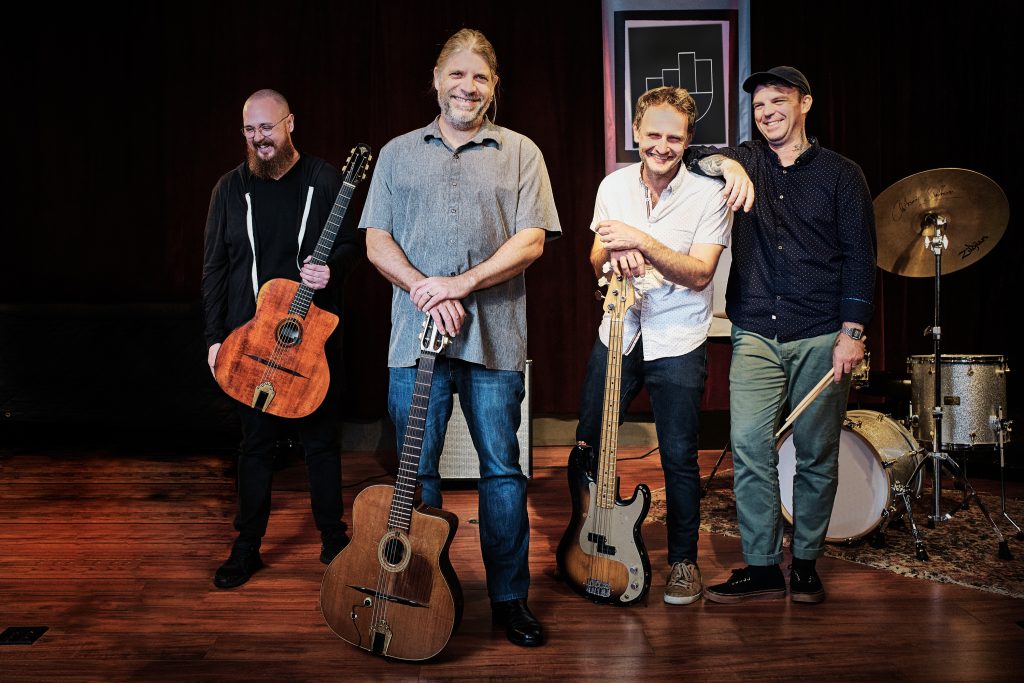
Stéphane Wrembel comes to the Vilar March 31 with a slight lineup change in his quartet, due to previous quartet members having health issues, but he assures audiences they’re in for the same high-quality performance, with one of the best guitar players in the world at the helm.
Longtime drummer Nick Anderson will be there, and Quico, from Spain, joins Wrembel as the second guitarist, while bassist Erik Alvar, who played on Billy Strings’ first EP, rounds out the quartet.
“On stage is more than a collection of instruments; everyone has their own personality, and you need people who have similar chemistry. But because we’re all unique human beings, the chemistry is always different, and you get a new result every time,” Wrembel said.
Raised in Fontainebleau, France, Wrembel grew up studying classical piano in the same town one of his main influences hailed from: Django Reinhardt. In his mid-teens, he discovered a passion for guitar and switched instruments while listening to the likes of Pink Floyd and other rock music, as well as the impressionistic feel in Reinhardt’s music. Reinhardt, a Sinti, or Roma group from Western Europe, is regarded as one of the most influential musicians and composers throughout history.
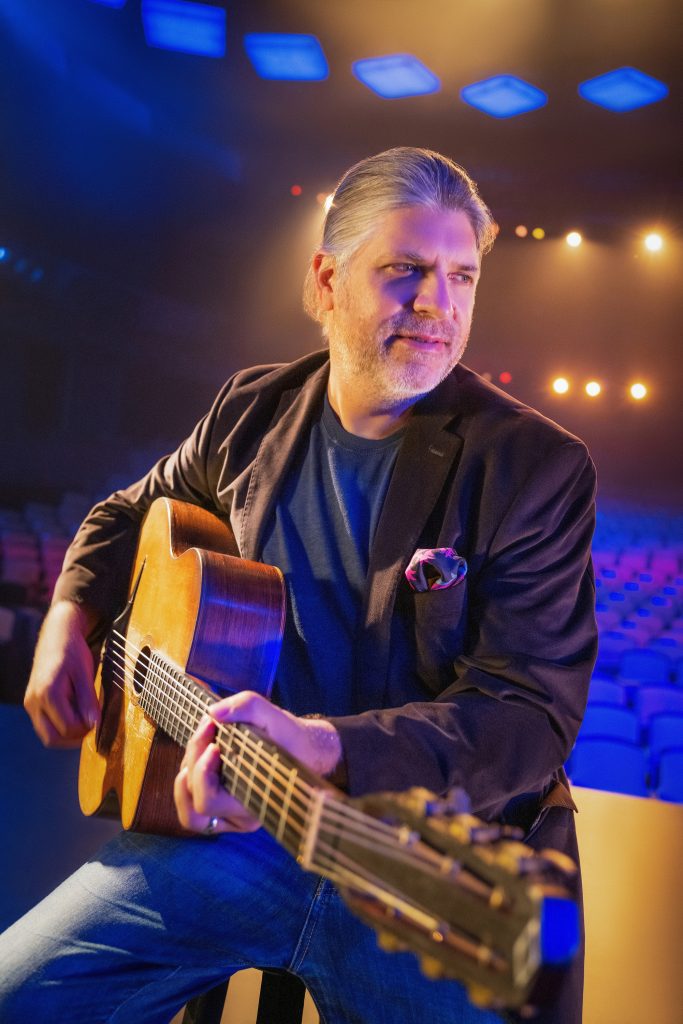
“I grew up in an environment where there was a lot of history in art — and with the kings and French history and surrounded by gypsies and classical music. I respond to my upbringing. And although there is always something unique in each of us, and always something new because the world moves on and we move on with it, there is still a route that’s there. So for me, it’s important to celebrate my roots, the music of Django Reinhardt, the classical music, that sense of art and history, Impressionism, and also my journey on earth — moving to America, living in New York and learning jazz, the American art, and letting all that brew and naturally come out,” Wrembel said.

Support Local Journalism
He describes all of his influences as a blend, whether that’s Jimi Hendrix, Pink Floyd, John Coltrane or 1920’s jazz.
“Once you’ve heard something, once you have experienced something it’s also a part of you — big or small, it doesn’t matter. It will spice your soul and your whole being,” he said. “And if you listen to your own nature and you let things unfold naturally, everything will find its own place. Your expression depends on all that. We have roots, but the world is also moving, and we are moving with it, so it has to be a natural process. It’s very spiritual and sincere.”
What: Stéphane Wrembel Quartet
When: 7 p.m. March 31
Where: Vilar Performing Arts Center
Tickets: $50.85 general admission; $84.75 reserved (the latter is sold out)
More info: vilarpac.org
Both Reinhardt and the jazz of New Orleans inspired his last two album releases, the 2023 “Django New Orleans” and last year’s “Django New Orleans II: Hors-Série.”
“You have brass sections and percussions (such as in New Orleans marching bands). That’s the foundation of it. And what Django Reinhard showed us is how to swing, but on the guitar. And he did even more with his band. There were three guitars, upright bass and violin, so a string quintet, basically. He showed us how to make the string section swing. It’s a very interesting move,” Wrembel said.
As he points out, swinging on the guitar isn’t something you can describe in words; it’s something you experience.
Within the albums, he kept the string sections, two guitars and violin and replaced the bass with a sousaphone, rounding out the nine-piece band with other horns, a singer, as well as percussion. The result sounds close to a full orchestra, only in a minimalistic way.
“It’s really the swing strings, the two guitars and the violin, so everything is bit a compact, very jazz oriented,” he said.
“Django New Orleans” is the most New Orleans-oriented, while the second version stretches a bit broader with various songs, including ones from Astor Piazzolla, Louis Guglielmi and Serge Gainsbourg.
“We’re not trained to copy the 1920s anymore, but we took those sounds. We kept the architectural frame of jazz in the background. We are very inspired by New Orleans, but we also respond to our modern nature, the physical experience nowadays, so it’s a very original band,” he said. “It seems like an obvious thing to put two guitars and a violin in the middle of some horns. It doesn’t seem that complicated, but I don’t think it’s ever been done that way, so bluntly.”
On March 31, the Vilar transforms into a club-style vibe, as audiences sitting at two-top tables join the musicians on stage. The evening also includes French red and white wine offerings, along with French 75, the classic gin and champagne cocktail.
Wrembel shares stories about each song as the concert unfolds and reacts to anything that happens on the spot from within the crowd.
“First of all, I make it a journey. I interact a lot with the audience, and I guide the concert. So there is a thread always to a concert, and I also put together a world-class band, some of the best drummers, bass players and rhythm guitar players in the world,” he said. “Everything we play is sincere because I’m not trying to be artificial, to construct things mentally. Things have to happen in an organic way. Everything revolves on that natural chemistry. The expression is sincere, and I think people can feel it.”
He’ll be covering plenty of Reinhardt and his own compositions, including “Bistro Fada,” a French-style jazz waltz, which sets the musical theme for the 2011 film, “Midnight in Paris.” The soundtrack won a Grammy.
“I believe that music is something we dream. It’s not something we experience intellectually too much. When you watch a movie, you dream with the movie. When we listen to music, we dream. And so the musicians dream, the audience dreams — we’re in a collective dream somehow. It helps to trigger an inner spiritual journey,” he said. “A concert is a symposium, and we’re going to reach that transcendental state for sure. That’s our concert: a transcendental experience. It really is. It’s not something where you can calculate notes; (that’s) irrelevant. It’s more like a story and something you dream.”
His philosophical approach, range of compositions and ability to play so many genres are what make him stand out as one of the finest — and most original — contemporary guitarists in the world.