Colorado’s unaffiliated voters, who make up half of the electorate, hold dim view of both major parties, poll finds
In a survey of over 1,200 active voters, most unaffiliated Coloradans said they want Democrats and Republicans to be more moderate

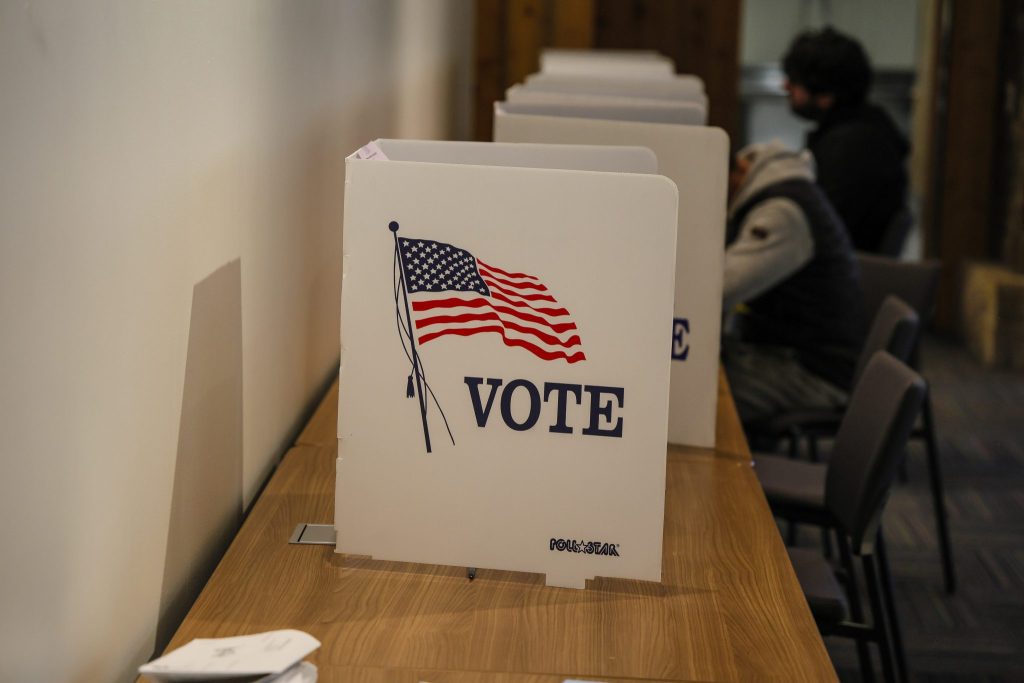
Chris Dillmann/Vail Daily
An overwhelming majority of Colorado’s unaffiliated voters say they reject both major parties and want to see Democrats and Republicans become more moderate, according to the findings of a new statewide poll.
Let Colorado Vote, a nonprofit founded by Kent Thiry, a multimillionaire and the former CEO of the Denver-based dialysis company DaVita, commissioned a survey of 1,210 active voters last month to gauge the sentiments of unaffiliated voters.
The poll was conducted by Keating Research from Nov. 10-17, and included 600 unaffiliated voters, 300 Democrats, 300 Republicans, and 10 others. The poll had an overall margin of error of 2.8 percentage points, and a 4 percentage point margin of error for unaffiliated voters. It had a 3.2 percentage point margin of error for likely 2026 voters.
Currently, 49.7% of all active Colorado voters are unaffiliated, a figure that has grown in recent years as political party registration shrinks. By comparison, just 25% of active registered voters are Democrats, and 23% are Republicans. Unaffiliated voters make up the majority of active voters in 21 Colorado counties, including Summit, Grand, Eagle, Garfield, Routt and Pitkin.
Thiry has been heavily involved in efforts to reshape Colorado’s political system in ways that give unaffiliated voters more voice. He was at the forefront of a successful 2016 ballot initiative that opened party primary elections to unaffiliated voters, and a 2018 measure that put redistricting in the hands of independent redistricting commissions, rather than state lawmakers.

Support Local Journalism
Thiry said the results of last month’s poll dispel the theory that the state’s growing unaffiliated electorate is due to the state’s automatic voter registration. The poll found that more than 8 in 10 unaffiliated voters said they chose their status intentionally, rejecting both major parties. Most unaffiliated voters, 54%, also chose to refer to themselves as “independent.”
“Some partisans like to say, ‘Oh, independents are just too lazy, and they like to default to being an independent,” Thiry said during a virtual briefing last week on the poll results. “Not true. Look at the data — 85% of people chose to be an independent. It was a conscious decision.”
Unaffiliated voters who were surveyed said they want Democrats and Republicans to move away from the extreme flanks of their parties. Sixty-four percent said they want Democrats to become more moderate, compared to 65% who want the Republican Party to become more moderate.
When asked which party has become the most extreme, a plurality of unaffiliated voters, 45%, said Republicans, while 36% said Democrats and 14% said both. Despite their dim view of the two political parties, unaffiliated voters still tend to vote for a Democratic or Republican candidate during elections, and usually lean toward Democrats.
Thirty-five percent said they usually or always vote for the Democratic candidate, while 35% said they sometimes vote for a Democrat and sometimes a Republican. Twenty-six percent said they always or usually vote for the Republican.
Thiry is critical of Colorado’s current primary system, in which candidates from the same party compete to be their party’s nominee in a general election, arguing that it gives unaffiliated voters fewer choices, since they must choose to vote in one party’s primary.
In heavily partisan districts, the primary is often the election of consequence, with the winning candidate usually cruising to victory in the general election.
“The current system tends to drive an excessive percentage of candidates who are far-left or far-right, and it is much more difficult for an independent to pick someone who hangs around center-left or center-right,” Thiry said, adding that unaffiliated voters tend to vote for the “person, not the party.”
More than 7 in 10 unaffiliated voters said Congress is dysfunctional, not representative, and their vote doesn’t really matter. A similar number said they are frustrated with how often only a single candidate runs in primary elections.
Unaffiliated voters’ negative view of the political establishment extends from federal offices to the state level. Sixty-two percent view President Donald Trump unfavorably compared to 37% in favor, while 57% view the Colorado Republican Party unfavorably compared to 37% in favor.
They have a 56% unfavorable-to-39 % favorable view of the Colorado Democratic Party and a 48% unfavorable-to-36% favorable view of the state Legislature, which Democrats control.
Chris Keating, who runs the polling firm that conducted the survey, said the “largest defining characteristic of Colorado’s registered independent voters is that they are younger.”
Sixty-six percent of voters aged 18-34 are registered as unaffiliated. Keating’s poll found that the median age of an unaffiliated voter is 42, compared to 49 for Democrats and 54 for Republicans. Keating added that Hispanic active voters and men are slightly more likely to be unaffiliated.
Other findings from the poll include:
- The top three issues for unaffiliated voters in Colorado are housing affordability and the cost of living, taxes, spending and budget issues, and political leadership and polarization.
- Fifty-two percent of unaffiliated voters say Colorado is on the wrong track, compared to 41% who say it is heading in the right direction.
- Unaffiliated voters trust Republicans significantly more than Democrats when it comes to crime, and slightly more on immigration. They trust Democrats significantly more on issues of education, democracy and voting, the environment and conservation, and slightly more when it comes to inflation and the cost of living.
- Sixty percent of unaffiliated voters favor keeping the Taxpayer’s Bill of Rights in place as a way of keeping government spending in check and giving voters the final say on tax increases, compared to 26% who say TABOR should be repealed because it prevents the state from adequately funding schools, roads and health care.
- In a generic matchup of congressional candidates, 44% of unaffiliated voters said they would vote for the Democratic candidate, compared to 38% who said they would vote for the Republican candidate if the election were held today.
- Of 916 likely 2026 voters surveyed, Democrats hold a 14-percentage-point lead in the generic congressional matchup, and Trump’s favorability is minus 27 percentage points.
To remedy some voter dissatisfaction and give Coloradans more choice in elections, Thiry advocated for moving to an “open” primary system, in which candidates of all political backgrounds can compete on a single ballot that is open to all voters, regardless of their party affiliation.
“I get accused all the time of wanting to destroy the two-party system — I think they’re doing a great job of destroying it themselves,” Thiry said. “What we’re proposing is to save that, to get them back to where they’re representing the core Americans who are center-left, center-right and center-center.”
Thiry pushed for open primaries in 2024 as part of Proposition 131, which sought to abolish party primaries for congressional races and state elections in favor of an open ballot. The measure would also have instituted ranked-choice voting in general elections for those same races. Unite America, a national nonprofit that Thiry co-chairs, has led similar election reform measures in more than a dozen other states. Still, Proposition 131 was ultimately rejected by voters in Colorado last year.
Curtis Hubbard, a Colorado political strategist who served as a spokesperson for the Proposition 131 campaign, said a post-election assessment found that most voters supported open primaries but were confused by ranked-choice voting.
“When voters are confused, they default to ‘No,'” Hubbard said. “The open primary is something that voters actually like. They like the idea of being able to support candidates, the best candidates, on the ballot regardless of party.”
Proposition 131 was defeated by just over 7 percentage points, with 53.5% of Colorado voters against the measure and 46.5% in favor. Thiry signaled there will be future attempts to revive the effort.
“We got awfully close, despite the complexity of our proposal,” Thiry said. “The reservoir of support was very strong, and going forward, we’re probably going to pay more attention to the fully open primary than ranked choice voting, in the short term.”