Eagle County conservation event recognizes state legislators for landowner easement extension

Chris Dillmann/Vail Daily
When Robyn Paulekas thought about her favorite spots in Colorado, most of them were public lands — and almost all of them had a connection with neighboring private landscapes.
On Monday, the Eagle Valley Land Trust hosted “Conservation in Action: Celebrating Policy Champions & Shaping What’s Next,” to celebrate recent conservation achievements and examine political pursuits of environmental stewardship alongside local partners such as Keep It Colorado, Aspen Valley Land Trust, Eagle Valley Land Trust and The Nature Conservancy.
The groups recognized the passage of HB26-1230, an extension of the state conservation easement tax credit to 2035. Originally established in 2000, this program provides a transferable state income tax credit to any landowner who voluntarily agrees to restrict the use of their land to protect and conserve the property.
According to the statewide coalition, Keep It Colorado, the benefits are both economic and environmental, mostly focusing on rural communities that depend on land for agriculture and ranching.
“This (program) allows for working farms and ranches to stay in families. It protects wildlife, habitat, and water, and open spaces,” said Paulekas, the executive director of the coalition.

Support Local Journalism
She pointed to a study from the Property and Environment Research Center, which looked at 12 states that adopted conservation tax credit programs. Colorado was recognized for its program that made it feasible for family farmers and ranchers who lacked the income to use the large tax deductions to be able to sell the credits and reinvest the proceeds into their operations.
Paulekas said she heard from other states looking to implement a similar tax credit program, using Colorado as a model.
“We truly have an abundance of riches when it comes to conservation funding in Colorado,” she said.
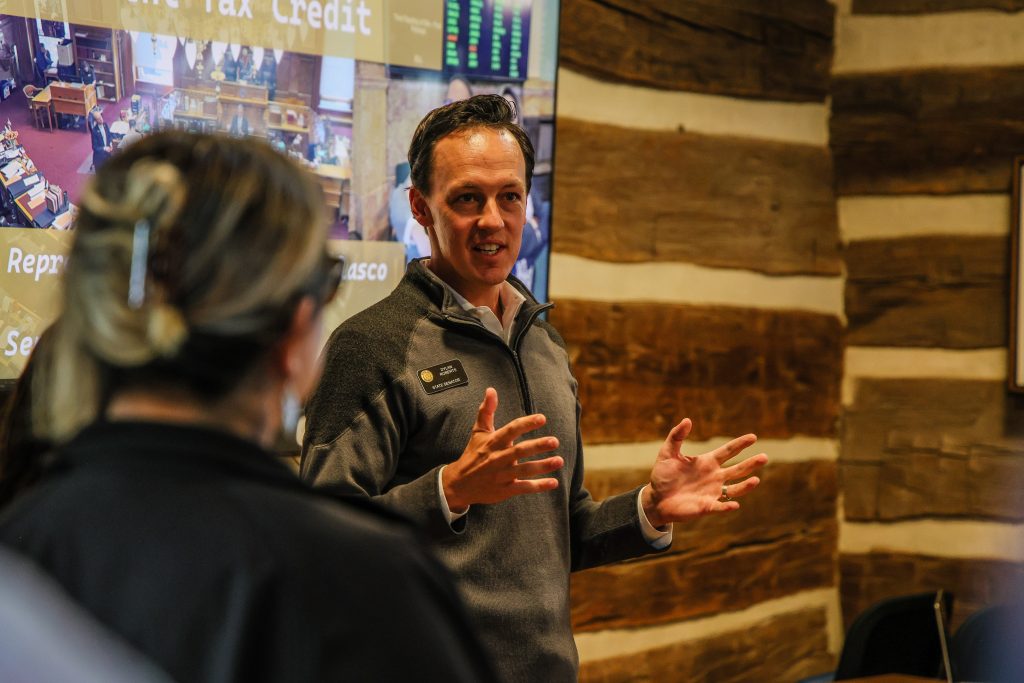
Eagle County’s state legislators, Rep. Elizabeth Velasco, D-Glenwood Springs, and Sen. Dylan Roberts, D-Frisco, were prime sponsors of the extension bill and were recognized at the Edwards event for their role in getting it passed.
Velasco has worked as both a wildland firefighter and in public information with the U.S. Forest Service. She knows how conserving land aids in the protection of natural resources.
“It was an honor to be able to do this work. We have visited many of the different projects across the state,” she said. “I think that one thing that’s so special about this program is that it is very flexible. So there’s an opportunity for the landowner and (to be) able to create these very special pockets in our communities.”
Roberts said during his time listening to testimony for the bill in the legislature, he heard how much it meant to people if it were passed.
“The farmers and ranchers, who probably would be out of business and had to sell their land if it weren’t for the ability to put their property under a conservation easement,” he said. “They’re still farming and ranching today because of that … we have to keep those small farms and ranches in business in Colorado; it is such an important part of our character and our economy, and conservation easements are an incredible tool for that.”
The event attendees also looked at two future political pushes for the county and beyond.
Proposition 137, which is currently on the ballot, would allow the state to keep money it receives for an existing sales tax on outdoor sports equipment and put it toward conservation projects such as wildfire risk reduction, land and water conservation, access to the outdoors for youth and families, and promote an outdoor economy and workforce development.
Another focus was an open space tax ballot question, which voters could see in a 2027 election. It would ask voters to release the revenue cap of $7 million, presenting the Eagle County Open Space program with more opportunities to look beyond what it does for acquisitions and land management of their properties.
“We do have the opportunity this year and next as voters in this community to make decisions that will impact conservation funding,” said Jessica Foulis, executive director of Eagle Valley Land Trust. “Conservation is a team sport, and it takes so many people to get this work done.”