Vail approves some Residences at Main Vail improvements
Project will include solar panels, better windows

When the Vail Town Council in August cleared the way for the Residences at Main Vail project, some council members encouraged further improvements to the plan. That’s going to happen.
The Vail Town Council has approved a roughly $300,000 package of changes and improvements to the project, now expected to open in November of 2023. The total project cost is now about $30.2 million. The town has borrowed about $25 million for the project. The rest will likely be paid in cash.
Most of the changes will benefit residents. Those include windows that let less sound into units. Since every unit will include a washer and dryer, the council agreed, for now, with a proposal to replace standard vented dryers in the 72 units with heat pump dryers, which don’t require outside venting.
Project architect Jeff Orsulak of Lipkin Warner Design and Planning said heat pump dryers are more efficient than condensation dryers, another kind of non-vented appliance.
The dryers are part of a package of changes to improve the looks of the project.

Support Local Journalism
But the dryers come with a caveat.
“If those dryers don’t work, we’re going to have a huge problem,” Council member Travis Coggin said.
Vail Public Works Director Greg Hall said the town will buy one heat pump dryer to see if the devices work as advertised.
“If it works, I’ll buy it (from the town),” Coggin said.
Mike Foster of Triumph Development, the firm working on the project, said planning for external vents for all 72 units was resulting in unworkably long ductwork.
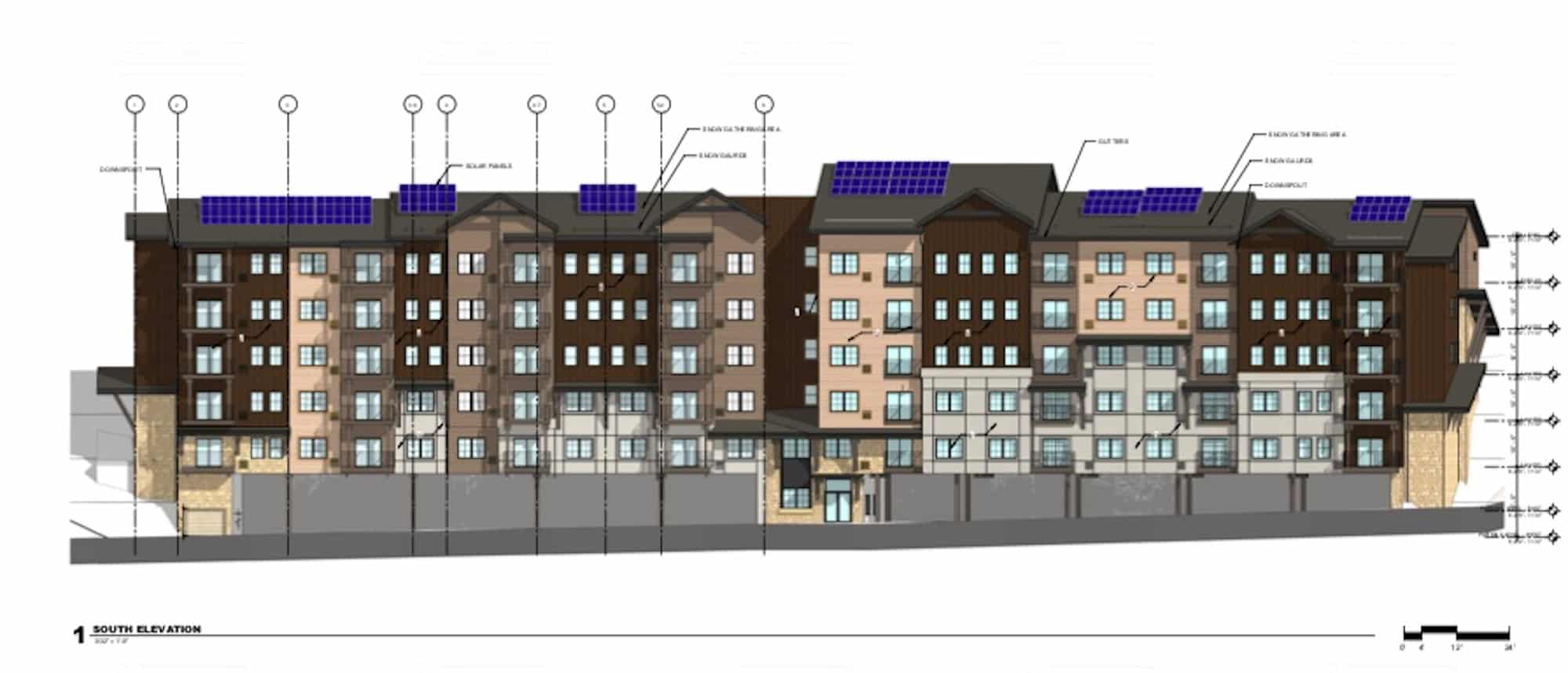
The council also approved a 25-kilowatt solar panel array for the building.
Mayor Kim Langmaid pushed for a more robust array, noting that town is far behind on its renewable energy goals. And Council member Jonathan Staufer noted that the apartments should be “the most environmentally sensitive building we can make it.”
But even the more robust array would handle only 70% of the complex’s energy needs.
But, Coggin said, the proposed payback on the cost of the bigger system is longer than the expected life of a standard shingle roof. And, he added, with the rapid advance of solar panel technology, it might be a better idea to go with the smaller system, but wire the project for a more heavy-duty system in the future. Council members ultimately agreed with that argument.
In addition to efficiency improvements, the project will see some aesthetic improvements. Those include broader trim around the windows, architectural trusses at the upper gables and painting the podium level between the parking area and a gabled design at the main entry.
Langmaid noted that the changes are a response to community input, largely about the building’s appearance. Saying she appreciates the work done, she added that the changes could have come if the project had taken a bit more time moving through the town’s approval process.
• Rooftop solar panels
• Sound-insulating windows
• Heat pump dryers
• Some appearance improvements