Expert offers 4 key tricks for a good night’s sleep at event in Beaver Creek
Vail Health, Vail Symposium host sleep researcher at VPAC who shares secrets behind getting more and better sleep

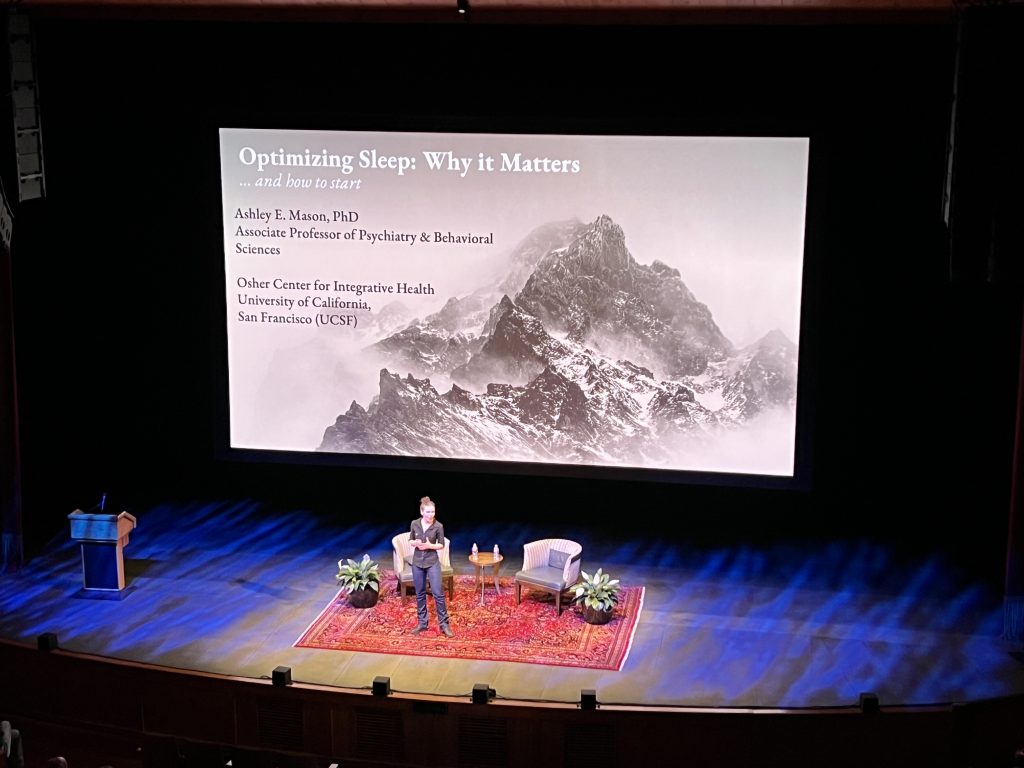
Zoe Goldstein/Vail Daily
Sleep is key to brain and body function, memory, physical performance, preventing chronic disease and improving mental health. Yet many people struggle to fall asleep, stay asleep and just get enough sleep.
There are four key elements to getting more and better sleep, according to Ashley Mason, clinical psychologist and sleep and heat researcher: Sleep regularity, sleep temperature, sleep architecture and light exposure.
Mason explained these topics at a Vail Health Learning Lab co-hosted with the Vail Symposium at the Vilar Performing Arts Center in Beaver Creek Wednesday, and debunked several myths about sleep.
Not everyone needs eight hours of sleep — some need more, while others need less, Mason said.
Even when people get enough sleep, “It’s normal to feel groggy and not alert for the first hour after you wake up,” Mason said.

Support Local Journalism
It is okay to wake up at night, and waking up does not mean the quality of sleep is bad, she said. People wake up more as they age, along with sleeping less overall and experiencing less deep sleep.
There are also many steps people can take to improve their sleep.
Going to bed at the same time increases longevity
One of the simplest ways to improve quality of life is to increase the consistency — or regularity — of sleep. But that does not mean it is easy.
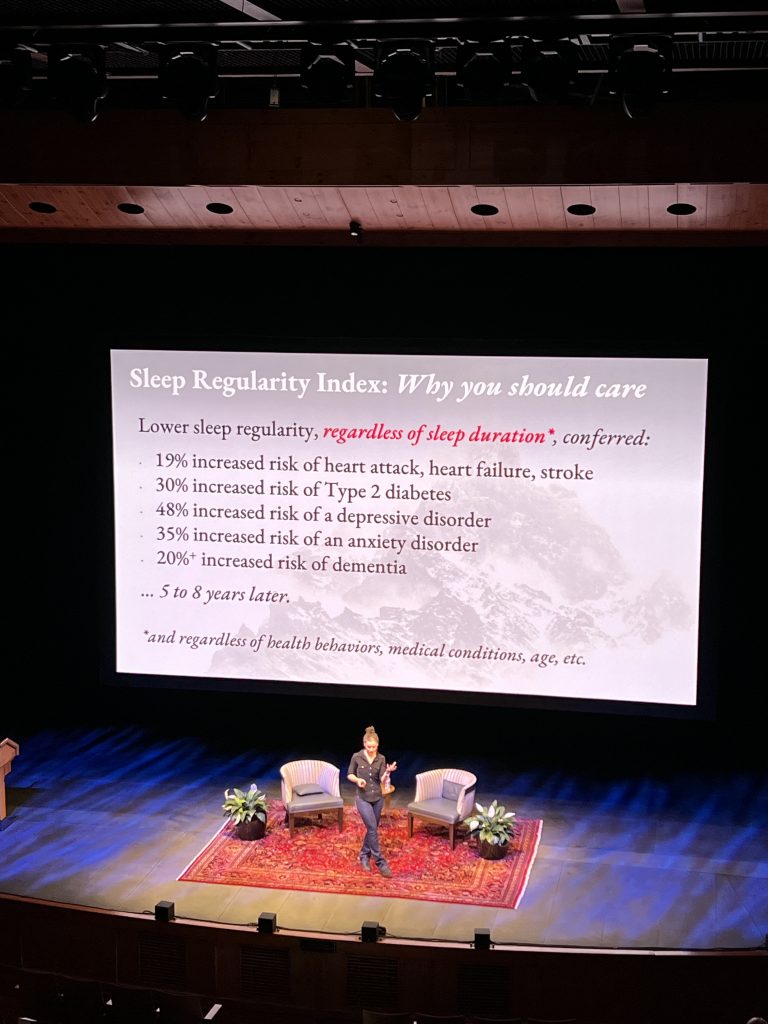
A 2023 study out of the United Kingdom showed that people who had less-regular sleep schedules were more likely to be diagnosed with conditions including heart attacks, heart failure, diabetes, depression, anxiety and dementia.
The people who lived the healthiest lives had just half an hour of variability in their sleep and waking times over the course of a week.
To start getting more regular sleep, Mason recommended setting an alarm that goes off at the same time every day.
“If you wake up at the same time every day, you’re going to start to get sleepy at the same time every night,” Mason said.
This is because sleep pressure, which causes people to fall and stay asleep, is driven by the chemical adenosine, which builds throughout the day.
Most people sleep too hot
Many have heard of circadian rhythm, the body’s internal 24-hour clock (though in reality, the cycle is closer to 24 hours and 15 minutes, Mason said).
The circadian temperature rhythm is less well-known. This is the rhythm the body’s core temperature follows throughout 24 hours.
Core body temperature is at its lowest during sleep, and begins dropping as bedtime approaches. To do this, warm blood circulates from the body’s core to the skin, dumping heat out of the body.
But when people sleep covered by warming materials, it can impact their sleep.
“If you’re waking up in the middle of the night, it’s possible that you are too warm,” Mason said. “If you’re trapping so much heat and you are warming your body in the middle of the night, your body might say, ‘hey, I’m warm, so maybe it’s daytime.'”
Mason advised people to sleep with cotton blankets and sheets, which are breathable and help the body eliminate heat.
Warming the extremities before bedtime can also help people fall asleep.
“It’s very hard to fall asleep when your hands and your feet are cold,” Mason said. “People with peripheral circulatory disorders — meaning that their hands and their feet are commonly cold — are more likely to have trouble falling asleep at the start of the night. When you successfully treat their circulatory disorder, their sleep improves.”
Making lifestyle changes can improve sleep quality
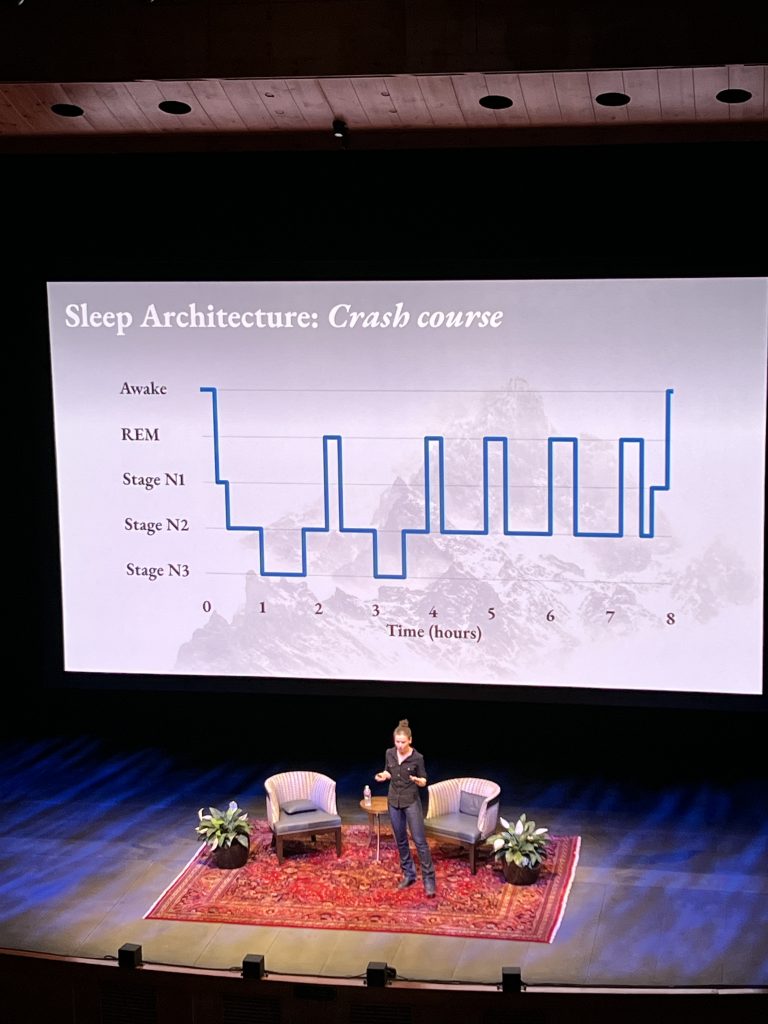
Sleep architecture is the temporal organization of sleep stages, or the way people cycle through deep and light sleep throughout the night.
Typically, people experience more slow wave, deep sleep at the start of the night, when there is the most sleep pressure, and more REM, light sleep in second half of the night.
It is common to wake up between sleep cycles, Mason said.
“If you feel like you dream a lot, it’s more likely that you’re waking up at the REM part of your sleep cycle, and that’s why you remember the fact that you were dreaming,” Mason said.
Certain lifestyle factors, including eating schedules, caffeine consumption, alcohol consumption, marijuana use and napping can negatively impact sleep architecture by limiting the quality and/or duration of sleep and making it harder to fall asleep.
The main way to protect sleep architecture is to make behavioral changes, Mason said.
Mason recommends that people stop consuming caffeine at least 10 hours before bedtime. Those used to having an afternoon coffee should not cut the coffee, which can lead to caffeine withdrawal, but adjust the timing.
“You just have to have it before 11 a.m. or so,” Mason said.
Also avoid replacing sleep with caffeine, Mason said.
Caffeine blocks adenosine, the chemical that creates sleep pressure, from binding to its receptors. Adding in extra caffeine can interfere with the extra sleep pressure, causing another night of bad sleep.
“The day after you have a bad night of sleep, and you feel sluggish and sleepy, that’s actually helpful,” Mason said. “That following night, you’re more likely to have more sleep pressure to fall asleep and stay asleep.”
The same goes for napping. Long naps, when a person reaches deep sleep, can decrease sleep pressure.
Mason tells her patients that if they must nap, they should take a “napportunity,” setting their alarm clock for 30 minutes and getting out of bed when it goes off. This forces them to only reach light sleep.
“When you wake up from light sleep, you are far more likely to feel refreshed, and to have not impacted your sleep in the night,” Mason said.
Alcohol makes people wake up more and reduces the amount of REM sleep they get.
“If you’re struggling with your sleep, taking a break from alcohol and seeing what the real price of admission is, is worth it,” Mason said.
“Marijuana is tricky,” Mason said. “Because marijuana was only recently legalized, we don’t have a lot of data … When I treat patients, I would rather get them off of most prescription sleep medications than off of marijuana.”
There is very little data on how CBD affects sleep, but “if CBD were some sort of magic elixir for sleep, we wouldn’t all be in this room,” Mason said.
There is some data on THC and sleep, which shows that chronic THC use leads to less slow-wave deep sleep, less REM sleep, less sleep overall and more nightly wake-ups. During THC withdrawal, people experience more REM sleep but wake up more during the night, leading to less restful sleep.
Wearing an eye mask is a simple solution
Due to the length of the human circadian clock, which is about 15 minutes longer than 24 hours, delayed morning light can cause circadian misalignment, which can lead to difficulty falling asleep.
Exposure to daylight within an hour of waking resets people’s circadian clocks so they fall asleep 16 or 17 hours later.
“Every morning, we are resetting our clock. If I didn’t reset that clock … I might start leapfrogging all the way around the 24-hour clock,” Mason said. “This is something that happens to people who are blind.”
Mason recommended people spend 15 to 30 minutes outside, where light is significantly brighter than indoors (1,000 to 10,000 lux, a measure of illumination, versus 100 to 500 lux indoors), within an hour of waking up.
On the other side, too much light in the evening suppresses melatonin secretion, which can make it hard to fall asleep at the start of the night.
Melatonin is “the hormone of darkness,” Mason said.
Humans associate darkness with sleep, which means more melatonin secretion helps with sleep. When sleeping, Mason recommends wearing an eye mask or a sleep hat to maintain steady darkness.
Despite the important role melatonin plays, Mason did not recommend taking melatonin supplements.
“I have yet to see excellent clinical trial data showing that any sort of sleep aid can address the things I talked about tonight,” Mason said. “As far as I’m concerned, the biggest changes that we can make are behavioral.”