Hiking to Berlaimont Estates site, Bennet calls project ‘ill advised’ amid concerns about wildlife, wildfires and affordability
A communications firm representing the Berlaimont Estates developers says it is ‘baffled’ by Bennet’s opposition to the luxury housing project

Chris Dillmann/Vail Daily
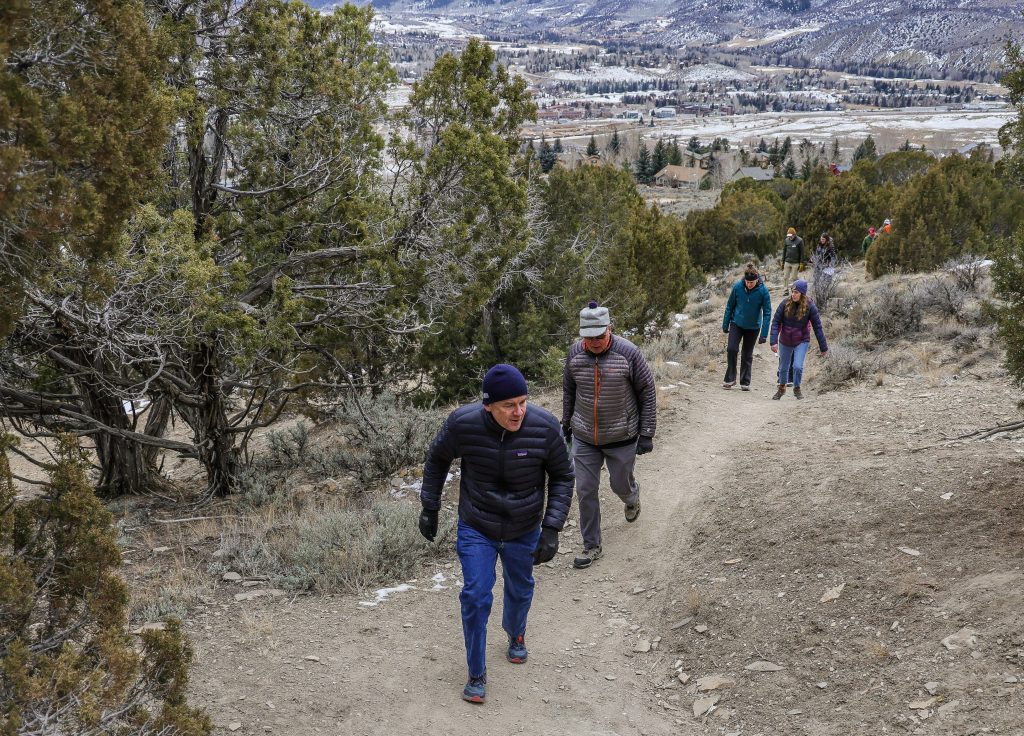
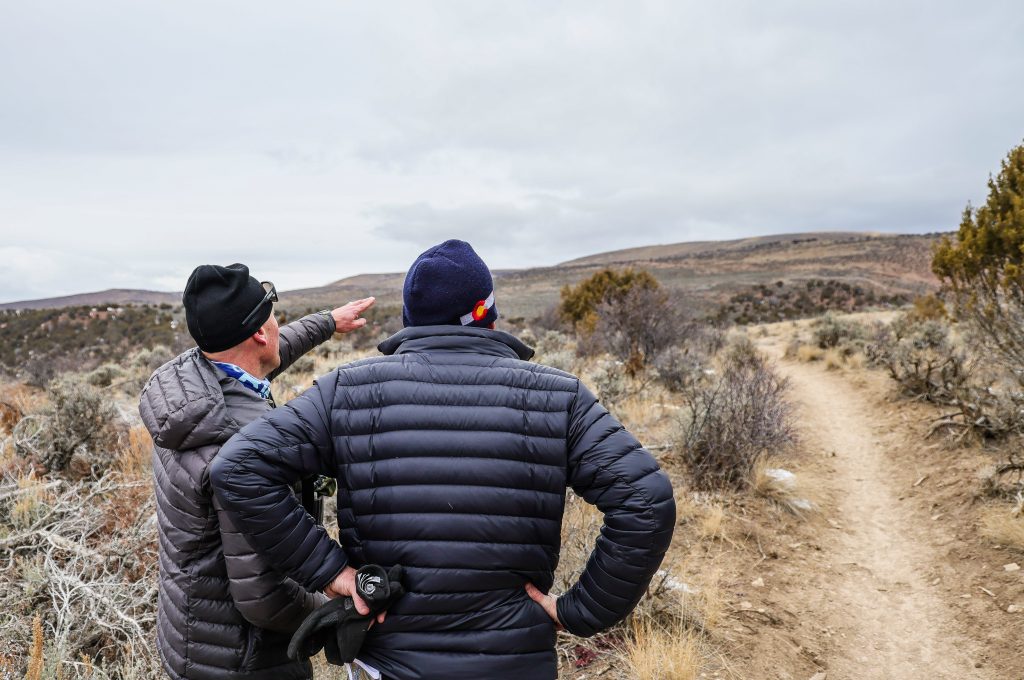
U.S. Sen. Michael Bennet, D-Colorado, got a workout Friday as he hiked to the top of a hillside in Edwards to view the site of a controversial luxury home development proposal.
Despite strong community opposition, the developers of Berlaimont Estates have long sought to build a year-round paved road to facilitate construction of estates on a 680-acre inholding surrounded by the White River National Forest.
“It’s rare that I find a community with a unanimous opinion on anything,” Bennet said. “Not just where I work (in Washington), but in general. I think the community has been very clear for a very long time that this isn’t something they want.”
The Berlaimont Estates project would construct 19 luxury homes on 35 acre parcels on land north of Interstate 70 that is completely surrounded by U.S. Forest Service lands. In 2023, the Forest Service approved the developer’s plans to pave about 2.5 miles of roads on National Forest lands to help facilitate the construction.
Earlier this month, Bennet introduced an amendment into the Senate Interior Appropriations Bill to block the road construction. While the amendment failed to make it into the final version of the bill, the senator said he remains opposed to the project.

Support Local Journalism
“This is a fight that isn’t going away,” Bennet said. “We’re going to continue to push. To me it just seems like the last thing in the world the Forest Service should be doing.”
The hike
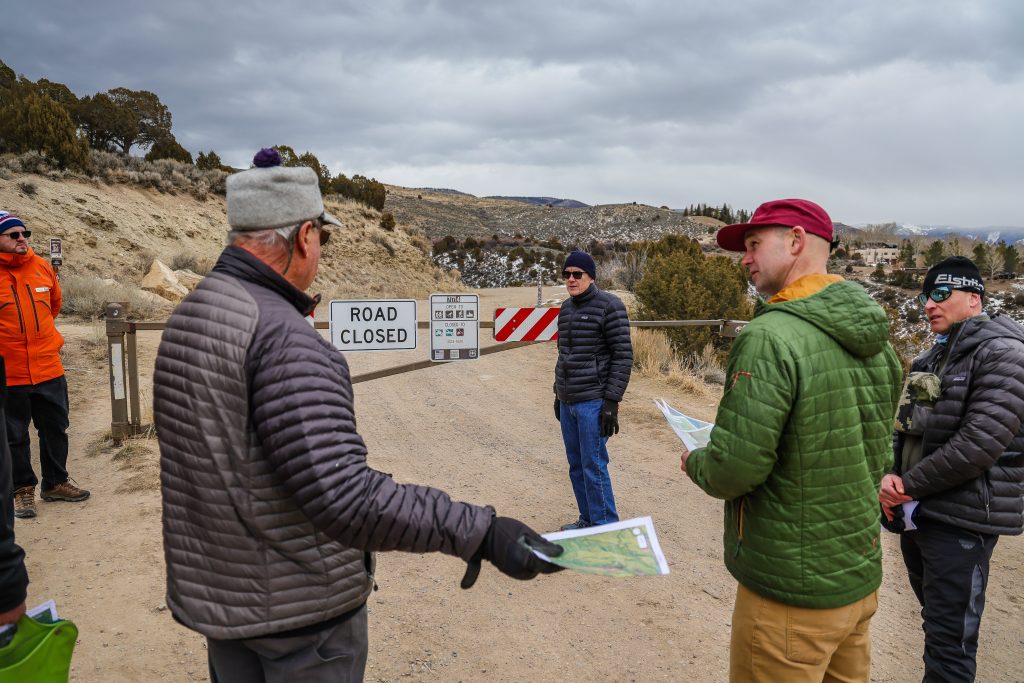
Dressed in blue jeans, a Patagonia puffy and a beanie emblazoned with a Colorado flag, Bennet spoke with local officials, conservation groups and residents opposed to the project in the parking lot near the Berry Creek Trail before heading up the trail.
Peter Hart, the legal director of the Wilderness Workshop, noted that the area near the proposed development is winter habitat for deer and elk. The Carbondale-based conservation nonprofit is suing the Forest Service over its approval of the road orientation for the Berlaimont Estates project, arguing that the approval violates the National Environmental Policy Act.
“Our biggest issue is that they’re going to undermine wildlife closures which are really critically important right now because wildlife populations in this valley have been in decline for a long, long time,” Hart said.
The Berlaimont Estates property is directly adjacent, and overlaps, with elk and deer winter habitat. The Forest Service roads that the developers are proposing to pave are currently subject to seasonal winter closures that restrict vehicle access. If developed, the roads would see up to 215 vehicle trips per day, according to the final environmental assessment for the project.
Bill Heicher, a retired district wildlife manager for the Colorado Division of Wildlife, which is now part of Colorado Parks and Wildlife, has lived in the Eagle Valley area for 54 years. Heicher said deer and elk populations in the valley are only a fraction of what they used to be, in large part due to impacts from development and recreation. He said the Berlaimont Estates project would result in “irreversible impacts, especially for wildlife.”
Kevin Hochtl, an avid outdoorsman who has lived in the Eagle Valley for 46 years, described the area near the Berlaimont Estates project as “the Serengeti of our wildlife herd right now in Eagle County.”
“This is where they winter. It’s an extreme winter range,” Hochtl said. “There’s no other place other than this that is more important for our ungulate herds.”
Hart and others opposed to the project also raised concerns about how the development will get water to the property and the possible wildfire risks associated with a road that is not “dual access,” or does not offer more than one route in and out.
“You’re basically putting 19 multimillion-dollar homes with accessory units, you’re putting them up on a hillside that has moderate to high fire potential and you’re basically putting them up at the end of a dead end road and hoping that the road isn’t compromised,” Hart said.
Ernest Saeger, the executive director of the nonprofit Vail Valley Mountain Trails Alliance, noted that the trails near the proposed development are well-loved by the community with trail counters there recording about 30,000 annual visits.
The Forest Service decision that approved the road orientation agreed that the project would have adverse impacts, but it determined that the federal agency is required to provide “adequate access” for “the reasonable use and enjoyment” of private inholdings. To mitigate for the loss of 1.8 miles of trail, a new 2.7 mile trail will be constructed to the west of Berry Creek, according to Forest Service documents.
“I fully understand that this project will have adverse impacts on resources that are important to the public and the Forest Service,” former White River National Forest Supervisor Scott Fitzwilliams wrote in the record of decision approving the road. “In particular, long-term impacts to wildlife habitat and recreation will occur if this access route and residential development are constructed.”
Gary Brooks, the vice president of the nonprofit Eagle River Coalition and an Avon Town Council member, noted that he formerly owned a civil engineering firm that was involved with designing the original road orientation for the project. Brooks said the Forest Service approved a different road orientation that is “even worse because it’s just multiple switchbacks (and) so impactful to the landscape.”
After reaching the crest of the hill to gaze upon the land where Berlaimont Estates is planned, Bennet said, “I saw a place where there’s going to have to be a 40-foot retaining wall up against the hillside in the middle of elk and deer winter range. There’s no reason to be doing that.”
Brian Woods, the mayor of Eagle, said that his biggest concern is that the project “is a distraction for the Forest Service. It’s a lot of staff time. It’s an already diminished office that is down about 30%.”
Bennet also echoed these concerns, noting that the Forest Service has lost thousands of employees under President Donald Trump’s administration, including top officials in the White River National Forest such as Fitzwilliams.
“I don’t want the priorities to be set in Washington, D.C.,” Bennet said. “I think the community here has a lot to say about this, and it’s not just the ill advised nature of Berlaimont Estates. It’s ‘What are the Forest Service folks spending their time doing during this budget constrained environment?'”
He added that Colorado and the Eagle Valley area are already struggling with affordability issues and more luxury development won’t help.
“Our kids have no confidence that they’re going to be able to live in Colorado, and I think our attention has to shift to that,” Bennet said. “We have to figure out how to make this state a place where people have a thriving economy but also the chance to have … the basics of a middle class life. This project does not reflect that set of values.”
Berlaimont Estates responds
Kristin Williams, the president of Commfluence Inc., a communications firm representing the Berlaimont Estate developers, said in a statement that the road approval is the result of a 12-year public process.
Williams noted that with the Forest Service issuing access permits for the new road alignment last November that the remaining burden on the federal agency “will be minimal.” She added that the developers have reimbursed the Forest Service for all costs related to reviewing and issuing permits for the roadway.
“We remain baffled why the Senator is seemingly throwing all of that Forest Service work and expertise to the side,” Williams said. “We actually believe the bigger opportunity is to work with the Senator, the Forest service and Colorado Parks and Wildlife to identify important, offsite impediments to herd movement that can be improved, resulting in healthier animals when they reach their winter habitat.”
Williams described Berlaimont Estates as a “good example of clustered, responsible development” that is far less dense than other nearby developments and leaves more than 85% of the property untouched. She said the project consists of “homes for the property owner, their family and friends” and “there is no commercial component.”
Berlaimont Estates has conditional water rights to divert and store water locally that will be sufficient to support the neighborhood, Williams said. Noting that Forest Service roads allow for additional ingress and egress via four-wheel drive vehicles, she added that safety issues related to accessing the property have been mitigated by “traffic safety experts, representatives of the first responder community, wildland fire experts, and others.”
“The area affected by the access road is not undeveloped wilderness: it is adjacent to I-70, surrounded to the south, east and west by existing residential development, and is crossed by high-voltage power lines and accompanying access roads,” Williams said. “While this land has habitat and recreational value (which are often at odds with one another), it is far from being pristine, wilderness or untouched.”