At Trump’s order, U.S. Department of Agriculture asks Colorado to review state wolf policies, protection status
Letters went out to all states with gray wolves and Mexican gray wolves as the federal government considers delisting the species from the Endangered Species Act

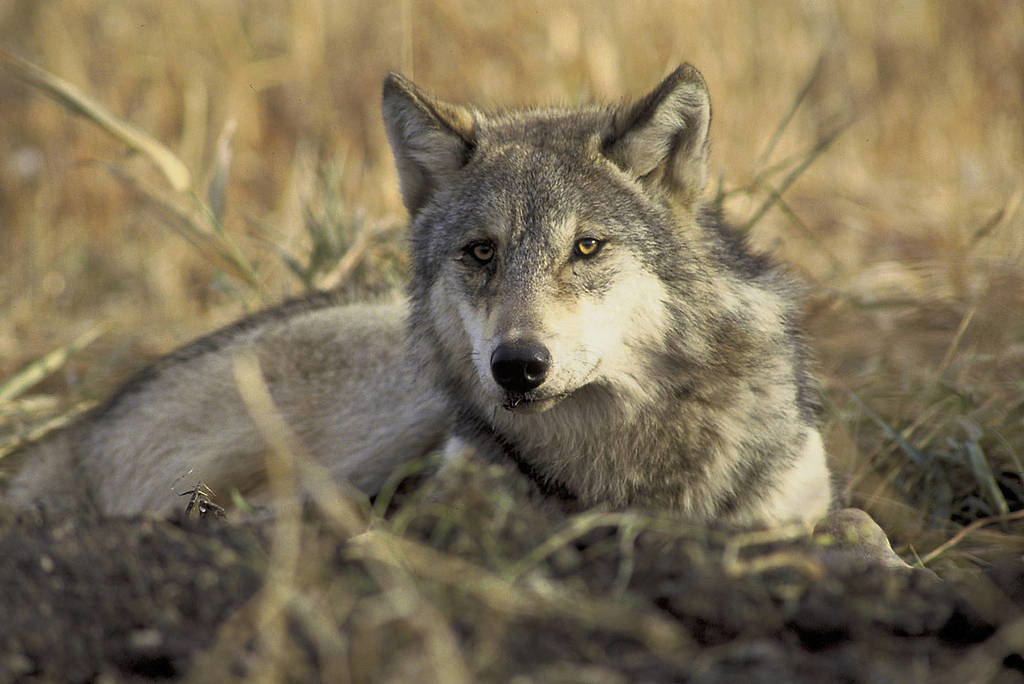
John and Karen Hollingsworth/U.S. Fish and Wildlife Service
Just over a month after President Donald Trump ordered the federal government to look at delisting gray wolves and Mexican gray wolves from the Endangered Species Act, the U.S. Department of Agriculture is asking the state of Colorado to review their wolf management and protections for the species.
It is part of the direction given by Trump’s Sept. 4 order — titled “Supporting America’s Ranchers” — which asked the Secretary of Agriculture to encourage states to “delist gray wolves and Mexican wolves from any state-specific lists of protected species and to revise their standards for lethal takings of gray wolves and Mexican wolves to assist ranchers in combating predation.”
“As ranchers await federal clarity on this issue, I am urging states to listen to their producers, review state-specific wolf protections, and work with (the U.S. Department of Agriculture) wherever possible to protect livestock, including through lethal removal when requested by the appropriate authorities and authorized by law,” said Secretary of Agriculture Brooke Rollins in a news release.
Identical letters went out to all states with populations of either wolf species — which have varied protection status under both state and federal laws.
In addition to asking states to delist — or maintain the delisted status — wolves from state protections, Rollins’s letter implores the states to support ranchers with wolves preying on livestock through both killing of the predators as well as compensation.

Support Local Journalism
The U.S. Department of Agriculture flags two specific ways the federal agency can help states manage conflict between livestock and wolves. This includes noting that its Animal and Plant Health Inspection Service can assist with euthanizing wolves involved in livestock conflicts. It also includes a USDA program that compensates livestock producers, with information available to those who are eligible at their local Farm Service Agency office.
In Colorado, gray wolves are listed as endangered at the state and federal levels. Following the voter-mandated reintroduction of gray wolves in the state, the species was also federally listed as an experimental population. Should the federal government delist gray wolves, the designation as an experimental population would be moot, but the state protections would remain and Colorado Parks and Wildlife would continue following its wolf plan and pursuing the reintroduction.
When voters passed Proposition 114 in 2020, it mandated that Colorado Parks and Wildlife build a self-sustaining population of gray wolves and help producers prevent wolf conflicts and compensate them for livestock losses — both of which have brought challenges.
Both the state and federal endangered species protections make it illegal to kill gray wolves in Colorado. The state’s designation as an experimental population — as granted by Colorado Parks and Wildlife’s 10(j) rule with the U.S. Fish and Wildlife Service — allows Colorado to kill wolves under strict circumstances, including allowing the shooting of a wolf caught in the act of attacking livestock or of wolves repeatedly targeting livestock.
Colorado’s wolf plan includes a framework for determining when the Parks and Wildlife Commission could move to delist from the state’s protections. The species could be downlisted when the state has a minimum count of 50 wolves for four successive years and delisted completely when the species is between 150 and 200 for two years and depending on circumstances.
As of Sept. 24, there were an estimated 45 wolves in Colorado, a number Parks and Wildlife expects to shrink over the winter, as 20 of the animals are pups. Wolf pups in the West face a 50% to 60% survival rate in their first year.
As Colorado rounds out its third year of the reintroduction program, Parks and Wildlife has reported a range of challenges and threats facing the nascent population. In addition to survival concerns for both adults and pups, the state has reported potential disease concerns in two of its wolf packs.
Colorado has also faced federal roadblocks in attempting to source wolves — something the wolf plan reports is necessary in the early years of reintroduction. The plan recommends the state release between 30 and 50 wolves in the first three to five years.
After releasing 15 wolves in the first two years, Parks and Wildlife plans to return to British Columbia to source more wolves for the third winter were thwarted by a change in direction at the federal level, which forced a pause in releases. Now, heading into its fourth winter, the agency has reported working to find a source, but no announcements have been made, and the deadline to find wolves is rapidly approaching.
These challenges and threats were among the reasons given by Parks and Wildlife in its recent decision to suspend its current decision-making framework for killing wolves involved in livestock conflict. It will still consider killing wolves but has said it will take a more conservative approach.
Colorado’s compensation program covers not only direct losses of livestock and working dogs by wolves, but also indirect losses related to the predator’s presence on the landscape — the latter of which can include impacts on livestock conception rates and weight. Ranchers can also receive compensation for missing livestock in large, open range settings once a wolf depredation has been confirmed. It pays ranchers up to $15,000 per animal.