Vail Mountain now facing worst snowpack in recording station’s 47-year history
Mountain passed into lowest on record for this time of year on Jan. 13

John LaConte/Vail Daily
The SNOTEL recording site on Vail Mountain showed, on Tuesday, 4.4 inches of snow-water equivalent, making something many suspected would happen to now be official: It’s the worst snowpack in the area’s history of snowpack recording.
Snow telemetry, or SNOTEL, is an automated system of more than 600 snowpack and water measuring sensors operated by the Natural Resources Conservation Service of the United States Department of Agriculture.
A SNOTEL site on Vail Mountain was installed in the water year of 1978-79, following the devastating drought year of 1976-77, (which could well have been worse than this year in terms of snowpack, although there’s no hard data to support that). Vail also started cloud seeding in 1977 after Gov. Richard Lamm suggested such programs could help with drought.
Up until Tuesday, the drought year of 2017-18 was worse than this year, meaning throughout November and December, despite what many locals might have told you on the chairlift, this year was not “the worst we’ve ever seen.”
But on Tuesday, Vail Mountain crossed into that realm by a tenth of an inch. Vail was at 4.4 inches of snow-water equivalent on Tuesday and Wednesday, and on Jan. 13-14 of 2018, the mountain was at 4.5 inches. In 2012, another brutal drought year, snowpack was at 5.1 inches on Jan. 14. While the following year isn’t remembered as being nearly as bad, conditions were actually worse at this time, with Vail recording 4.7 inches of snowpack on Jan. 14, 2013.

Support Local Journalism
Meteorologist Joel Gratz, early this week, predicted this outcome. In his daily forecast on opensnow.com on Sunday, Gratz said he was taking solace in the fact that we’re making turns despite low snowpack, which was, in his words “soon to be a likely record-low snowpack as we flatline for the next 12+ days.”
“The bottom line is that seasonal snowfall is below average,” Gratz said on Wednesday. “Last week’s snowfall has helped to open more inbounds terrain, it’ll be mostly dry for the next 7-ish days, and snow is possible around January 22-25. This isn’t the best situation, but it’s what we have, and at least there’s snow to slide on.”
It’s also looking like it will be one of the latest Back Bowl openings in Vail’s history. During the 2011-12 season, the Back Bowls opened in late December, and the 2017-18 season saw Chair 5 running by Jan. 13. Reporting is scant on that seminal 1976-77 season, but Chair 5 was definitely running by late February as a Vail Trail story from Feb. 25, 1977 contained a mention of people skiing in the Back Bowls during a ski race that was being held at Golden Peak.
While Vail Mountain spokesperson Lee Nielsen said the mountain has always been able to open the Back Bowls at some point, she concurred with Gratz in saying the rest of January isn’t looking likely.
“The rest of January is looking very dry in terms of snow, but since our typical high snow months are end of January to February-March we are hoping Mother Nature can deliver then,” she said. “In the meantime, we are focused on opening 10 and connecting the rest of the front side.”
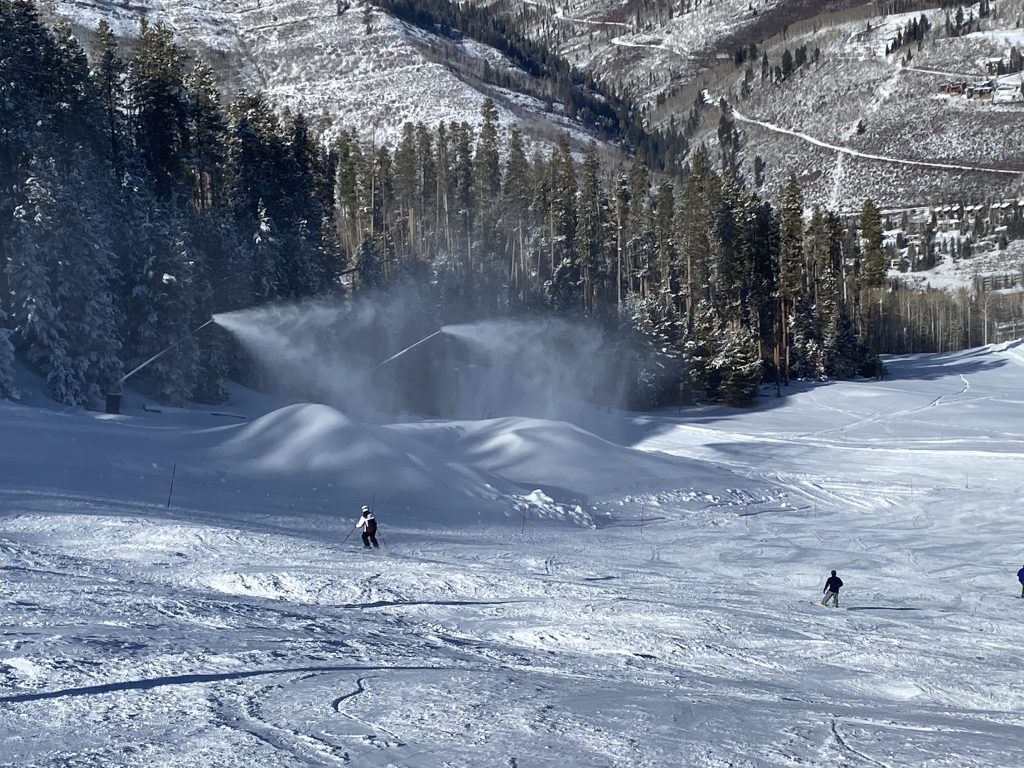
Vail Mountain’s Chair 26 opened on Saturday, leaving just Chair 10 remaining for the frontside of Vail Mountain. The mountain is continuing to make artificial snow in the meantime.