What’s behind the resistance to wolves in Colorado?
A look into understanding these 'real' and 'mythical' animals in ranching culture


Malisa Samsel/CMNM
Last month, when the first group of wolves were reintroduced to media fanfare in Colorado, following a slim statewide affirmative vote (50.91%) in 2020, Bonnie Brown was dismayed.
The Colorado Wool Growers Association executive director, who has worked with sheep and cattle producers across the West for decades, was aware that Colorado Parks and Wildlife couldn’t let the adjacent landowners in the area know that these releases were happening in their metaphorical backyards. But, these same landowners, she said, have the very livestock that might be threatened by these apex predators.
“That type of stuff,” she said, “just further drives a wedge between the rural people on the landscape that have to live with this issue and the people in the city that voted for it.”
Kaitie Schneider, with Defenders of Wildlife, a national conservation organization that seeks to protect endangered wildlife, understands that sentiment.
“Ranching in the West is no easy business,” she said, “and I can understand how wolves may seem like one more thing for ranchers to account for. That’s part of the fear, too — not knowing if you will be impacted.”

Support Local Journalism
The other part of this fear is historic and a significant, yet underlying factor behind the resistance to wolves being reintroduced in the state, a type that goes back generations.
“I think the issue with wolves is this long–standing fear,” said Andrew Gulliford, a professor of history and environmental studies at Fort Lewis College in Durango, with expertise in the American West and its wilderness. It’s a fear in the United States that reaches back to the Colonial Era and beyond, with some of the first environmental laws in the country placing bounties on wolves, he said.
“But that fear of wolves is that deep, European fear of canis lupus,” he added. “It’s just part of who we are as humans because, indeed, wolves are a species that competes with us.”
This combination of fears as well as the historic, mythical, and modern-day views between ranching and wolves officially peaked in the state with the passage of Proposition 114 in 2020, the recent lawsuit in December attempting to stop the reintroduction, and Colorado’s plans to add more wolves in the future to its introductory stock.
Even with compensation and nonlethal deterrents available, the reintroduction of these federally endangered apex predators struck a nerve in the ranching community. So, what’s behind it?
The numbers
The U.S. Department of Agriculture keeps tabs on not only the number of cattle, calves, sheep, and lambs throughout the country (in addition to other livestock, like pigs), but also, through different agencies within the department, the number of livestock killed by non-predatory and predatory means. Those agencies are the National Agricultural Statistics Service and the Animal and Plant Health Inspection Service.
For comparison purposes, Colorado is set side by side with the other mountain states of Idaho, Montana, and Wyoming which have had established wolf populations, allowing Colorado to see what it may face in the future with its own established wolf packs. While the latter three states have had wolves for years now, some of these predators do journey down into Colorado, which is reflected in the data to follow.
For cattle and calves, the most recent data set published is from 2015. For sheep and lamb, it is 2019.
For cattle and calves, the total combined head in each of the four states was the following: Colorado, 3.35 million; Idaho, 3.02 million; Montana, 3.995 million; and Wyoming, 1.88 million.
Non-predatory losses, as defined by both NASS and APHIS, encompass the following forms: assorted diseases, lameness/injuries, weather, calving-related problems, poisoning, age, theft, other non-predatory causes, and unknown other non-predatory causes.
-
Data sourced from the U.S. Department of Agriculture, “Death Loss in U.S. Cattle and Calves, Due to Predator and Nonpredator Causes, 2015
Malisa Samsel/CMNM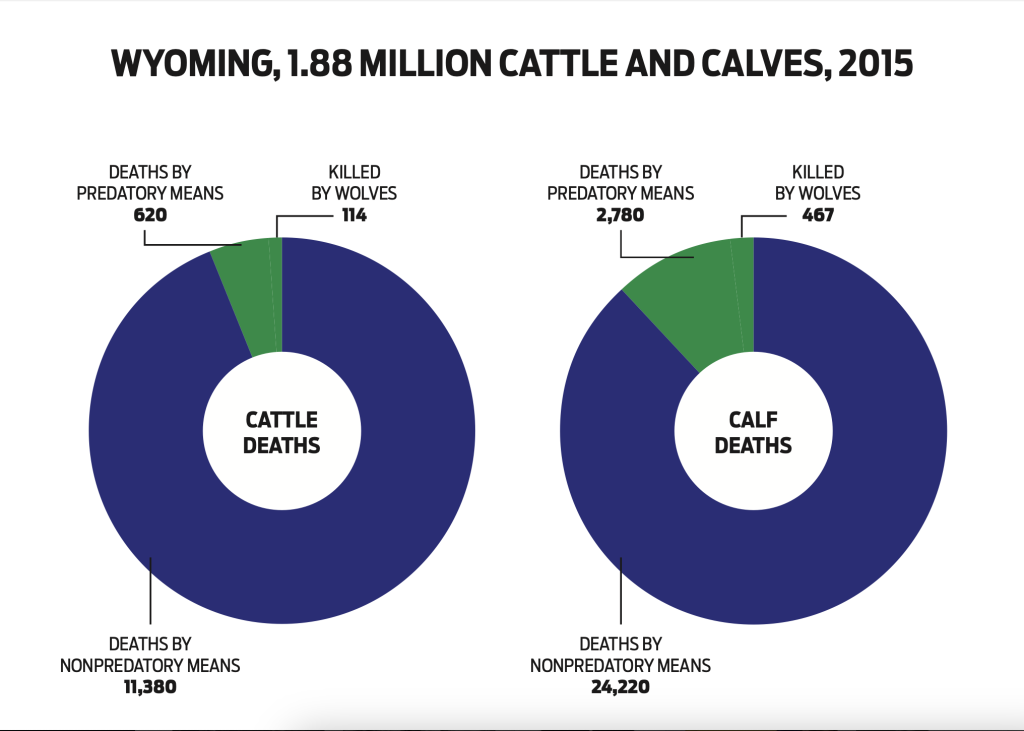
-
Data sourced from the U.S. Department of Agriculture, “Death Loss in U.S. Cattle and Calves, Due to Predator and Nonpredator Causes, 2015
Malisa Samsel/CMNM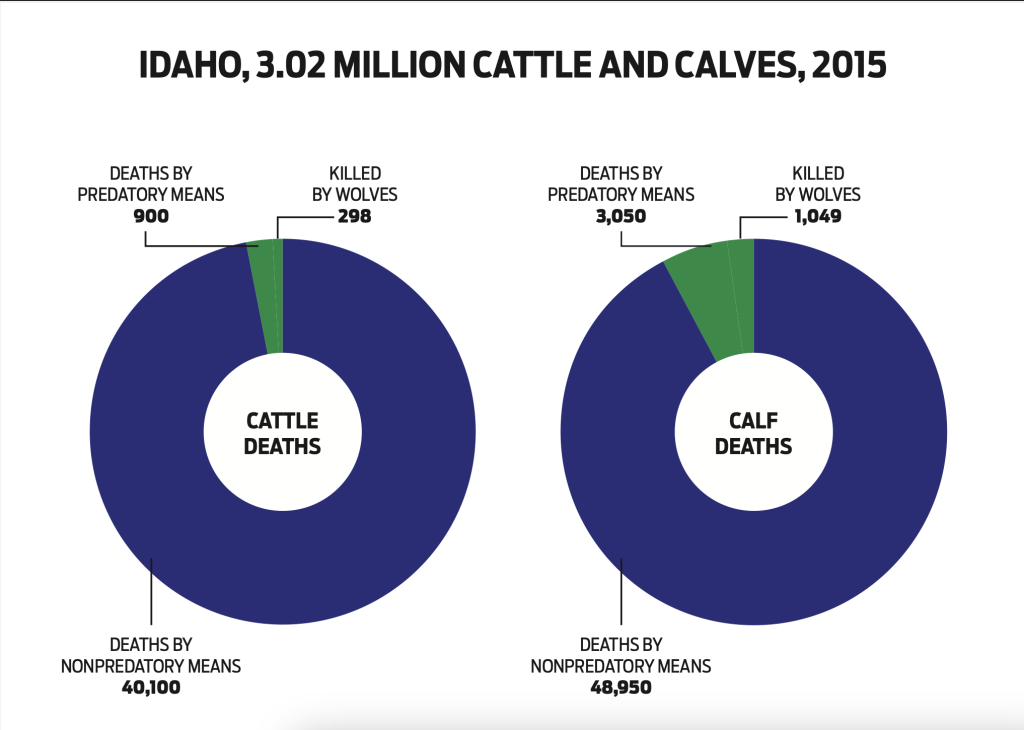
-
Data sourced from the U.S. Department of Agriculture, “Death Loss in U.S. Cattle and Calves, Due to Predator and Nonpredator Causes, 2015
Malisa Samsel/CMNM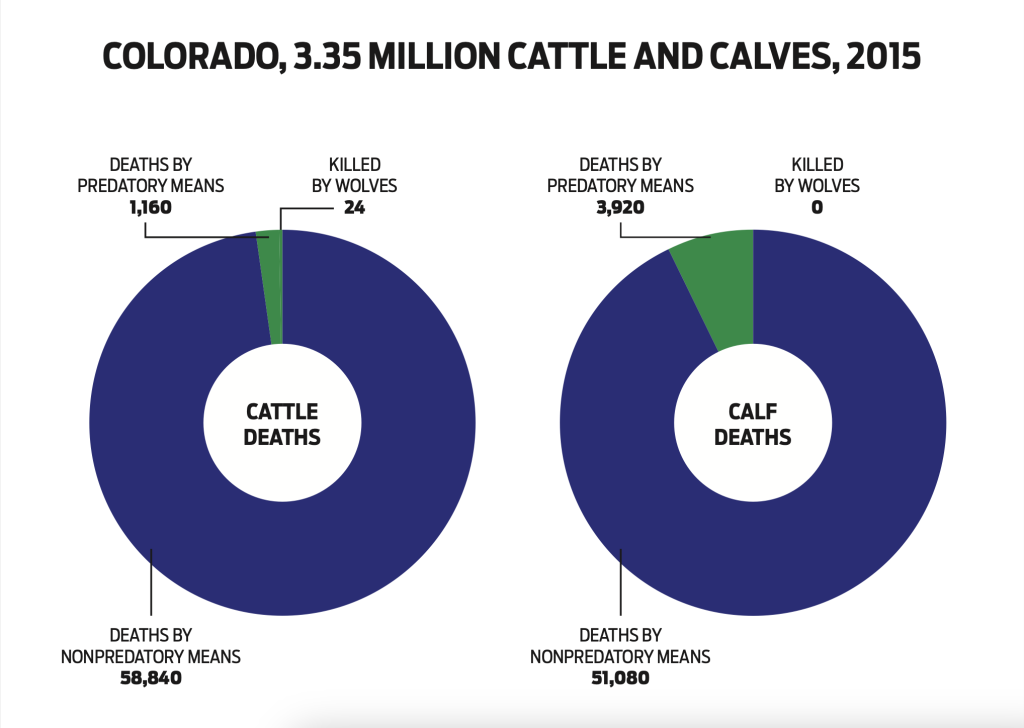
-
-
Data sourced from the U.S. Department of Agriculture, “Death Loss in U.S. Cattle and Calves, Due to Predator and Nonpredator Causes, 2015
Malisa Samsel/CMNM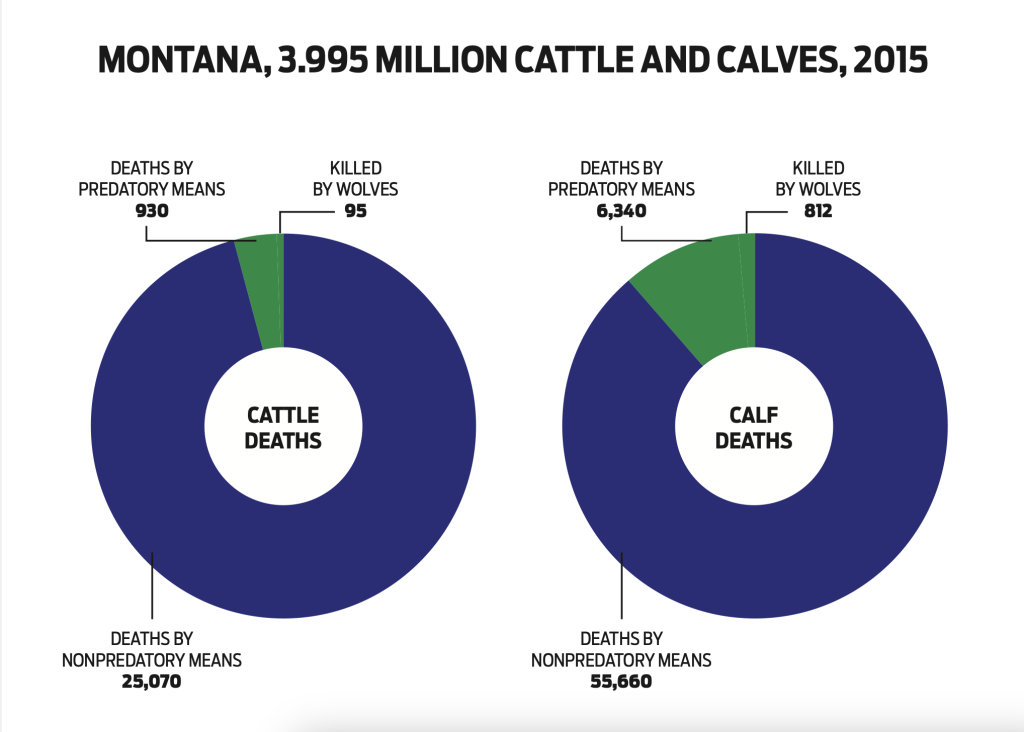
For Colorado, 58,840 cattle and 51,080 calves died by non-predatory means. For Idaho, 40,100 cattle and 48,950 calves; Montana, 25,070 cattle and 55,660 calves; and Wyoming, 11,380 cattle and 24,220 calves.
Predatory losses encompass the following animals: grizzly bears, black bears, bobcat/lynx, coyote, dogs, foxes, wolves, predatory birds, mountain lions, other predators, and unknown predators.
For deaths by predatory means in Colorado, 1,160 cattle and 3,920 calves were killed; Idaho, 900 cattle and 3,050 calves; Montana, 930 cattle and 6,340 calves; and Wyoming, 620 cattle and 2,780 calves.
Of these cattle and calves killed in Colorado, 24 cattle and 0 calves were killed by wolves. In Idaho, 298 cattle and 1,049 calves; Montana, 95 cattle and 812 calves; Wyoming, 114 cattle and 467 calves.
Now for statistics for sheep and lambs: The total combined head in each of the four states was the following: Colorado, 425,000; Idaho, 230,000; Montana, 200,000; and Wyoming, 340,000.
For Colorado, 4,600 sheep and 6,400 lambs died by non-predatory means. For Idaho, 6,160 sheep and 4,150 lambs; Montana, 7,900 sheep and 6,400 lambs; and Wyoming, 8,400 sheep and 6,400 lambs.
For deaths by predatory means in Colorado, 7,400 sheep and 10,600 lambs were killed; Idaho, 8,400 sheep and 4,850 lambs; Montana, 3,100 sheep and 10,600 lambs; and Wyoming, 3,600 sheep and 7,800 lambs.
Of these sheep and lambs killed in Colorado, less than 100 sheep and less than 100 lambs were killed by wolves. In Idaho, 40 sheep and 440 lambs; Montana, 100 sheep and 200 lambs, and Wyoming, 100 sheep and 100 lambs.
-
Data sourced from the U.S. Department of Agriculture, “Sheep Death Loss in the United States, 2020”
Malisa Samsel/CMNM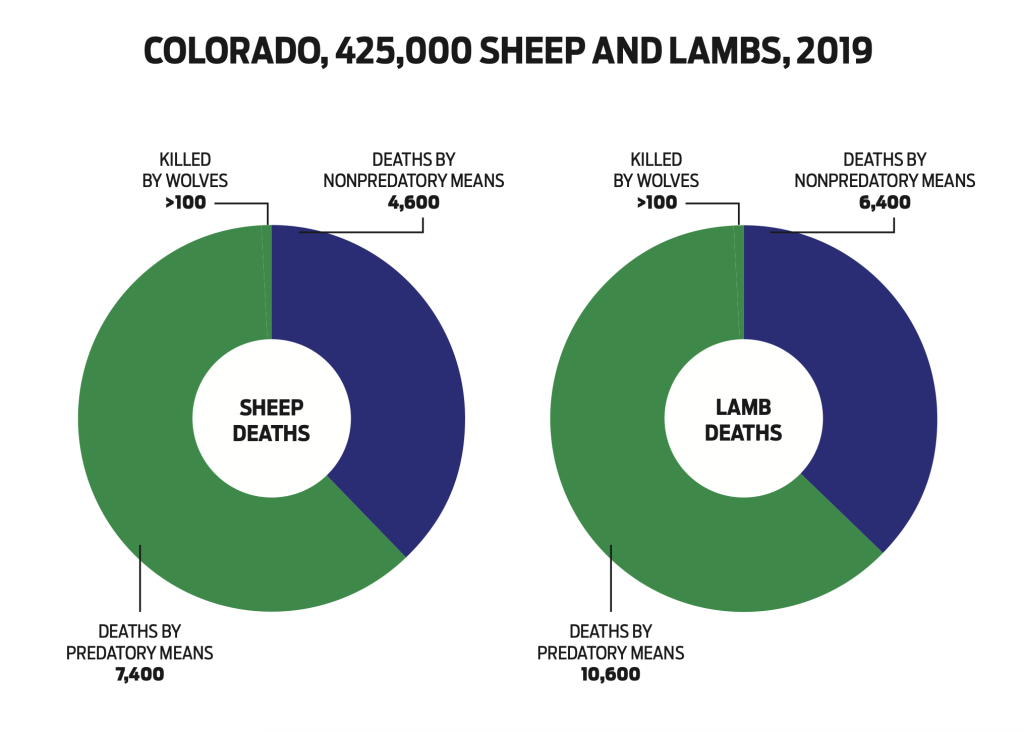
-
Data sourced from the U.S. Department of Agriculture, “Sheep Death Loss in the United States, 2020”
Malisa Samsel/CMNM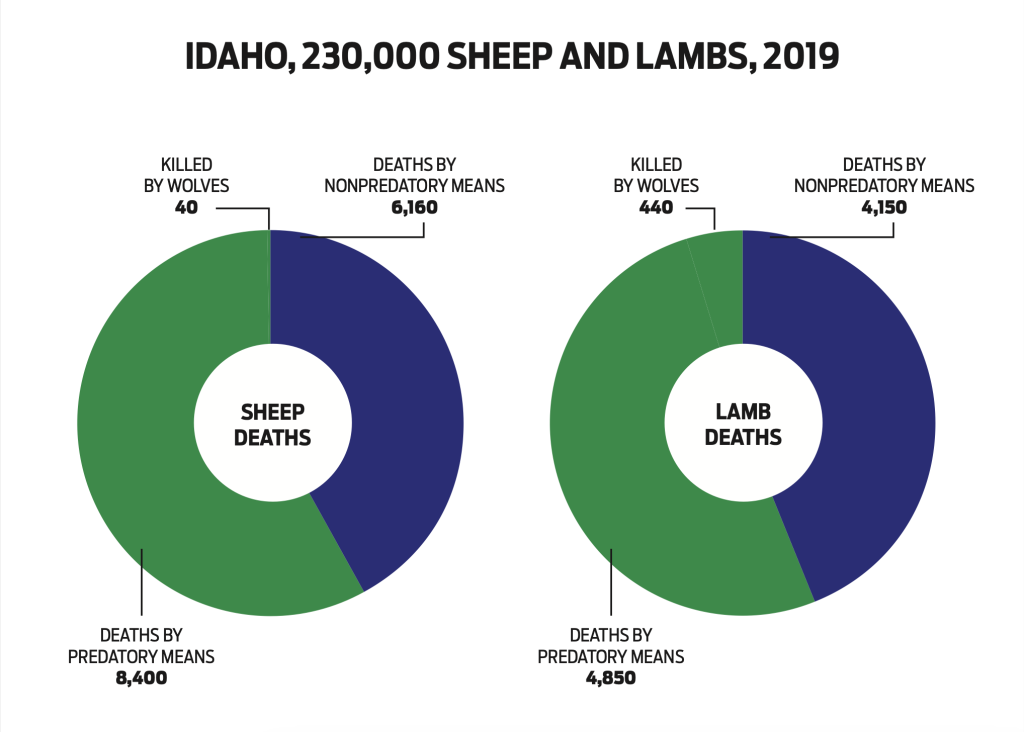
-
Data sourced from the U.S. Department of Agriculture, “Sheep Death Loss in the United States, 2020”
Malisa Samsel/CMNM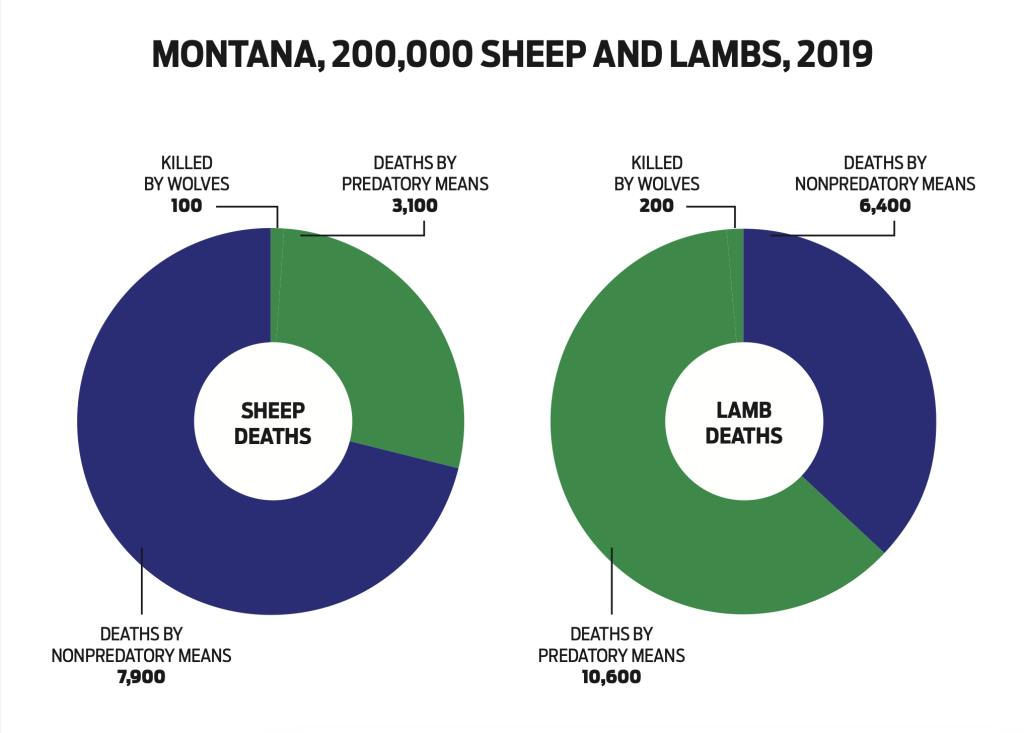
-
-
Data sourced from the U.S. Department of Agriculture, “Sheep Death Loss in the United States, 2020”
Malisa Samsel/CMNM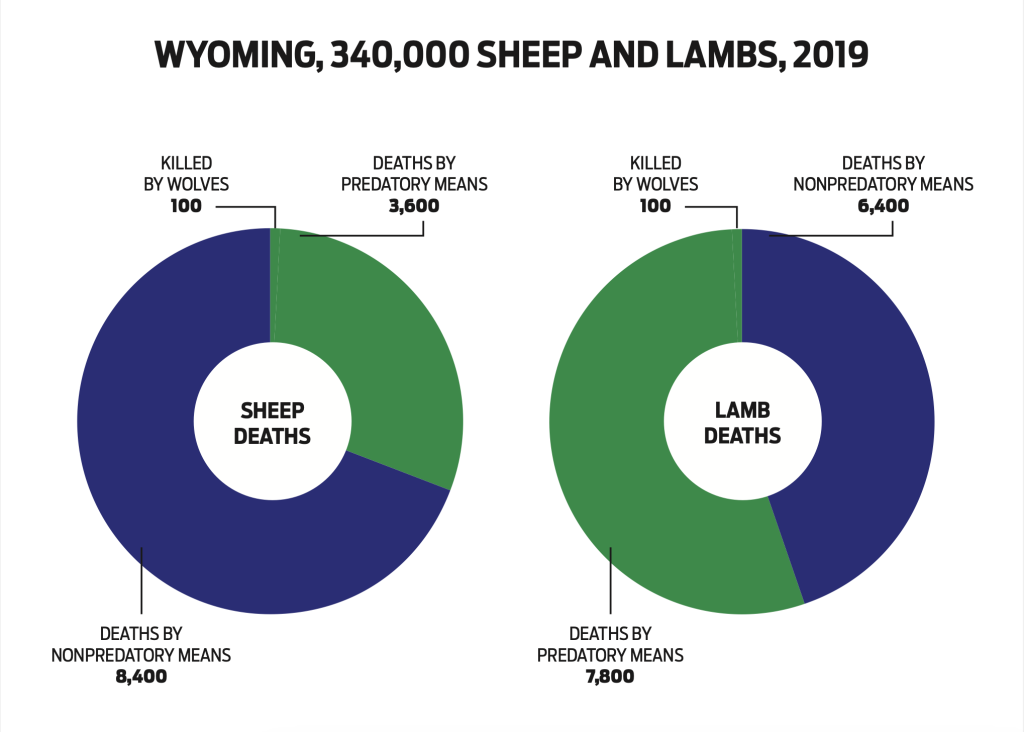
Overall, the percentages of these cattle, calves, sheep, and lamb killed by wolves is small.
Statistics, however, are only one part of the whole when it comes to wolves in the lives of ranchers, according to Gulliford.
“That’s the rational part,” he said. “The irrational part are these deep-seated fears, which are essentially cultural.”
The fears
“The mythic wolf,” said Matt Barnes, a rangeland scientist with the Northern Rockies Conservation Cooperative (NRCC) who also served on the CPW Stakeholder Advisory Group, “is the greatest enemy of the real wolf.”
Gulliford was much more blunt in his view of the wolf and its history with humans.
“We hate wolves because they’re like us,” he said. “We hate wolves because they have a social system, and they clearly have families, and they mate for life. Native peoples have always respected wolves, and wolves were powerful symbols and are powerful symbols. But, for Euro-Americans, wolves were just competition.”
Barnes spoke of the history of lands in America, where you have both the cowboy myth — sometimes called the frontier myth — competing with the wilderness myth. He said both of them are idealized narratives about the Western landscape and the meaning they each convey.
With the former, which is the oldest and most traditional, he said you “make the West safe for livestock, kill off the predators. They’re dangerous; they’re bad. We use them in our folklore to personify evil or personify characteristics that we do not like in our fellow human beings.”
He said that this push to eradicate wolves was “almost on a religious level.”
“It’s this whole idea of human dominion over nature that was very much acted out in the history of the Western frontier,” he said.
The latter view, that of the wilderness myth, has only been around for the past 50 years, he said, and “tends to see wild animals as probably more valuable than domestic ones.”
Another way of looking at these two, though, is where both ranching and wildlife are valued and respected, he said.
“I think you could see a West where we bring back these animals intentionally. But we also deal with the ones that cause conflicts, admit that society values these animals, but we also value our ranching landscape,” he said.
Gulliford pointed out the stark difference in the way the wolf was perceived in the 1920s compared to now.
“Here we are a century later, we understand the whole ecosystem,” he said. “We understand that wolves can have an impact on prey species.”
Beyond the numbers
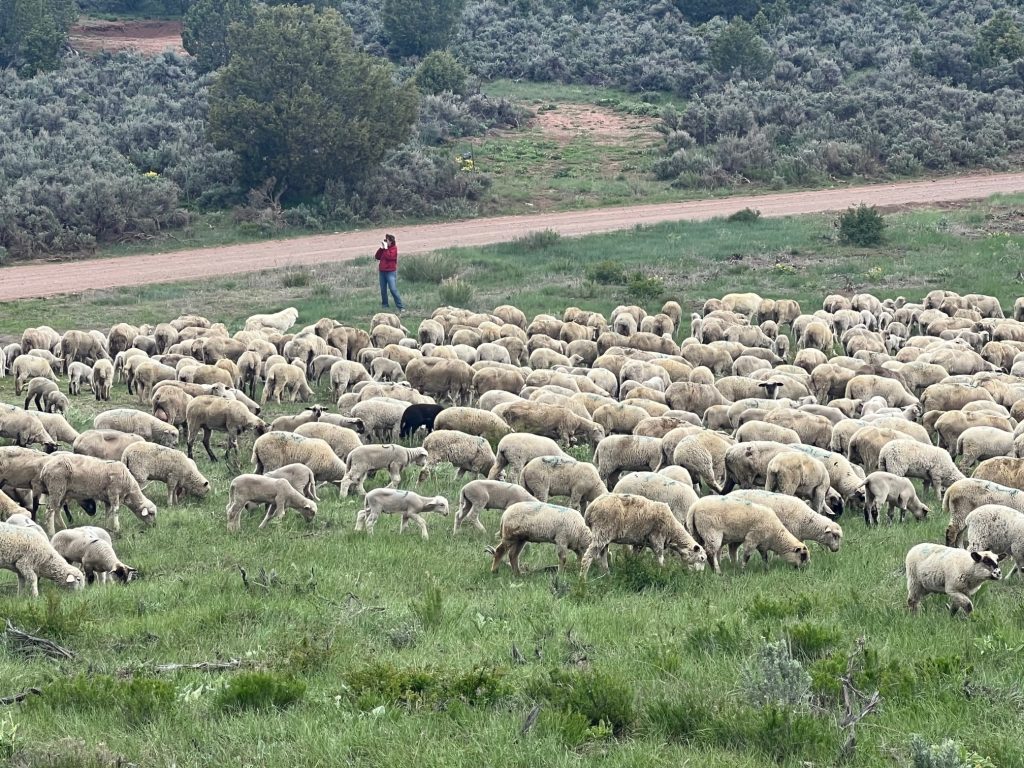
While the aforementioned statistics show the loss on a statewide basis, there is a problem with these, said Brown, of CWGA. She said the way they need to be looked at is on a county scale.
“Obviously, you’re not going to have wolf depredations if you don’t have wolves in your area,” she said. “Those counties that do have wolves will have a higher depredation rate than those that don’t have wolves. It may be minimal overall, but in the areas where wolves are at, it’s high.
“It’s a very localized impact.”
Additionally there are other issues at stake with any livestock that is difficult to quantify, she added. When these animals become aware and afraid of predators, they may lose weight, have lower conception rates, or may injure themselves trying to hide.
Gulliford, the historian, who grew up on a ranch in Lamar, Colorado, agreed.
“There are some kinds of issues with wolves,” he added, “that cannot be adequately compensated. And that includes hours and hours spent guarding your flock, guarding your herd.”
Ranching can be a gamble, he said. Not only with the amount of time and effort involved for a price tag, but also the sale that may be far less than the expenses incurred.
“Those sorts of things are very hard to categorize, and yet, they are very real for ranchers,” he said.
Wolves, too, have to be managed differently — as applied specifically to use of lethal means —because of their endangered species designation on a federal level. One that is different from not only from other game animals that are nonendangered, but also those that are not.
“The only time a rancher/landowner may use lethal control is if they encounter a wolf in the act of depredating livestock or if they are in an act of self defense or defense of human life,” said Travis Duncan, CPW public information supervisor. “If lethal control is used during a depredation event, a permit must be issued, and an investigation by CPW would determine whether there is proof of either of these instances occurring at the time of take. As wolves are federally-endangered, any other lethal control would be prohibited by the endangered species act.”
He added that Colorado-designated game animals — for example, bears and mountain lions — may be lethally controlled with a permit issued by CPW when causing excessive damage to property or without a permit in situations when it is necessary to prevent them from inflicting death, damage, or injury to livestock, real property, a motor vehicle, or human life.
In order to help ranchers through this reintroduction process and help reduce conflict with wolves, several tools were enacted by CPW.
“If a depredation incident (by wolf) is confirmed by CPW,” said Duncan, “livestock owners can be reimbursed the fair market value of the animal, up to $15,000 which is one of the most generous in the country.”
By comparison, physical trauma resulting in injury or death to livestock caused by big game wildlife have much lower compensation amounts, he said. Damages are limited to fair market value of animals up to a statutory cap of $5,000 per head.
In addition to compensation, he said management tools are available, such as management-intensive grazing, livestock guardian dogs, carcass management, range riders and herders, fladry, scare devices, high risk landscapes, and herd composition.
“The goal of the Colorado Wolf Restoration and Management Plan,” he said, “was to identify the steps needed to recover and maintain a viable, self-sustaining wolf population in Colorado, while concurrently working to minimize wolf-related conflicts with domestic animals, other wildlife, and people.”
Assorted organizations — like DoW, Colorado State University’s Wolf Conflict Reduction Fund, Rocky Mountain Wolf Project, among others — have also set up means to supplement CPW’s efforts to reduce human/wolf conflicts.
“I know that even one loss can make a big impact to small generational farmers, regardless of the cause,” said Schneiderm with DoW. “A big hurdle has and will continue to be building trust, so that more folks feel comfortable accepting the help from the variety of support programs already growing in the state — but trust me, that support is out there for those willing to meet us in the middle.”
But that may not be enough because of how “exceedingly dangerous” wolves are for members of her association, Brown said.
“We’ve relied on livestock protection dogs for decades now to protect our flocks,” she said. “They’re quite effective against black bears and mountain lions and coyotes; they’ll run if you’ve got a predator coming in; they’ll push them away from your flock and protect them. Oftentimes, what we’re seeing in other northern states, wolves are so territorial, they’ll just come down and kill your guarding and herding dogs and then start killing sheep.”
With other forms of non-lethal deterrence, like fladry, noise makers, fox lights, she said even these come with their own issues.
“On small acreages, they work for a very limited time,” she said. “They work up until the time they don’t because wolves get habituated to them.
“That’s really what we’re up against, is really limited ability to protect our livestock.”
Competing interests

While the CPW compensation and assorted nonlethal deterrents are available, Barnes, the NRCC rangeland scientist who has spent his whole career working with ranchers, said the fight against the reintroduction isn’t about any of that.
“It’s not primarily about the money. You might even say it’s not really about the animals themselves but the deeper, philosophical issues,” he said. “To those ranchers, this should not be happening. This is moving backwards. It’s undoing the progress of their ancestors.”
And this was reflected in part by the lawsuit filed in December 2023 to stop the reintroduction by both the Colorado Cattlemen’s Association and the Gunnison County Stockgrowers Association. While CWGA didn’t join due to its smaller financial resources, Brown said the association supported their efforts.
She said many of the ranchers in Colorado own the critical wildlife habitat, which is private land located at lower elevation, and their summer pastures — the public land allotments where livestock graze — are in higher elevation pastures. And if ranchers are pressured off these allotments, many of them do not have another place for their livestock.
Additionally, when big game head down to lower elevations, the predators follow, further complicating management for farmers and ranchers, she said.
Wolves being added to Colorado just creates not only more competition for these public lands, but also more pressure on the pasture that the livestock — more in the case of cattle than sheep — graze on, she said. When the cattle become scared, they bunch up and are unwilling to move on; they then start trampling the ground in that area, which is overutilization. With that, the U.S. Forest Service says that livestock must be removed from the grazing allotment, she said.
“Those are the things we’re seeing wolf activists saying, is ‘Well, just get your livestock off an allotment.’ That sounds like an easy solution but, again, it’s that cascading effect of what you are doing to the overall ranching operation,” she said. “Land is at such a premium now.”
For Gulliford, the fact that what livestock graze on are public lands is the key issue for him. He said what ranchers do on their own ranch property is their own business. If a wolf, for example, trespasses on their property, the ranchers can take certain measures.
“But for decades,” he said, “cattlemen and sheepmen basically were able to do what they wanted (with public land). Finally in 1934, we had the Taylor Grazing Act, requiring specific allotments. Ranching fees — the fees to run cattle and sheep — on public lands are extraordinarily low.”
He sees these low fees as essentially welfare since ranchers are able to graze their livestock for so little cost, unlike grazing on private land, which would be expensive.
Environmental issues and recreation, too, have played a bigger part in public land use in recent years, he said.
“This wolf reintroduction will have costs,” he continued. “And that’s the price of putting livestock on public lands, where now the public is much more interested in other things.”
Moving forward

While the various livestock associations in the state do represent some ranchers, not all ranchers are opposed to the wolf reintroduction, according to assorted news stories on the topic and most of those interviewed for this story.
“I’d venture to say that most of the difficulty that comes with living and working with wolves is social, more than biological,” said Schneider of DoW. “Many ranchers that I’ve met are content as long as wolves don’t cause them conflicts.”
Now that wolves are here, though, Brown outlined how she’ll help CWGA members even while compensation isn’t the focus of the help.
“We’ll be providing educational materials and information to our members,” she said, “to try and ensure they understand the regulatory framework that surrounds wolves, make sure they have access to and help with non-lethal deterrents, and work with Colorado Parks and Wildlife to make sure they are aware of the impacts wolves are having on farmers and ranchers. We will continue to fight for adequate financial compensation to cover all of the costs associated with managing livestock with wolves on the landscape.”
CWGA was the only livestock association to grant an interview with the Times. Both the Colorado Cattlemen’s Association and Gunnison County Stockgrowers Association declined interview requests.
CPW has stated that it will continue to conduct outreach and education in areas likely to have wolves, which would range from internal trainings to joint external presentations, demonstrations, panels, and attending local meetings. A recent CPW hire was a wolf conflict coordinator.
“For those with general questions and concerns about wolves,” said Duncan, “the Living with Wolves Educational Resources Page has been created on CPW’s website, and there is a wide selection of resources/reading options that live in the first accordion section of our management page. Our new ‘Living with Wolves’ brochure is also a great resource. A ‘Wolf Resource Guide‘ has also been developed that is available online and in printed format to be distributed to ranchers in Colorado who are concerned about preventing wolf depredations.”
The agency also has an Education Team, which has developed a variety of resources for both school-based and general public use. Included in these resources are a four-part educational video series highlighting basic wolf biology and the reintroduction process, as well as opportunities for in person and virtual guest speaker engagements. It is continuing to develop classroom activities for a K-12 audience, as well.
Both ranching and, hopefully, wolves are here to stay, said Barnes, and what’s needed is involved parties learning to work together.
“If you’re the rancher who loses several calves or a dozen sheep, you’re not going to be happy, obviously,” he said. “I totally get that. But in the bigger scheme of things, it’s not going to put ranching out of business in Colorado. It didn’t put ranching out of business in Montana or Wyoming or Idaho, either.
He provided Washington State as the best example of minimizing conflicts, saying that it “spends by far the most on preventing livestock conflicts, and they have the least livestock conflicts.”
“What we really want is an incentive to make the kind of changes that then make future conflicts less likely because society wants wolves, and — I would argue — society also wants ranching.”
Gulliford spoke of how livestock owners in other states have had to change their operations in order to live life among wolves and remain successful.
“Our ranchers, farmers are now catching up with things that have happened in other states,” he said. “It’s difficult. It’s time consuming. But it’s possible.”
He said resistance to change in use of public lands is generational, where ranchers are losing more control over public lands where once there were places their livestock roamed where people didn’t go or recreate.
“The rancher pretty much has it all to himself or herself. Well, that’s changing now with wolf reintroduction,” he said. “I’m all for wanting ranchers to succeed, and so how do we make this work?”
This story is from AspenTimes.com
Jonathan Bellg is the news editor for The Aspen Times. He can be reached at jbellg@aspentimes.com.