Amid federal involvement, where does Colorado stand with getting, managing wolves?
Colorado Parks and Wildlife acting director provides an update on wolf releases, federal challenges at the January commission meeting
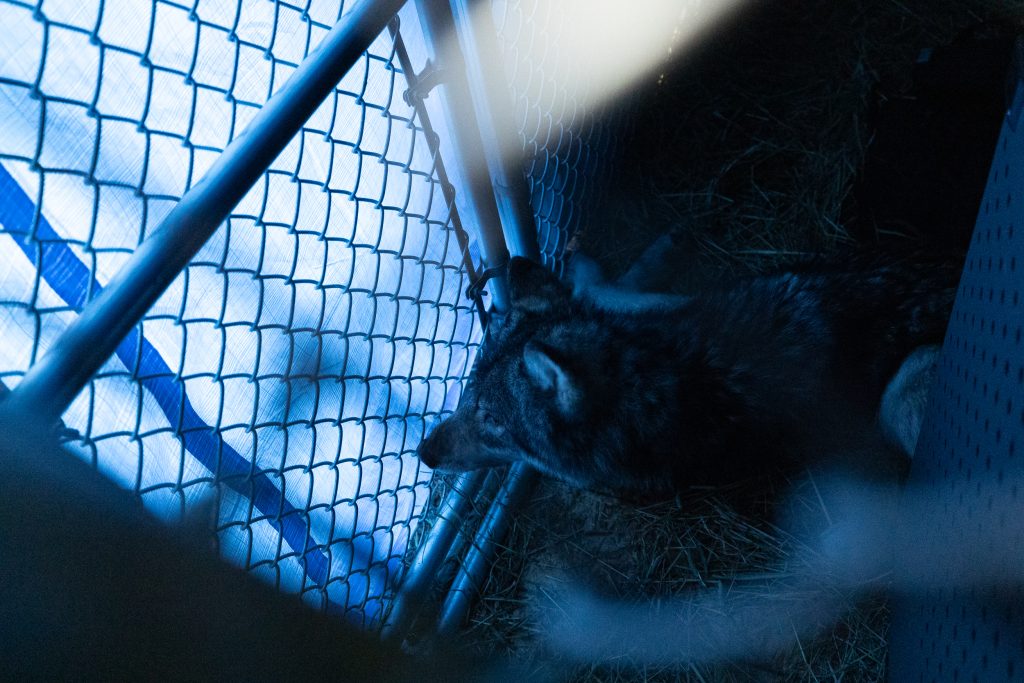
Colorado Parks and Wildlife/Courtesy Photo
On Jan 14, 2025, Colorado Parks and Wildlife was halfway through its operation to release 15 wolves from British Columbia in Eagle and Pitkin counties. One year later, facing a different federal direction, there are a lot of question marks surrounding the future of the state’s voter-mandated wolf reintroduction.
Laura Clellan, acting director of Parks and Wildlife, provided a brief update on where Colorado’s wolf restoration sits today at the agency’s commission meeting on Wednesday, Jan. 14. This included how Parks and Wildlife is working with the federal government to maintain its management authority as well as an update on whether it plans to release wolves this winter.
Clellan stepped into the role seven weeks ago, taking over from Jeff Davis after he was forced to resign in November. Clellan said Wednesday her goal is to “ensure operational continuity” as Parks and Wildlife aims to hire a new director by the end of February.
Will Parks and Wildlife keep its management authority over Colorado wolves?
On Dec. 18, Brian Nesvik, director of the U.S. Fish and Wildlife Service, sent a letter to Clellan, requesting a full report of the agency’s wolf conservation and management activities since reintroduction began in December 2023. The letter threatens to take over management of Colorado’s wolves if the agency does not comply within its 30-day deadline.
Clellean clarified that the letter was intended as a request, and not “to make a final determination on any future program outcomes.”

Support Local Journalism
“No immediate changes are identified,” she said, adding that Parks and Wildlife intends to comply with the request.
Nesvik’s letter indicates that if the state fails to comply, the federal agency could revoke the 10(j) rule and agreement that grant Parks and Wildlife authority over wolves in Colorado, despite wolves’ status as federally endangered in the state.
Clellan told the commission that “consequences of a change from state to federal management would be that (Parks and Wildlife) would not administer any of the wolf management actions in the state authorized by the 10(j) rule, ranging from injurious non-lethal hazing permits to lethal removal decisions.”
At the Thursday, Jan. 8, Colorado Parks and Wildlife northwest region sportspersons caucus meeting, Travis Black, the agency’s northwest regional manager, said that “any sort of change in management would be difficult.”
“I don’t know that they would have the staffing to manage wolves in the state of Colorado, at least not as responsibly as we have,” he said. “At least with (Parks and Wildlife) management, we have wildlife managers on the ground and all those vicinities that can be responsive to them.”
While the letter asks for a full report, it requests specific information about two management decisions made by Parks and Wildlife. First, is the agency’s release of “a wolf from a pack with a confirmed history of repeated depredation,” referring to the Dec. 11 release of a Copper Creek wolf in Grand County. The wolf was relocated after being captured in New Mexico by wildlife officials there.
Second, it claims that the state wildlife agency “with no notice or warning to its own citizens, released 15 wolves imported from Canada.” It follows a letter sent by Nesvik to Parks and Wildlife in October that claimed Parks and Wildlife’s 10(j) rule for wolves requires it to source the animals from a specific region of the United States, and that sourcing wolves from British Columbia violates that agreement.
Clellan clarified to the commission that, “(Parks and Wildlife) has coordinated with U.S. Fish and Wildlife throughout the gray wolf and reintroduction effort and complied with all applicable federal and state laws as well as international treaties.”
“This includes the translocations in January of 2025, which were planned and performed in consultation with the U.S. Fish and Wildlife Service,” Clellan added.
A sportsperson at the caucus meeting also asked how a piece of federal legislation — The Pet and Livestock Protection Act, sponsored by Rep. Lauren Boebert, a Republican representing Colorado’s 4th Congressional District — to delist wolves from the federal Endangered Species Act could impact Colorado’s program and management of wolves. The bill passed the House in December. It still faces a Senate vote before it heads to the president.
If the bill passes and wolves are delisted, management would fall back on the state, which is legally required to create a self-sustaining population of gray wolves following the passage of Proposition 114 in 2020, Black said. Colorado’s gray wolves would also retain protections because they are listed as endangered by the state, he added.
“We still have that plan that we have to follow,” Black said. “And we’re still going to continue to move forward with that.”
Will Colorado release wolves this winter?
Nesvik’s October letter interrupted Parks and Wildlife’s plans for a third release this winter, having already reached an agreement with British Columbia to receive another up to 15 wolves.
“Because of that memo with Fish and Wildlife Service, that’s kind of closed that door of going to Canada again, which we really felt was our best opportunity of capturing wolves that have no exposure to livestock and that were not depredating wolves to start with,” Black said.
A third release would bring the reintroduction in line with the wolf plan‘s recommendation to release 30 to 50 wolves in three to five years. Colorado has released 25 wolves in two years.
Per Nesvik’s direction, Colorado can only get wolves from the United States’ Northern Rockies region, where wolves are federally delisted. This includes Idaho, Montana, Wyoming and portions of Oregon, Washington and north-central Utah — the majority of which have declined to provide Colorado with wolves.
On Wednesday, Clellan said Parks and Wildlife “continues to evaluate all options to support this year’s Gray Wolf releases” in alignment with its plan and the recent guidance from the Fish and Wildlife Service.
Black told the caucus last week that the “window of opportunity is closing quickly.”
“From a biological perspective, there’s a time of the year that we want to capture wolves and release wolves,” he said, adding that February brings the start of the breeding season for wolves, after which there’s a risk of capturing a pregnant female and causing issues for the wolves.
Black added that there’s a likelihood “that we may not get wolves to release this year.”
What will happen if Colorado doesn’t find wolves this winter?
If Colorado is unable to release more wolves this winter, the impact on the restoration’s biological success depends on factors like wolf survival and reproduction, Clellan said. While the state saw successful reproduction in 2025 and its mortalities were in line with what Parks and Wildlife expected at this point in the restoration, the future is unknown.
“When populations are small, each individual becomes increasingly important,” she said. “Not knowing what the mortality rate will be over the next year, it’s going to be difficult to predict with certainty the overall impact of not completing a third year of translocations. If we have a high level of mortality, as we observed in 2025, we run a higher risk of not meeting the goal of establishing a self-sustaining population of wolves in Colorado and having to spend resources to do so.”