Avon Police tailed car break-ins closely using Flock system, and will use facial recognition software in attempt to ID a suspect in the case
Police chief says high-tech tools' ability to solve crimes outweighs concerns of mass surveillance

Typically, police only learn of vehicle break-ins after car owners report them.
But when a dozen vehicles were broken into in Eagle County last Tuesday morning, the roles were reversed: Police discovered the break-ins first and then notified the vehicles’ owners.
It was part of a wave of break-ins taking place across the state, originating in Douglas County and then moving its way into Avon, Vail and Silverthorne. Detectives, using the Flock license plate reading system, which has garnered negative headlines in Colorado in recent months, were able to track the thieves closely, showing up to the locations the burglars had hit just after they left.
Avon Police Chief Greg Daly says he understands the apprehension many people feel toward Flock’s mass-monitoring software, but says the system’s crime-fighting capabilities outweigh the negative effects of what the American Civil Liberties Union calls the “dangerous nationwide mass-surveillance infrastructure” being built by Flock.
Daly says the Tuesday break-ins are an example of the Flock system helping his department track criminals in real time.

Support Local Journalism
“Just like with this event, usually the individuals coming in to steal vehicles or break into vehicles are driving stolen vehicles in the first place,” Daly said. “So that was the main impetus why I put this before council and explained to them why we need (Flock cameras). They are a great crime-solving tool, and we only share them amongst Colorado agencies; we don’t share them out of state, and we don’t share them with any federal agency.”
On Tuesday, a deputy in Douglas County noticed that a license plate that had been used to break into vehicles in hotel parking lots there had popped up in the Flock system as being in Vail. That deputy notified area law enforcement, which started checking nearby hotel parking lots, finding about a dozen vehicles that had been broken into.
“(A Douglas County deputy was) dealing with break-ins that same night, but there was a different vehicle involved, but he knew a different vehicle that had been used in the previous two weeks had a similar M.O., so he put that license plate into the Flock license plate reader, and it popped up in Vail around 1:30 in the morning,” Daly said. “He then took the initiative to reach out and say ‘this plate just popped up in Vail, we have it associated with previous break-ins down here, and those break-ins occurred at hotels close to interstates,’ so that’s prompted us to go look at the parking lots of some of our hotels, and we discovered some of these cars had been broken into.”
Avon police looked at security footage from three hotels, observing a dark blue Chrysler 300 being used in all three break-ins. The individuals appeared to be targeting pick-up trucks with Texas license plates, and were looking for cash and guns, Daly said.
“At the moment I believe we’re looking at $2,000 worth of cash and three firearms,” Daly said. “They bypassed electronic items and luggage, so they appeared to have a very specific laundry list of items that they were looking for.”
After registering in Vail and Avon, the license plate then popped up in Silverthorne, where the same group is suspected of committing similar crimes.
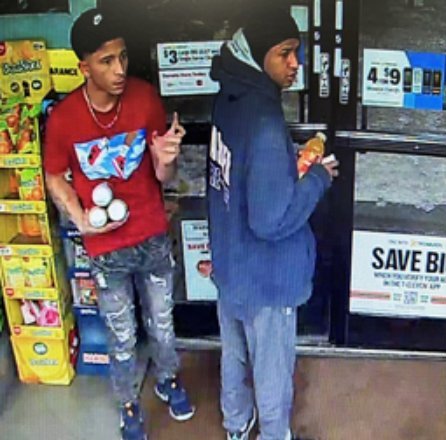
An officer in Silverthorne then checked nearby convenience stores to see if anyone in a blue Chrysler 300 had stopped by for snacks, and found that indeed that vehicle had stopped by one of those convenience stores. The officer was able to pull a high-quality image from one of the convenience store’s cameras.
Daly said the image was quickly circulated and created a lead right away, as another department in Colorado came forward saying it may know who one of the individuals in the photo is. Daly said he plans to run the other image through the Colorado Bureau of Investigation’s facial recognition system in an attempt to identify that person. Daly said his department only uses the facial recognition technology sparingly, when major crimes are committed.
“We went through a process a number of years ago to allow our department to use facial recognition software,” he said. “Because we went through that legislative process — we had to have three public meetings, we had to go through our council a number of times, etcetera — we’re allowed to do it.”