Behind the scenes at Bravo! Vail Music Festival

Courtesy photo
Wednesday night, the Vail Symposium hosted a free zoom webinar reviewing unseen aspects that go into creating the Bravo! Vail Music Festival, which opens this summer on June 22.
Now in its 38th season, the six-week festival showcases about 400 musicians within four internationally acclaimed orchestras: St. Martin in the Fields, the Dallas Symphony Orchestra, The Philadelphia Orchestra and the New York Philharmonic, alongside renowned chamber ensembles.
This summer marks the second year of the Bravo! Symphonic Commissioning Project, which brings two world premieres to the festival: “This Moment” by Anna Clyne with The Philadelphia Orchestra and a piece by Nina Shekhar with the New York Philharmonic.
“We’re the most important orchestral festival in the nation, if not the world. We’re the only one to have four orchestras,” said artistic director Anne-Marie McDermott during Wednesday night’s Zoom meeting, adding that, with the commissioning project, Bravo! adds to the symphonic repertoire “for the next 100 to 200 years.”
The secret also “slipped” that Bravo! plans to present its second operatic performance in 2024. It will make the official announcement during this summer’s festival with The Philadelphia Orchestra, said Bravo! executive director Caitlin Murray. The festival’s first opera with The Philadelphia Orchestra took place in 2019, after the orchestra’s music and artistic director Yannick Nézet-Séguin brought up the idea. At the time, it was a gigantic, and very expensive, notion.

Support Local Journalism
“We literally move mountains to get projects to happen, and we have and we did,” McDermott said.

She and Murray also discussed the curveballs the festival inevitably faces. One obviously occurred in 2020, when large public gatherings came to a screeching halt. McDermott spent “endless hours on the phone with Caitlin desperately trying to bring music to Vail. We couldn’t let go of the idea,” she said. So they hosted 13 musicians in Vail for a month, built a mobile mini stage and delivered 49 concerts to extremely small groups of people throughout the community, including chamber music concerts at Ford Amphitheater with 175 people properly physically distanced.
In 2019, a mischievous raccoon loosened a screw on the roof of the Ford Amphitheater, causing a panel to fall on the first violinist’s head, yet she continued on, nonplussed.
A few years ago, a morning snowstorm on June 23 required staff to erect a tent with heating ducts on stage. A technical director using an infrared camera ensured the instruments didn’t get too cold. The performance also required buying all the hand warmers and emergency blankets staff could find.
The perfect way to plan your weekend.
Get a rundown of all the things to do in the Vail Valley every Thursday.
Sign up here: VailDaily.com/newsletter
Mountain weather has wreaked its fair share of havoc but hasn’t stopped the show: One evening, a tornado, fire, flood and hurricane warning were all issues, they said, and still, prepared lawn-goers wouldn’t leave. For safety, Bravo! does employ risk assessment experts, including an on-call meteorologist who gives minute-by-minute weather updates when necessary.
“It’s impressive to see the fortitude (of the musicians and audiences),” Murray said.
The latest curveball came in the form of New York Philharmonic music director Jaap van Zweden, who will be in South Korea conducting the Seoul Philharmonic Orchestra, in memory of the victims of last October’s Halloween stampede, during much of this summer’s Bravo! festival.
“He couldn’t say no,” McDermott said, adding that welcoming four guest conductors, along with van Zweden, who will return to Vail July 23 to lead two of the most recognized works in classical music: Beethoven’s Symphony No. 5 and Rossini’s William Tell Overture, will be a “fun opportunity.”
Throughout the year, the “small but mighty staff,” as Murray termed the approximately 20 full-time, year-round employees, works to nail down programming, housing and all the many other logistics to pull off such a grand festival.
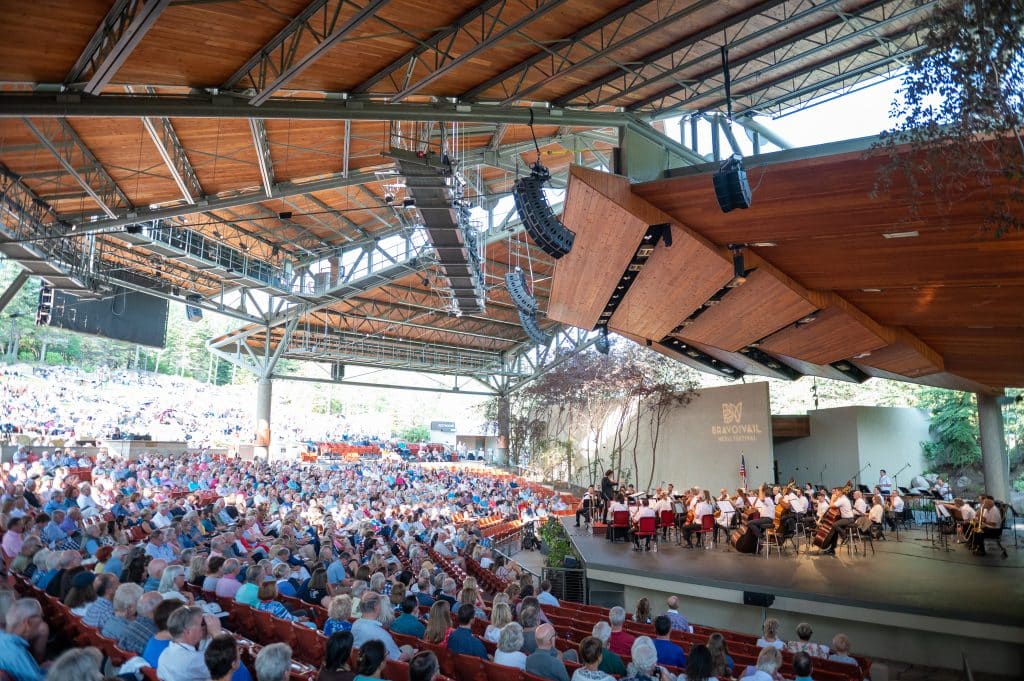
Of course, housing is the biggest expense, and often the most challenging — which means booking lodging years in advance these days for musicians and their families — particularly as Bravo! attracts more and more visitors to the valley. In fact, the festival brings $29 million in revenue to the valley in six weeks, Murray said.
The jigsaw puzzle, as they termed it, extends into programming.
“We look at the architecture of the entire season, bringing in new soloists and beloved (artists),” McDermott said.
The goal: great variety and a wealth of repertoire.
“It’s a complicated puzzle, but it’s a collaboration,” she said. “It’s a lot of conversations.”
The last portion of Wednesday’s webinar reviewed the importance of volunteers and talked about how and why all of the orchestras sound very different (The Philadelphia Orchestra possesses a strong sound, while the New York Philharmonic is the “most feisty” with a powerful brass section) and what separates good conductors from great conductors.
“Great conductors, of which we have some of the greatest conductors in the world, have a vision and an architecture for a great symphonic work. They understand the storytelling of the symphonic work,” McDermott said, adding that they also possess deep trust with the musicians (and vice versa) and know how to draw in audiences.
The webinar ended with the future vision of the festival, which includes presenting more soloists with a global reach, as well as new composers, commissions and operas.
“There’s always a lot more dreams we have for Bravo!,” McDermott said. “It would take me a couple of hours to tell you all of the dreams we have for Bravo!”