Colorado’s winter birds are ‘extraordinary survivors’ that grow ‘snowshoes,’ build snow caves and stash thousands of seeds
White-tailed ptarmigans, Steller’s jays, Clark’s nutcrackers, mountain chickadees and golden-crowned kinglets are just 5 of the birds that brave the Rocky Mountains’ cold, long winters

Jamey Degner/Courtesy photo
Winters in the Colorado Rocky Mountains can be long and formidable. Before the snow flies, thousands of birds migrate each fall to escape the cold.
Mary Harris, the chair of the Roaring Fork Audubon, said that migrating birds are “astounding in their own right” as they can travel hundreds of miles — often guided by the stars — to warmer climates as far away as South America. Yet, despite abundant snow, blizzards and chilled temperatures, there are dozens of species of birds that live in the mountains year-round.
“Our resident birds are some of the most extraordinary survivors in the natural world,” Harris said. “In the Rocky Mountains, with what they have to deal with, each one of these species has evolved its own blend of resilience and intelligence — from birds that build insulated snow caves to others that store tens of thousands of seeds with pinpoint accuracy to find them again. Some even transform their feathers to turn into winter survival gear.”
The Roaring Fork Audubon is the local chapter of the National Audubon Society, covering the region from Aspen to Vail to Rifle. Harris, who has been the local chapter’s chair for nearly two decades, has lived in the Roaring Fork Valley, where she has been fascinated by the natural world — especially birds — for more than 50 years. She shared her knowledge of five birds that spend the winter months in the Colorado High Country.
“These winter birds are resourceful problem solvers and constantly adapting to Alpine conditions that would pretty much overwhelm most wildlife — and even us humans, right?” Harris said.

Support Local Journalism
White-tailed ptarmigans
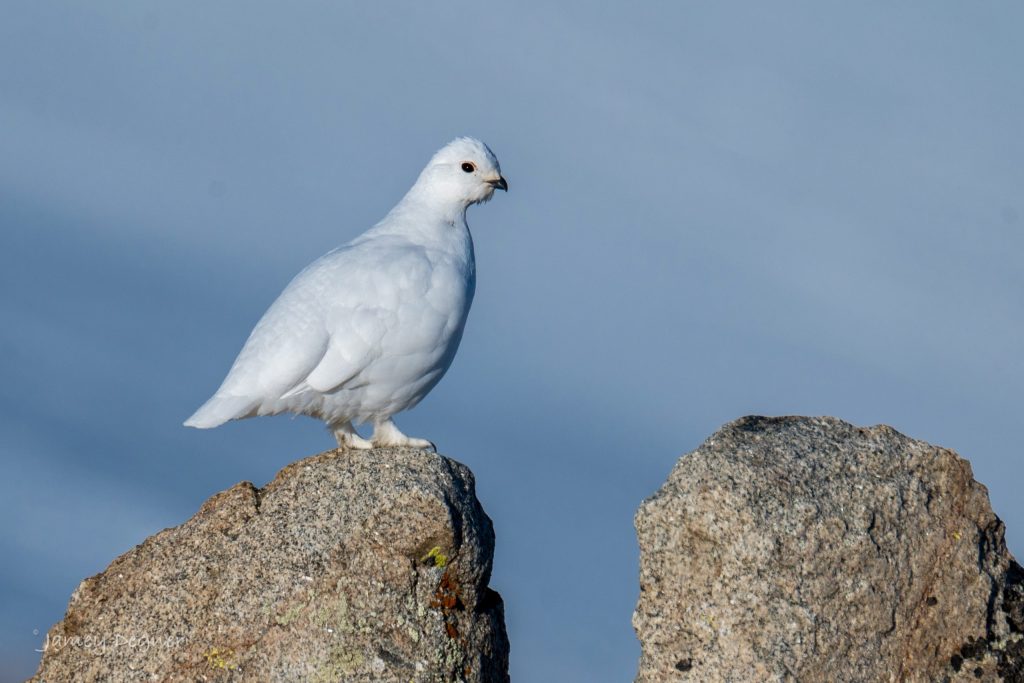
The white-tailed ptarmigan is a “small, tubby grouse” that turns white in the winter, camouflaging it with the snow, according to All About Birds, a website run by the Cornell Lab of Ornithology.
The white-tailed ptarmigan is the only bird in North America that spends its entire life cycle at high elevations in the Alpine tundra environments of the mountain West. Ptarmigans are typically found above about 10,000 feet in Colorado, including in Summit County and Rocky Mountain National Park.
As the cold sets in, Harris said ptarmigans will “dig little snow caves” up to a foot deep to roost in. In the winter, she said these birds will survive by eating dried leaves and buds and eating snow to keep hydrated. To conserve energy amid the cold, harsh winters, ptarmigans avoid flying.
During these winter months, ptarmigans “start growing snowshoes,” Harris said. Feathers sprout from their feet to provide extra insulation and create additional surface area to help them to walk atop the snow.
Steller’s jays

All About Birds describes Steller’s jays as blue-and-black songbirds that have a “prominent triangular crest” on their head.
In Colorado, Steller’s jay populations typically have a white “eyebrow,” Harris said, describing them as a “gorgeous” bird that is commonly found at people’s feeders during the winter. Steller’s jays live in conifer or mixed forests in the West and are often more noticeable in the winter, when they tend to move to slightly lower elevations where Colorado mountain residents live, as food becomes more scarce up higher, she said.
To survive the winter, Steller’s jays will seek “protective roosts” inside spruce or fur trees, fluffing up their feathers to keep warm. For food, Steller’s jays cache — or hide — nuts and seeds in trees during the summer months, then return to find the stashes as food becomes scarce in the winter.
“They’re generalists like the raven and the crow. They’ll find anything and try to eat it,” Harris said. “They have a really good spatial memory, so they’re capable of hiding something and finding it later.”
Clark’s nutcracker
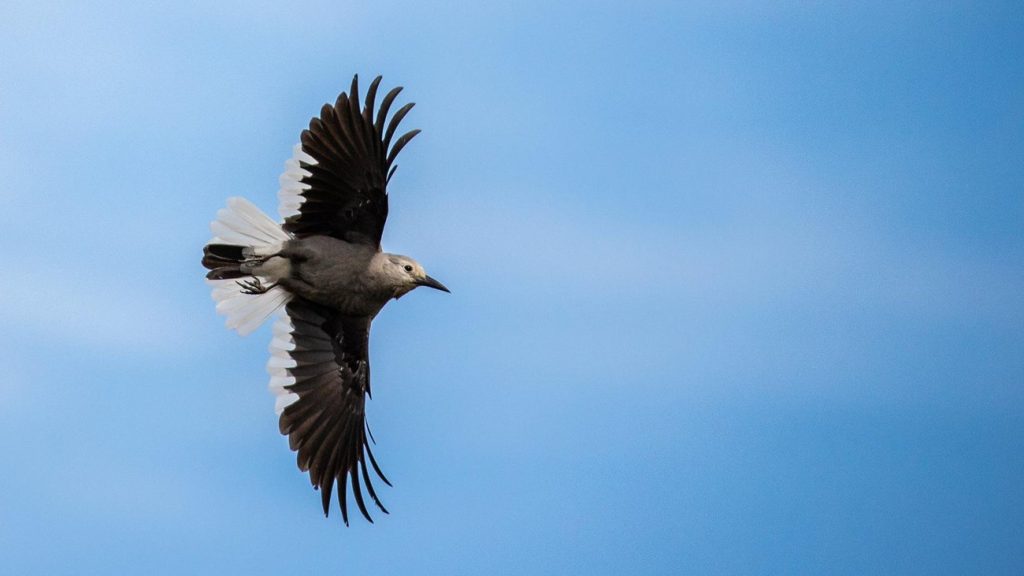
All About Birds describes Clark’s nutcrackers as gray-and-black birds that “swoop among wizened pine trees, flashing white in the tail and wing.”
Clark’s nutcrackers co-evolved alongside the whitebark pine and have sharp beaks that they use to rip into the pinecones to get seeds, Harris said. Unfortunately, whitebark pines are listed as a threatened species under the federal Endangered Species Act, and as the tree species has struggled, so have Clark’s nutcrackers.
Harris said Clark’s nutcrackers can each cache up to 100,000 seeds and typically bury seeds at depths of about an inch.
“One inch deep — that’s the perfect depth for propagating,” she said. “That’s another reminder of how everything works together in nature.”
Mountain chickadee
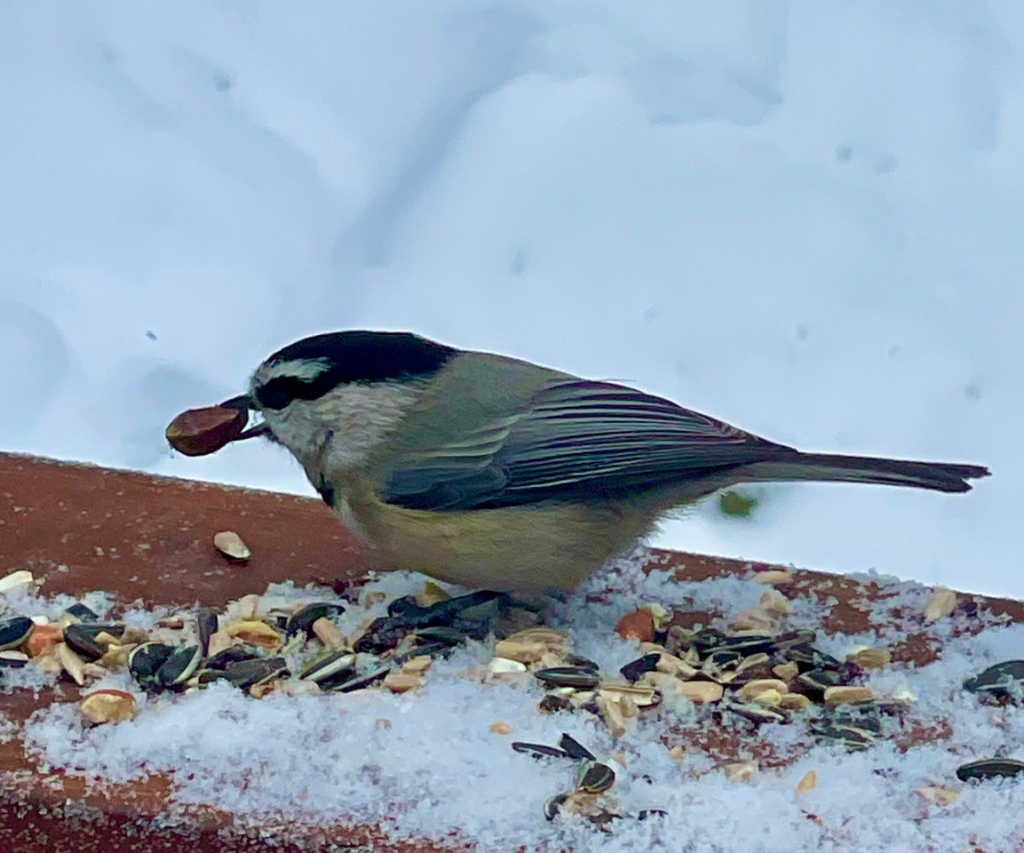
Mountain chickadees are tiny birds that weigh about the same as “12 paper clips or one quarter and one penny,” Harris said, but despite their small size, recent “mindblowing” research has shown chickadees to be surprisingly smart birds with excellent spatial awareness.
Individually, each mountain chickadee can cache as many as 80,000 seeds to store for winter, Harris said. Studies completed in recent years have shown that the hippocampus — the part of the brain responsible for memory and learning — of a black-capped chickadee, a species closely related to the mountain chickadee, grows up to 30% during the fall.
Other bird species can also recognize and respond to chickadee calls, which convey information about predators in the area, such as the size of the predator and the level of threat it poses, according to a University of Washington study.
“When you’re out walking, skiing or cross-country skiing and you hear the chickadees, it’s like music to your heart,” Harris said. “It’s like an old friend.”
Golden-crowned kinglet
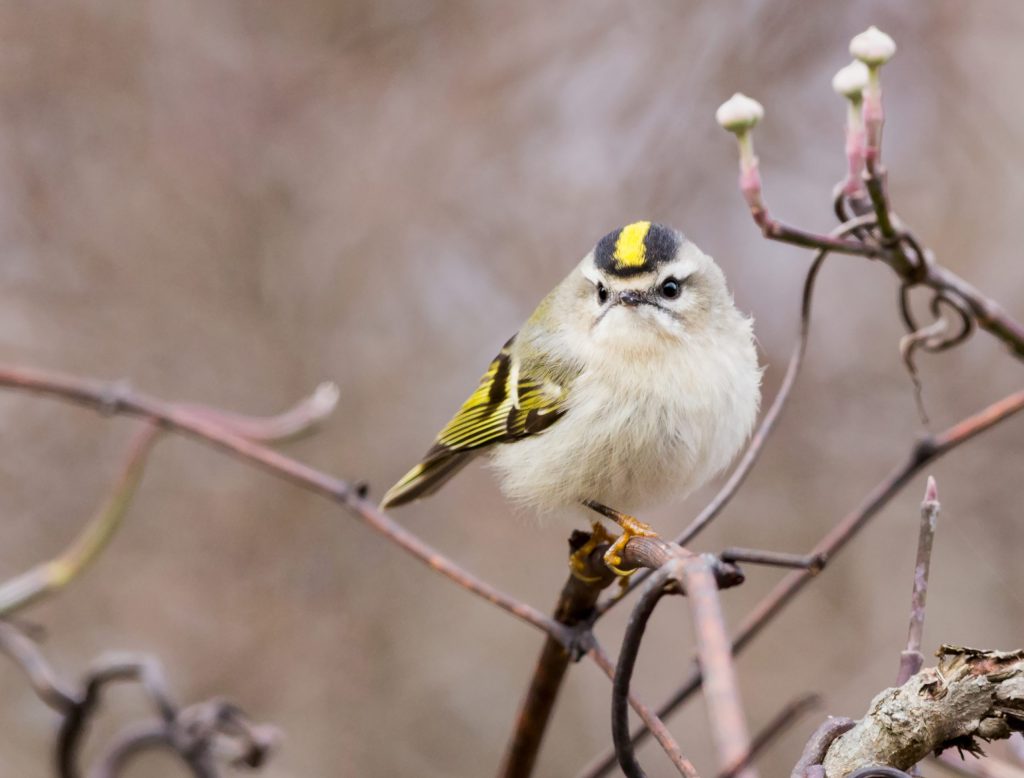
The golden-crowned kinglet is a “tiny songbird” that is “pale olive above and gray below” with a “black-and-white striped face and bright yellow-orange crown patch,” according to All About Birds.
Golden-crowned kinglets live mostly in boreal spruce-fir forests and spend much of their time high up in the tree branches. To stay warm overnight, these birds will nest in tree cavities, roosting in small groups and huddling together. They also have high metabolisms that can help keep their body temperature as high as 111 degree Fahrenheit, she said.
To make up for the high death rate that this species can experience some winters, Harris noted that female golden-crowned kinglets will lay up to 11 eggs. Then, shortly after those eggs hatch, the mother bird will lay another set of eggs and the father bird will watch over the first set of eggs while the mother looks over the second set.
“At a fraction of an ounce, they weigh the same as about two pennies — not a quarter and a penny (like a chickadee) — but two pennies,” Harris said. “They brave our deadly winters without migrating.”
Protecting birds
While mountain residents and visitors are often lovers of the outdoors and wildlife, Harris noted that bird populations across the globe have faced widespread declines due to multiple pressures including loss of habitat and climate change.
The 2025 U.S. State of the Birds report published by the U.S. Committee of the North American Bird Conservation Initiative estimates that the U.S. has lost 3 billion birds since 1970, or nearly one-third of all of its birds.
“I just can’t imagine losing bird song. How many years ago was it that Joni Mitchell sang ‘You don’t know what you’ve got till it’s gone?’ I think that was (nearly) 60 years ago,” Harris said. “Since she sang that, since that time, we’ve lost ⅓ of our birds. So basically we’re not paying attention to the warning signs and it’s getting worse.”
Harris encouraged those who love birds and the natural environment to keep domesticated cats indoors so they don’t kill birds, clean bird feeders regularly and feed birds the proper foods and become aware of other issues impacting birds, like habitat loss.
For more information on how to protect birds, visit RoaringForkAudubon.org.