Eagle County’s oil-train lawsuit tab came in over $1 million, but second suit capped at $225,000

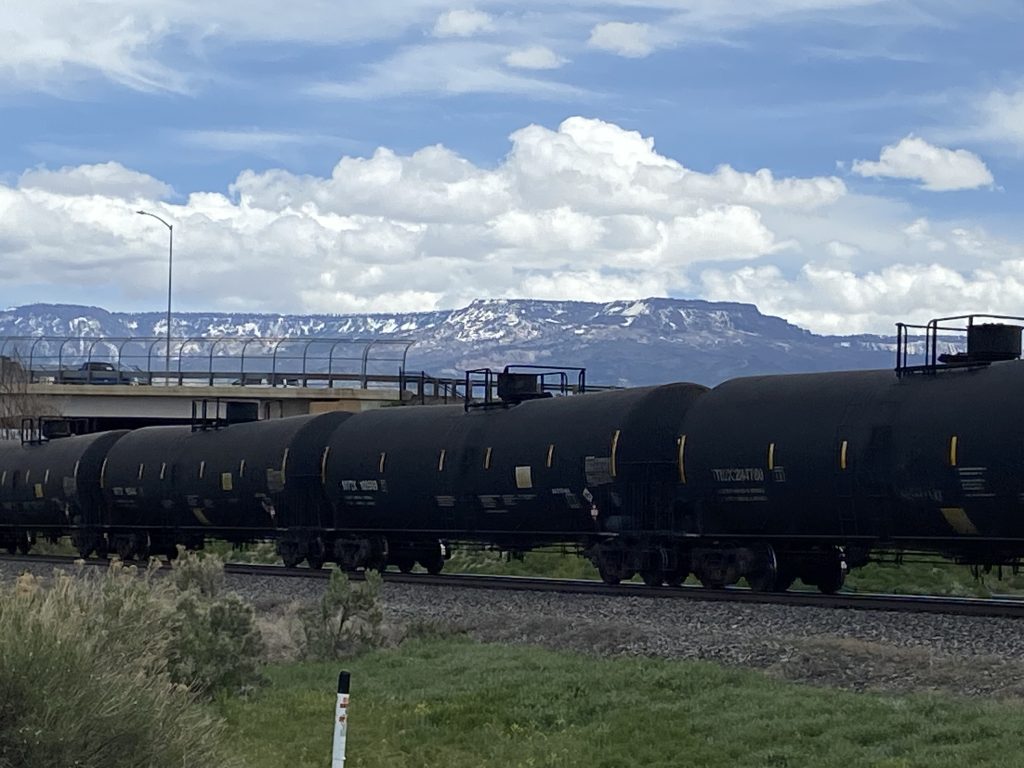
David Williams/Vail Daily
The final tab for Eagle County’s ultimately unsuccessful legal challenge of the proposed 88-mile Uinta Basin Railway project in Utah — a lawsuit that succeeded at the appellate court level in 2023 but was rejected by the U.S. Supreme Court last year — came in at just under $1.2 million.
“Since February, 2021, the county has paid a total of $1,179,694 in attorney’s fees and costs in connection with the Uinta Basin Railway litigation,” Eagle County Strategic Director of Communications Justin Patrick wrote in an email Tuesday.
“Of that amount, $921,003 has been paid to Kaplan Kirsch (a Denver law firm), and $258,691 to the firm of Goodwin Proctor LLP in Washington, D.C., for specialized litigation services associated with representation of the county before the U.S. Supreme Court,” Patrick added. “There are no further costs anticipated at this time.”
In that case, filed by Eagle County with the backing of environmental groups and mountain towns such as Avon, lawyers argued the U.S. Surface Transportation Board did not adequately weigh the potential environmental impacts of the massive surge of oil the rail spur proposed by Utah’s Seven County Infrastructure Coalition would cause along the Colorado River.
The Eagle County commissioners were disappointed in the 8-0 SCOTUS decision last May, which essentially narrowed the scope of National Environmental Policy Act (NEPA) consideration to “proximate impacts” of a project, but vowed to keep fighting.

Support Local Journalism
Last week, Eagle County filed a second lawsuit against the U.S. Department of the Interior and the U.S. Bureau of Land Management for using so-called “Alternative Arrangements” under President Donald Trump’s “energy emergency” executive order to expedite the expansion and conversion of an old coal-loading facility on BLM land in Utah to accommodate Uinta Basin oil. The agencies did so by ignoring multiple federal laws and the public-input process, the county argues.
The so-called Wildcat Loadout alternative to the proposed railway spur could achieve up to 75% of the capacity of the multi-billion-dollar Uinta Basin Railway, which translates to 260,000 barrels a day along 100 miles of the upper Colorado River on mountainous Union Pacific tracks.
“This action is about ensuring that federal agencies follow the law and fully evaluate the impacts of projects that affect our communities,” Eagle County Commissioner Tom Boyd said in a press release. “Eagle County is committed to protecting our natural resources, public safety, and quality of life, and we’ll do what’s necessary to stand up for those values.”
County officials are concerned about the potential for wildfires and spills into remote Colorado River canyons of Utah’s waxy crude oil that’s too thick for pipelines and therefore must be transported in heated tanker cars. Colorado Attorney General Phil Weiser also has joined a multi-state lawsuit challenging Trump’s “energy emergency” executive order, based in part on the Wildcat Loadout expansion. There is a cap on how much the county will spend on its suit.
“For the Wildcat Loadout lawsuit, the county has paid the law firm Kaplan Kirsch $83,185 to date, with a price-capped fee arrangement of $225,000,” Patrick wrote in an email last week.
Environmental groups cheered Eagle County’s continued legal battle against the oil-train expansion, but some rail experts say there are other reasons to reroute Uinta Basin crude. Retired Amtrak conductor Brad Swartzwelter, credited with reviving the popular Winter Park Express Ski Train and other state passenger and freight rail proposals, recommends Uinta Basin oil be trucked straight north to Wyoming with around $100 million in highway improvements on remote U.S. Highway 191.
It’s only about 110 miles on 191 from Vernal, Utah, to Rock Springs, Wyoming, where Union Pacific owns the underutilized, double-track Overland Route that runs east-to-west across Wyoming before connecting with north-south rail lines on Colorado’s Front Range, he said.
“America needs that energy. We don’t want to try and stop those oil trains, but those oil trains will definitely slow down and cause great trouble to whatever we try and do on (Colorado’s Moffat Line), whether it’s passenger rail or a truck by train rail bridge, or even running the ski train,” Swartzwelter said. “I was late 30% of the time because of the very few oil trains that are running today. The Uinta Basin Railway, to me, is a nail in the coffin of the Colorado River.”
Proponents of the Wildcat Loadout expansion have not responded to multiple requests for comment. BLM officials in Utah said they do not comment on active litigation.