EagleVail local who lost it all in Marshall Fire says being ready starts with your homeowner’s policy

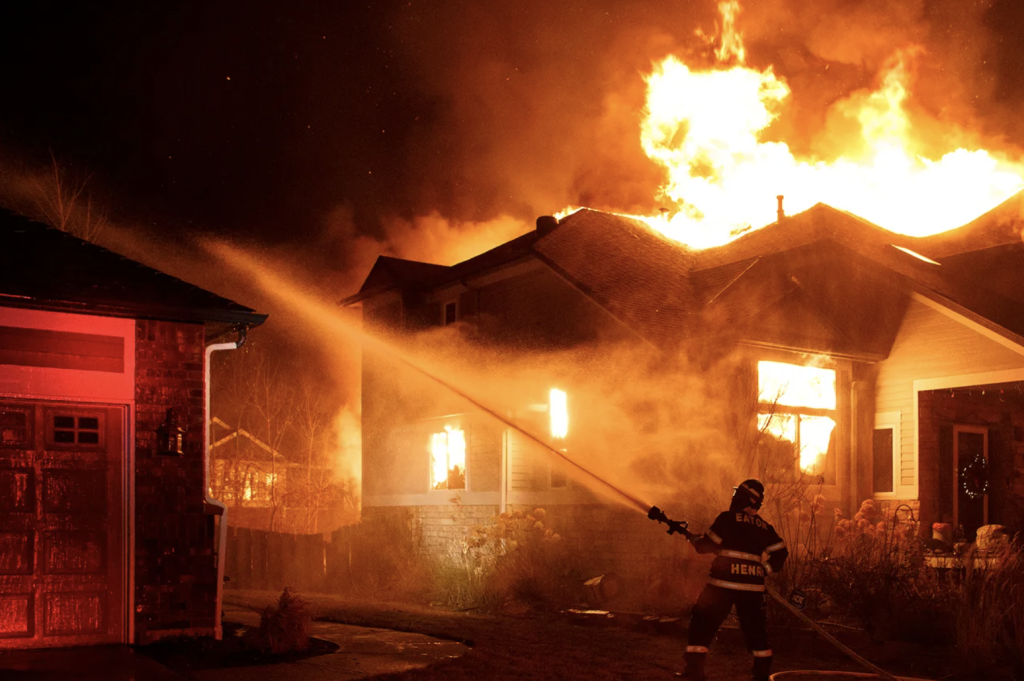
Jeremy Sparig, Special to The Colorado Sun
Michael Friedberg has held many quintessential Colorado jobs growing up in Boulder and skiing and ski coaching in Vail, from U.S. Ski Team mogul skier to sports marketer to restaurateur to professional cyclist. But the day he launched his latest career in real estate was the day his home burned down on Dec. 30, 2021.
That was the day the wind-driven Marshall Fire swept through Louisville and Superior just outside of Boulder and destroyed 1,084 homes and claimed two lives — the costliest wildfire in Colorado history.
Friedberg spent four years mired in insurance-claim disputes, building contracts, permitting nightmares and project managing the rebuild of a duplex and a single-family home on the scorched property where all of his family’s possessions had gone up in smoke.

Now through the other side of that ordeal, he and his wife Rachel and their two daughters are happily back in the Eagle River Valley fulltime, living in EagleVail but also living with the shadow of what can happen in an instant almost any time of the year in Colorado.
The recent fire up Squaw Creek near Edwards sparked those memories for Friedberg and prompted him to put together a PDF entitled “Are you prepared? A homeowner’s guide to fire season from someone who lost everything” that he is trying to share with as many homeowners and renters in the Eagle River Valley as he can.

Support Local Journalism
“We had insurance. We thought we were covered. We were not, at least not nearly enough,” said Friedberg, now a real estate adviser with Slifer Smith & Frampton Real Estate. “And when I started asking around, I learned that most of our neighbors were in the same position. Not because they were careless, but because the industry is set up to leave you short.”
Sure, put together a go bag, figure out emergency evacuation points, sign up for Eagle County emergency alerts, clear fuels away from your home. All of those and more are critical steps in terms of preparing for a big wildfire some experts say is a matter of when, not if, locally, but Friedberg’s two biggest takeaways in the aftermath of the fire that annihilated his family’s home on the Front Range have to do with insurance.
First, he highly recommends calling your homeowner’s insurance policy provider immediately and going over your dwelling unit and personal loss coverages to decide if you need to increase what you’re paying in order to come closer to what it will actually cost to rebuild your home and replace all the valuables lost in a fire.
Fortunately, Friedberg, his wife and daughter (they only had one at the time) were in Vail during the Marshall Fire, visiting his folks, Alan and Jean, who are longtime Vail skiers who met in a Chair 4 lift line back in the 70s.
“We were up here enjoying time with my parents and then our house burned down,” Friedberg said. “So, it’s like good news, bad news. The good news is we didn’t have to evacuate with a dog, a cat, and an 8-month-old. The bad news is we literally didn’t take anything; we had what we took to go skiing for a week. We didn’t take our passports. We didn’t take our … insert name of most prized possession here. I think we’re all massively unprepared. We were one of 1,000-plus people who had the same experience.”
Friedberg said his research shows that between 67% and 74% of homeowners are underinsured. Those numbers come from data dives he did on both the very personal (for his family) Marshall Fire and the even-costlier Palisades Fires in California that claimed thousands of homes.
“If their homes burned to the ground tomorrow, their insurance would not come close to paying for a rebuild. Most people have no idea,” Friedberg said. “The policies look fine on paper. The problem is that most dwelling limits either don’t increase at renewal, or increase by a small annual percentage that hasn’t come close to keeping pace with actual construction cost inflation, which has run more than 60% over the past decade.”
A local builder confirmed reconstruction costs in Eagle County could run north of $600 a square foot, so put that into your calculations when reviewing your homeowner’s policy.
“By the time you need your insurance, the gap between what it covers and what rebuilding actually costs can be hundreds of thousands of dollars,” Friedberg said. “I put together the guide because I wanted to give people something concrete and actionable. It covers the insurance gaps most people don’t know about, what the data from (other fires) actually shows, and what to do the next time you replace a roof, repaint siding, or clean your gutters. It takes about 10 minutes to read and could protect you and your family if the worst happens.”
Secondly, Friedberg recommends going room by room in your home, photographing and cataloguing your personal possessions, which comes in very handy when trying to file a claim for all the things from jewelry to artwork to furniture to sports gear that we accumulate over time. Store that list somewhere secure offsite or in a fireproof safe, although fire officials say anything inside those safes needs to be waterproof to survive a serious soaking in a fire.
Unfortunately, Friedberg speaks from a place of gut-wrenching experience. Check out his wildfire preparedness guide (pdf) on his Slifer web page, or email him at mfriedberg78@gmail.com.