Gypsum eyes 2029 construction start for $150 million I-70 airport interchange
Next 3 years will be devoted to project design, finding funding


Vail Daily archive
Gypsum is eyeing a 2029 start to construction in an effort to relaunch a project to install an Interstate 70 interchange by the Eagle County Regional Airport.
In December, the Gypsum Town Council contracted with HDR, a Denver-based engineering firm, to conduct a feasibility study for the project after taking over leadership. On Thursday evening, the town held an open house for members of the community to examine the results.
While the project stalled out in 2010, Matt Figgs, Gypsum’s town engineer, believes it will be a success this time around.
“I think what’s different now is the partnerships,” Figgs said. “The first time this project went through, there were a lot of local disagreements between different government entities. Not everybody was rowing the boat in the same direction. I feel it’s different this time because we are all rowing the boat in the same direction, and so we’ve been able to generate a groundswell of local stakeholder support.”
On top of stakeholder organizations, Figgs said, the community is more interested than ever in the interchange.

Support Local Journalism
“There is a lot of demand in town because they see the congestion, they see the safety problems, they experience the problems of not being able to get to work on time or not being able to get to the hospital because things are closed,” he said.
History of the project
The project’s initial concept was proposed in 1986.
In 1999, the Colorado Department of Transportation led a concept study for the potential interchange. “At that time, it was realized that another connection into I-70 is needed in Western Eagle County,” Figgs said.
Between 1999 and 2010, CDOT conducted an environmental assessment, purchased the right-of-way between I-70 and Cooley Mesa Road and created a design for the interchange.
But the project was shelved in 2010 due to a lack of construction funds. At the time, it would have cost $80 million to build the interchange.
In 2023, Gypsum conducted a traffic study across the town and examined the community’s needs based on its current and projected growth. Town staff “saw that this interchange is still very, very needed from a community standpoint,” Figgs said.
Last year, Gypsum assumed leadership of the project. Gypsum is working with CDOT and the Federal Highway Association, Eagle County and other municipalities.
“We started it not afresh, but we’re using the foundation of what was done in the past to build upon and look forward,” Figgs said.
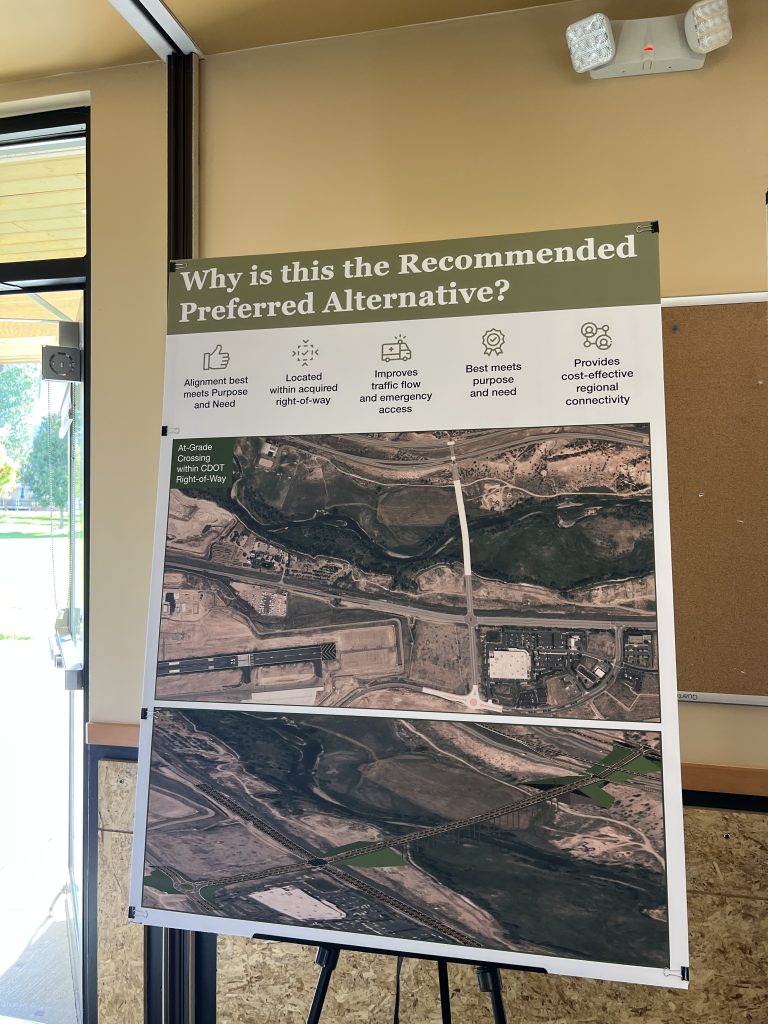
Why take on this project?
The project is needed at this time for “several reasons,” Figgs said. “One, the growth in our community. There is always a lot of traffic and congestion.”
Combined, Eagle and Gypsum grew 143% between 2000 and 2023.
The proposed interchange “pulls up to 30% of traffic off of (the Eagle and Gypsum) interchanges and actually lengthens the lifespan of those interchanges by 15 years,” Figgs said.
On top of reducing everyday congestion, the interchange makes driving in Eagle and Gypsum safer in two ways: emergency evacuation and reducing the number of large trucks that travel on U.S. Highway 6.
“We feel that it’s vitally important for emergency evacuation. In case of wildfires, if there was ever a wildfire that was near an interchange, we need another relief valve to the interchange,” Figgs said.
An additional interchange also serves as a valve for traffic control. “Anytime they close I-70, they detour traffic through town. The more on and off points you can have, the easier it is for state patrol to manage that traffic,” Figgs said.
Feasibility study confirms the project still works
The feasibility study looked at the old designs to see if they were still relevant, if there were any options that were missed, and if the needs for the interchange remained the same. The study determined that the project is still reasonable and feasible, almost as originally planned, with one key difference.
“When we went back and looked at all of the alternatives that were originally considered, the one that was preferred back in 2004 … that one is still our preferred option,” Figgs said.
When the original project design was created, the Union Pacific railroad that runs along I-70 had only recently stopped running trains. As a result, the original preferred design involved building a bridge that went above the railroad to avoid the tracks.
Today, the Union Pacific Railroad track “has been inactive for almost three decades,” Figgs said. “When the project was originally done, it was only a few years since it had been active.”
Project leaders considered an overpass that went above the railroad, an underpass that went beneath the railroad, and an at-grade option that crossed the tracks. They settled on the at-grade option.
“We feel the conversation has changed, and the cost savings by having a shorter bridge and crossing at-grade is significant, but also, it fits better with safety and evacuation, with operational flexibility, the connection to Highway 6, it helps better with congestion, it helps better with growth, so we feel that more than just the cost savings, it really fits the need of the community by landing at grade,” Figgs said.
One of the project’s next steps is to confirm with Union Pacific Railroad that the interchange can cross the railroad at-grade.
“It’s not a guarantee, it’s just our preferred alternative,” Figgs said.
Project leaders have had initial conversations with Union Pacific Railroad staff about the option, and aim to confirm a final answer in 2026. “The door is open to continue to talk to them about this,” Figgs said.
If the at-grade crossing does not work, the project will switch to one of its design alternatives, which won’t cause a significant delay at this point.
Funding the $150 million project
The project is estimated to cost $150 million in 2029 dollars, the planned start date for construction.
“With a project of this size, it is going to take more than just the town of Gypsum funding it by ourselves,” Figgs said.
The source, or, more likely, sources, of the funding is still in the works, Figgs said.
“We’re working through a funding strategy that involves a coalition of local funds, working through federal and potential state grants, and keeping all of our options on the table to see what we can do to fund it,” Figgs said. “One of our big efforts over the next couple of years is working on solidifying that plan.”
Gypsum solicits feedback
Gypsum is soliciting feedback on the project before it heads into the next phases of the project to get ready for construction.
“Most of the next three years of design and agreements is going to be unseen work that will get us to be ready for construction,” Figgs said. “We’ll continue to have community meetings, continue to do stakeholder updates.”
Feedback can be submitted on the town of Gypsum website.