Judge lifts gag order, testimony continues in teen murder case
Reverse transfer hearing for Nefi Ezequiel Armijo Hernandez is scheduled to wrap up on Thursday

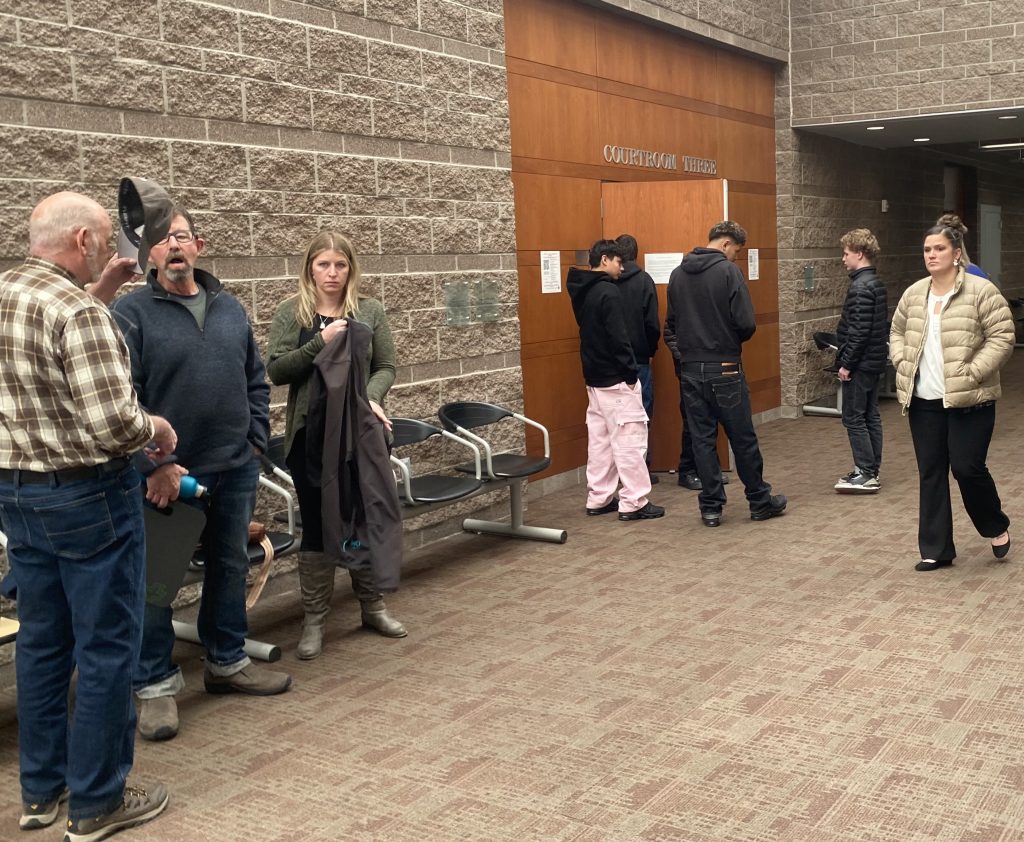
John LaConte/Vail Daily
Judge Rachel J. Olguin-Fresquez lifted a gag order on Wednesday in the criminal case of 17-year-old Nefi Ezequiel Armijo Hernandez, who has been accused of stabbing and killing 14-year-old Jackson Davis during an April 24, 2024, fight in Gypsum.
The gag order was imposed on Tuesday to prevent the media from reporting on the reverse-transfer and preliminary hearings, which are currently underway at the Eagle County Justice Center. The Vail Daily filed a motion on Tuesday, calling the gag order unconstitutional and requesting that it be lifted.
Olguin-Fresquez, on Wednesday, said the Vail Daily misreported Armijo Hernandez’s age in its coverage of Monday’s hearing (at the time of his arrest, he was 16, not 15), and warned the media against using the names of the juveniles involved in the case. Armijo Hernandez has been charged as an adult, which is why the paper is using his name, and Davis’ name has been released to the paper by his family and his mother has granted the media permission to use his name.
The reverse-transfer hearing will determine if Armijo Hernandez can be moved to juvenile court, and the preliminary hearing will determine if there is sufficient evidence to charge Armijo Hernandez with the crimes he is accused of, which include both first-degree murder and second-degree murder, among other charges.
Armijo Hernandez’s defense team, which had called for the gag order, asked Olguin-Fresquez to keep it in place on Wednesday, a request that the judge denied. The defense said that media coverage could make it difficult for the court to find an impartial jury, should the case go to trial. The defense also pointed out that there has been extensive media coverage thus far, with much of it focused on Davis and his family.

Support Local Journalism
Armijo Hernandez’s story
While there has been much focus on Davis, little information had been revealed about Armijo Hernandez before Tuesday’s and Wednesday’s hearings.
Testimony from Tuesday and Wednesday allowed those in attendance to learn more about Armijo Hernandez and his background, growing up in Honduras and journeying across the United States’ border by himself at age 15.
Much of the background information revealed during the hearing came from Avon Police Sergeant Bal Herrera, himself a native-born Honduran immigrant. Herrera based his statements on interviews he had conducted with Armijo Hernandez’s parents, along with an aunt and uncle.
Armijo Hernandez was born in Honduras in February of 2008, and his parents left him in the care of his grandmother and aunt at a young age.
Herrera said Armijo Hernandez attended a very good school that was “extremely difficult to get into” in Honduras, and he had a strict upbringing, with the family striving to keep him busy with school and soccer because they did not live in the best neighborhood.
Armijo Hernandez volunteered in a local firefighting squad from ages 7 to 12, Herrera said, before a period of change upset the family. His aunt moved out of the house and his father, David Hernandez — who had been visiting on weekends — also left Honduras for the United States around that time.
David Hernandez was adored by his son and his absence affected the boy, Herrera said.
When Armijo Hernandez’s grandmother broke her hip and had to spend a lot of time in the hospital, he was left unsupervised before moving in briefly with his mother. During that time, Armijo Hernandez began to act out, Herrera said, and his mother would respond by hitting him with a belt.
“She explained her discipline,” Herrera said. “She said it was socially accepted in Honduras.”
After a month or two of living with his mother, Armijo Hernandez decided to journey to the United States to follow his father. He arrived at the United States-Mexico border at Eagle Pass, Texas, on Nov. 13, 2023.
David Hernandez then received a call from immigration, with border agents asking for his address, Herrera said, so that they could send his son to him. When he reunited with his son in November of 2023, “Him and Nefi shared a living room with two other men,” Herrera said. “It was a two-bedroom apartment and the other two bedrooms were leased out to other people.”
Once with his father, Armijo Hernandez spent a lot of time unsupervised because of his father’s busy work schedule, Herrera said.
Armijo Hernandez enrolled in Battle Mountain High School in December of 2023 as a no-English-proficiency student, said Michelle Gentry Nixon, an assistant principal at Battle Mountain, who testified on Tuesday.
Gentry Nixon said Armijo Hernandez was placed in sheltered algebra, sheltered history, sheltered science, English language development, English language enrichment, Spanish for native speakers and physical education. Sheltered classes contain two teachers — a content-level teacher and a language teacher.
Within a few months, Armijo Hernandez had formed a group of friends and had a girlfriend. One friend, according to testimony from Detective Sgt. Jeff Waltz with the Eagle County Sheriff’s Office, described Armijo Hernandez as an instigator, goading others into fights.
Armijo Hernandez has a characteristic smile that has been described as a smirk. Detective Jose Balderas said he saw that smirk come out during a key moment in an interview with Armijo Hernandez.
Balderas, quoting Armijo Hernandez, said Armijo Hernandez described a knife found near Davis as “bigger than the one I used to hurt the kid…”
“When he said that statement, he had a smiling smirk on his face, and his head was nodding up and down,” Balderas said.
The concurrent hearings are scheduled to wrap up on Thursday, but are currently running behind schedule, with at least one witness who was set to testify on Wednesday pushed back to Thursday. Two to three more witnesses are expected to testify before the judge issues a ruling in the hearings.