The Reality of Wildfire: A new product can protect neighborhoods from wildfires

Eugene Garcia/AP
We know wildfires pose a significant threat in the Western United States, but Mark and Jackie Hoppenjans experienced the devastation of losing their home to fire firsthand.
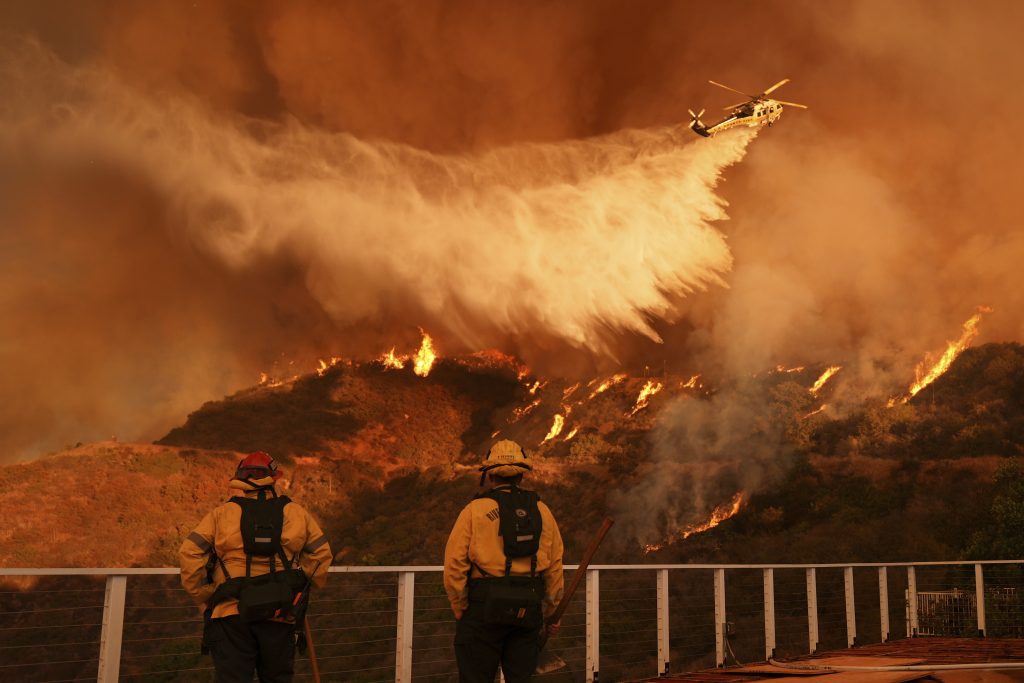
On Jan. 7, 2025, the Hoppenjanses’ home in Pacific Palisades became endangered, as the Santa Ana winds kicked up after months of little to no rain. At 10:30 a.m., a small blaze on a ridge in Pacific Palisades turned into a large plume of dark smoke people could see from miles away. For the next couple hours, cars jammed the roads as residents fled the rapidly growing flames.
At 6:17 p.m., the Eaton Fire started about 30 miles east of the Palisades. By 8 p.m., it had doubled in size, and all firefighting aircraft in the county was grounded due to high winds.
The two fires ultimately charred acreage roughly the size of the city of San Francisco, killing 31 people, 12 of whom were in the Palisades. The Palisades Fire burned for 31 days before firefighters completely extinguished it; investigators later determined the blaze originated from an earlier fire, which began on Jan. 1. The two fires destroyed 16,246 structures, 6,833 of which were in Pacific Palisades and neighboring areas.
One of those structures was the Hoppenjanses’ home, even though it sat so close to a water reservoir.

Support Local Journalism
Mark Hoppenjans recalls fitting as much as he could into his vehicle and thinking they’d only be gone for three to five days while they hunkered down in a hotel. He was able to travel back up the canyon on an e-bike and fought the fire for a couple of days, but then the winds changed, engulfing their home in flames.
“You think you’re going to be coming back in a day or two. You don’t think that everything’s going to be gone. We had 75 mph winds — an extremely difficult situation — it’s just very comprehensive. I mean, it’s all gone. There’s just 40 inches of ash in the foundation of your house,” he said.
Rising from the ashes
Part of moving on included becoming the chief commercial officer of Wildfire Guardian, a company that offers an innovative, eco-friendly, gel-based fire retardant called GraphGel. The exterior coating provides over 90% protection against a wildfire burning a structure.
“When the ember storms come, and once something gets to the internal part of the house, it’s kind of over,” he says about unprotected homes.
The GraphGel system is unlike any other, in that it works dry. During the Palisades Fire, downtown shops hired private firefighters to apply a gel on the commercial buildings, which they had to rewet every four hours, he says.
After a fire, the Wildfire Guardian team completes a full cleanup, not only rinsing off the gel, but also cleaning up melted plastics and other toxic elements that can affect the environment.
The team undergoes wet drills once a year, and twice a year it inspects everything in the neighborhood. When a fire breaks out and the risk score reaches a certain number, the team automatically dispatches locally, applying the gel to contracted homes.
“It’s not negotiable. When it hits that number, they go,” he says.
Preparing as a Coloradoan
When two separate homeowners from the Vail Valley read about Wildfire Guardian’s new product, they encouraged Mark Hoppenjans to visit and get to know the community.
With last winter’s dry spell, creating defensible space and evacuation plans is essential, but not everyone seems to be taking heed.
In terms of preparing for the physical devastation of a possible wildfire, Hoppenjans recommends walking through your home and recording and/or photographing all of your belongings.
“And keep notes. (Insurance companies) don’t just write you a check for the amount. It’s amortized, based on the years and everything else, so that’s a pretty challenging process,” he says.
Raj Manickam, a co-owner of SteamMaster in Minturn who has won awards for educating locals about wildfire, reminds residents: “Always be prepared to leave.”
“Grab a bag with some clothes and anything valuable that you would like to take with you because you just have to hop in the car and go,” Gidney says. “Don’t stick around to try to get everything out — follow the mandates and evacuation orders.”
In addition to having a list of items you’d take in an event of an evacuation, plan out your route and any alternative routes, as well as where you would go.
“You don’t have to have your apocalypse kit or anything laying around, but I think that at the time of risk, you need to have some things in your garage, around the car: the water, the cash, the five days’ worth of clothes and have some clarity on where you are going to go. I would do the very best you can to have a plan,” Hoppenjans says. “I would encourage everybody to get together and talk to one another and really think about things. There are a lot of solutions out there.”