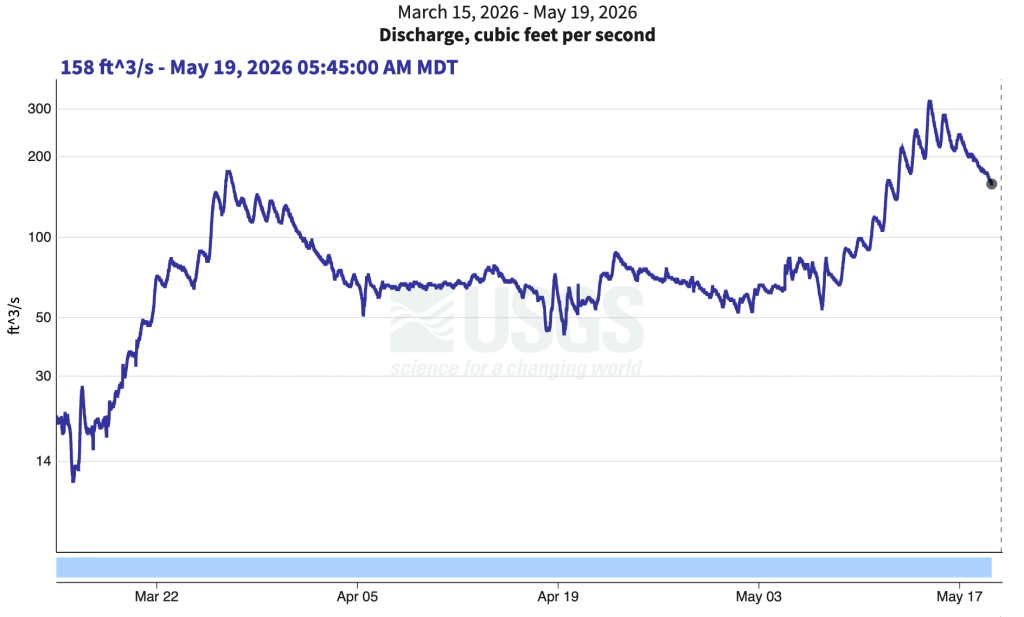
A few days after local waterways hit peak flow for the year, the Vail Town Council heard town staff’s plans to reduce water usage by more than a third this summer as drought conditions are expected to reach record levels due to historically low snowpack in the region.
Vail’s senior landscape architect, Greg Barrie, said the town’s goal is not only to comply with recent restrictions from the Eagle River Water and Sanitation District — which recently implemented a two-day-per-week schedule for outdoor watering, rather than the three-day schedule used in years past — but to also provide “some level of public amenity” when it comes to things like turf grass on athletic fields, Barrie said.
“We do have a busy summer season, so we’ll take that into account,” Barrie said.
Additional restrictions are likely if flows in Gore Creek and the Eagle River continue to decline, Barrie said. After reaching a false summit in March, flows in Gore Creek and the Eagle River peaked over the weekend, about three weeks ahead of what would be considered normal.
The Eagle River Water and Sanitation District is expected to give an update on flows at its regular meeting next week, scheduled for May 28 in the district’s main office in Vail at 12 p.m.
Barrie said the town of Vail’s proposed measures will affect nearly every aspect of Vail’s outdoor landscape operations, including parks, athletic fields, flower displays, fountains and municipal vehicle washing.
Under the recommendations, the town would eliminate irrigation in many nonessential turf areas and sharply reduce watering in neighborhood parks, potentially leading to temporary closures if grass goes dormant. Officials noted that bluegrass turf can survive drought conditions by turning brown and entering dormancy, but once dormant, the grass cannot tolerate foot traffic without sustaining damage.
Several of Vail’s water features could also go dry this summer as the town considers shutting off four of its six fountains entirely, while limiting operation of the Children’s Fountain in Vail Village and the Sunbird Park splash pad in Lionshead to weekends only.
Barrie said the town of Vail has spent decades preparing for drought conditions through irrigation upgrades and landscaping changes.
“This isn’t our first drought scenario,” Barrie said. “We’ve been dealing with these for the last 25-30 years and have really become much more resilient in town in how we manage these drought scenarios.”
Over the past 25 years, the town has replaced approximately 1.4 acres of bluegrass turf with native grasses, shrubs and perennial plantings, reducing water use in those areas by as much as 60%.
The Town Council expressed support for closing turf areas of certain pocket parks like Bighorn and Ellefson in exchange for keeping turf fields open at Donovan and Ford Park.
“The Vail Recreation District is still looking to maintain the ball fields,” Barrie said. “There are important summer events for us, like lacrosse, where we don’t want to just simple shut those fields down. So it’s managing water in a way where we can keep some grass at that location, to give the community some turf areas.”
Vail Recreation District Director Mike Ortiz said the Ford Park fields have only been watered once so far this year and are in great shape as of right now.
The town’s extensive collection of annual flowers are likely to be displayed only in Lionshead this year, said Flower Crew Supervisor Hannah Sorensen.
“The hanging baskets could potentially live on two days a week in Lionshead, because the lining is protected,” Sorensen said. “The village ones won’t, so we’re not even going to try that.”
Sorensen said those Vail Village hanging baskets will likely be filled with “artificial greenery.”
Sorensen said its doubtful that the town will plant annuals in the West Vail, Simba Run, Evergreen roundabouts, as well.
“We’re going to be nimble, we don’t know what to expect,” said Town Manager Russ Forrest. “We might very well get into a place where we have zero irrigation, and we’ll have to live with that.”