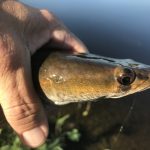
Salomone: Dead drifting crayfish.
The underutilized tactic can be the ticket to giants

Michael Salomone/Courtesy photo
I read about this technique from a Wyoming fly-fishing guide years ago. The more I learned, the more I realized this approach can be duplicated in a variety of water — from our cold-water trout angling to warm-water bassing. Moving water is the key factor enabling the technique to really sing. Regardless of the river or stream where you intend to try this approach, dead drifting crayfish flies bring the big boy brown trout out to eat.
Anglers who are puzzled about the prevalence of crayfish in their selected waters can solve the riddle easily by asking the raccoons. The telltale signs left by raccoons are crayfish body remnants left on the bankside rocks. Claws, carapace and more get scattered when raccoons wash and feed on crayfish.
Crayfish, crawdad, crawfish or mudbugs — the list of names continues and becomes more ingrained with locality. Found worldwide, with the exception being India and Antarctica, crayfish are recognized everywhere. A valuable food source, the tail provides a substantial piece of meat. As a point of confirmation, I’ve eaten them on three continents so far. Whether served in Cajun style, etouffee or simply mixed in with rice, crayfish aren’t just eaten by people. Trout adore them as well.

The rigging is simple if the angler can envision the crayfish fly as a nymph and rig their setup accordingly. Most fly anglers are familiar with nymphing and how the rig is constructed. With crayfish flies, the objective is to present the offering close to the bottom of the river or stream. A free-floating crawdad looks out of place. A crawdad fly tumbling along in the spate will get hammered.
Large indicators assist in the presentation. The big floats suspend the fly at a known, desired level. Making the presentation in like-depth situations increases effectiveness when dead drifting crayfish flies. Heavy weights applied to the leader drag the fly toward the river bottom and allow unweighted crayfish flies a little more life to drift with the illusion of disconnection. Another approach is to weigh the fly with lead wire or with the assistance of weighted eyes. Either way, the crawfish imitation is meant to stay down.

Support Local Journalism

Proximity to the bottom is key. A crayfish knocked into the current or escaping the attack of a predator struggles to regain purchase on the river bottom. That struggle takes them down toward the bottom to hide amongst the rocks in safety. Heavy weights sink with speed and purpose, making the fly ride deep and low where trout expect to encounter crayfish.
Crayfish are weakened during the molting process. Trout recognize the sensitivity of crayfish during molting. The shell of the crayfish is soft, making them more vulnerable. A freshly molted crayfish possesses a reddish orange hue. Use color to your advantage by incorporating bright red or bold orange into your tying for crayfish.

There is no indicator signaling a mass molting. Rather, each individual crayfish will molt on their own schedule. Larger examples take longer to molt, whereas smaller, younger crayfish molt more regularly. A solid, bright orange crayfish fly has been the ticket for me lately, reinforcing the color theory for weakened targets.
Primary water for the wading angler is downstream of heavy riffles. Any heavily broken water displaces crayfish in the strong currents. And crayfish escaping predators inadvertently get misplaced in the water column where they become easy to eat. Float fishers can present their crayfish flies in the depth change along the bank. Just where the water drops into the main river channel and hold on.
This is the realm of the 6wt fly rod. Heavy indicators, weights and large, clunky flies eliminate any chance for finesse. This is brutal fly fishing but the results yield trout of substantial proportions. Big trout love crayfish, and they hit it to kill it. No fish likes anything struggling or potentially dangerous in their gullet. Crayfish will try to grab ahold of anything to avoid being eaten and that means sensitive gills. To prevent that, trout hit crayfish with authority, stunning or killing the crawdad in the process. Stronger tippet is required to keep flies from being bitten off.
An underutilized approach to trout fly fishing, crayfish can be the ticket to giants. And not just trout— smallmouth bass regularly fall for this presentation when waters get too warm to chase flies. Dead drifting crayfish is a technique any angler can replicate.
You’ll be glad you did.