Avon passes new short-term rental fees, management requirements
This is the town's first major step toward getting a handle on short-term rentals an their impact on community housing


Karl Anderson/Courtesy photo
At its Tuesday meeting, the Avon Town Council passed new short-term rental regulations and fees that will go into effect this November.
The changes come after the council has considered numerous options for limiting or stopping the conversion of long-term residential properties to short-term rentals since last fall.
The ordinance passed Tuesday is not only the town’s first step toward managing this conversion but also a step toward the members of the council better understanding the inventory of short-term rentals in the town.
The ordinance itself creates minimum management requirements for the properties, and establishes a new fee structure for short-term rentals in town.
The ordinance was passed on first reading at the council’s June 28 meeting. Since that meeting, few substantive changes were made to the management requirements and fee structure.

Support Local Journalism
As passed, short-term license holders will now have to sign an affidavit affirming their compliance with a number of new management requirements. Intended to create a baseline of safety for guests in these rentals, these rules range from parking and general maintenance requirements to occupancy maximums and the required presence of a management contact. License holders will be required to inform guests of these minimum requirements.
Along with the requirements, the ordinance establishes mechanisms for the town to receive complaints and manage violations and non-compliance with the rules. The town’s community development department will oversee the complaints as well as oversee the procedures for violations, penalties, revocation, and enforcement of licenses.
It also establishes a new fee structure, increasing fees from a flat $75 fee for all rentals to a tiered structure based on property type and use. The new fee structure is as follows:
- Resident-occupied: $150
- Front desk or managed for a timeshare: $250 plus $25 for each bedroom in the property that is used as a short-term rental
- All other short-term rentals:
- Studio or one-bedroom unit: $350
- Two-bedroom unit: $400
- Three-bedroom unit: $450
- Four-bedroom unit or bigger: $500
These fees were created to cover the increase in town costs for the staff to implement, administer and oversee the new management requirements.
Short-term rental license fees are paid on an annual basis, and as such, current license holders won’t have to pay the new fees until their license is up for renewal. However, according to the ordinance, the new fees and regulations will go into effect Nov. 1, 2022.
More changes likely to come
High Five Media/Screenshot
While this ordinance was passed on Tuesday, there still may be changes to the ordinance as the town contemplates a second ordinance regarding short-term rentals. Town Council continued the first reading of this ordinance to its next regular meeting on Tuesday, Aug. 9.
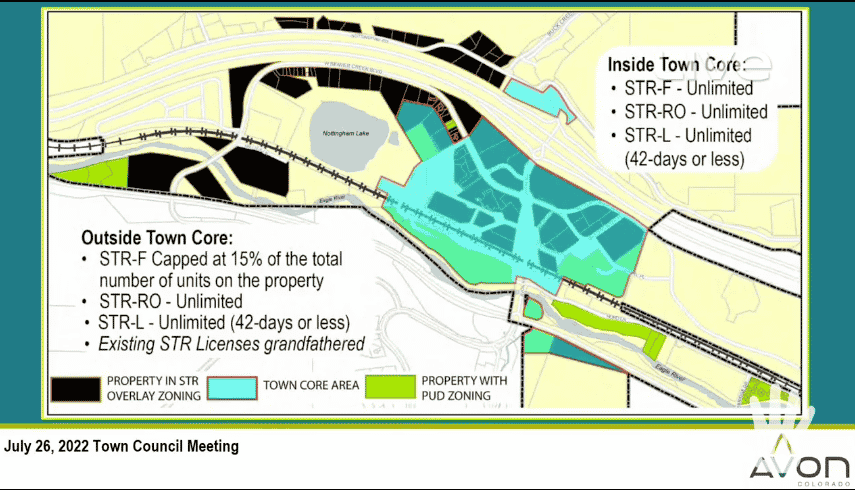
The second ordinance contemplates establishing a minimum cap on short-term rental licenses; a reconfigured short-term rental overlay map; as well as an additional type of short-term rental license.
The new overlay map “provides an efficient and intuitive boundary area for unlimited STR licenses and areas which would be subject to a cap on STR licenses,” according to a report in the Town Council packet. It establishes a town core, where licenses would not be capped, and an area outside of town core where these rentals would be limited.
As currently written, the ordinance proposes that “the total number of STR licenses permitted for a multi-family subdivision property in the Short Term Rental Overlay zone district and outside the Town Core shall be 15% of the total number of residential units for such property.”
There are a few exceptions to this, including that this limit will not apply to resident-occupied short-term rentals and part-time short-term rentals (a new concept introduced by this ordinance); and that the number of allowed short-term rental licenses will round to the nearest whole number and not be less than three units for a multi-family subdivision. It also defines multi-family subdivision property.
This 15% cap, according to Town Planner Max Morgan, “would allow short-term rental growth at almost all properties outside of the town core that currently has short-term rentals and those that have none,” while still exacting limitations based on geography.
“This system also allows for proportional growth to development. It’s not a hard cap, it’s relative to the number of units per property. I think that it’s critical people know that as the town grows, the number of short-term rentals can also grow,” Morgan added.
At Tuesday night’s meeting, the minimum of three units was up for debate as council members expressed differing viewpoints on whether this would achieve the council’s goal with the short-term rental regulations.
Some Council members felt it “runs contrary to what our original motivation was” by not preserving communities and not limiting these rentals, as Mayor Sarah Smith Hymes framed the argument.
“Part of the genesis of this was we wanted to curb the growth of short-term rentals, which we are doing certainly,” she said. “We are basically giving a much higher cap than 15% to quite a few properties.”
On the contrary, others argued it would be “unfair” to property owners in smaller complexes.
“Having that small number is appropriate, that minimum,” said Council member Scott Prince.
In his argument, Prince gave the hypothetical of a small six-unit property, where with a 15% cap (and not a three-unit minimum), only one person could short-term rent their unit.
“Should only one person be able to get the license?” he posed. “That’s not fair because (hypothetically) we live in a 6-unit and is that really where the impact is? I think the three (-unit minimum) is appropriate.”
This idea of having a minimum will be one idea fleshed out more at the next council meeting.
The other new concept that the second ordinance establishes — and which, if passed, would be worked into the ordinance that did pass on Tuesday — is a limited short-term rental license. This license would apply to short-term rental properties that are rented for up to 42 days a calendar year.
The new license type attempts to capture the properties that are not purchased as purely short-term rental investment properties, but rather second-home owners or residents who go for summer or winter holidays who are never going to long-term rent it because they want the flexibility of using their property, said Town Manager Eric Heil.
“The idea is that you’re trying to accommodate situations that weren’t going to allow for long-term rental anyway, but not have so many days that it becomes a loophole substitute to just getting a regular short-term rental license,” Heil said.
These other changes to the short-term rental overlay district and licenses will be further contemplated at the council’s next regular meeting on Tuesday, Aug. 9. However, council members overall showed support for the direction of this ordinance, but sought more details on certain aspects.
“I think it’s meeting a lot of our goals in town to regulate this. I think it will be of great value and I think that councils that come after us can re-evaluate it with whatever works with what current economics exist,” said Council member Lindsay Hardy. “I believe that this is a valuable path for Avon. … I think this is an incredible starting point considering where we started.”