Avon tries to make it easier for those buying their first home in town
The town looks to increase the eligibility requirements for its Real Estate Transfer Tax exemption


Chris Dillmann/Vail Daily archive
As free market home prices continue to rise in Eagle County, Avon looks to cushion the blow for those buying their first home in the town.
Avon collects a 2% real estate transfer tax on every real estate transaction conducted in the town, and the funds go to its Capital Improvement Fund. But the town also has an exemption policy meant to support those buying a primary residence in Avon for the first time.
Avon initially adopted a Real Estate Transfer Tax exemption in 1989, allowing first-time homebuyers to receive a tax break on up to $80,000 of the purchase price of their home if it was intended to be their primary residence. In 2002, the exemption was increased to $160,000.
In 2019, following months of debate, an addition was made to the exemption to allow homebuyers an exemption from the tax on $240,000 for homes up to $700,000. The $160,000 exemption remained and has no price cap.
During the Avon Town Council meeting on Tuesday, May 14, Chase Simmons, the town’s financial analyst, presented proposed updates to the exemption numbers designed to adjust the program to accommodate for increasing real estate costs.

Support Local Journalism
The updates presented by Simmons, developed by a group including Avon Mayor Amy Phillips and Council member Ruth Stanley, increase the eligible dollar amounts to which the exemption applies.
According to the presentation, the $160,000 eligible for exemption would double to $320,000, and the $240,000 eligible exemption would more than double to $500,000. Calculating the dollar amount of the 2% exemptions results in savings of $6,400 and $10,000, respectively.
The maximum home price eligible for the $500,000 exemption (formerly $240,000) would also be increased, from $700,000 to $1.2 million.
While the exemption numbers were altered for ease of calculation, the $1.2 million is based on the current real estate market in Avon.
“It’s a convenient doubling, and the other one was almost a convenient doubling with a rounding,” said Eric Heil, Avon’s town manager.
The $1.2 million number is tied to the going rate for a three-bedroom townhome in the town, according to Phillips.
“It could be anywhere, but that’s a pretty standard, right now, cost of a three-bedroom townhome in Wildridge,” she said.
Impact on the town
While the Real Estate Transfer Tax proceeds go directly to the town’s Capital Improvement Projects fund, Simmons said increasing the exemption amounts will not significantly impact these revenues.
“These numbers aren’t really going to impact anything. If we had implemented this all a year ago, in 2023, we would have seen a half percent impact to our CIP funds, or $34,000,” Simmons said. “What we want to do is give these people, give our primary residence citizens, a bit of a break, at very little impact to the town,” he said.
What matters in your community, delivered daily.
Sign up for our morning newsletter at VailDaily.com/newsletter
With the exception of 2021, the number of Real Estate Transfer Tax exemptions in Avon has decreased every year since 2018, as real estate prices climb and fewer homes fall within the set guidelines for qualifying for exemptions. Meanwhile, the town’s revenue from the Real Estate Transfer Tax measures much higher than it did in 2018, more than doubling from under $3 million to over $6.5 million between 2018 and 2023.
“The real estate prices are really what’s driving this,” Phillips said.
“Our base (cost) of homeownership opportunities has gone through the roof,” Phillips said.
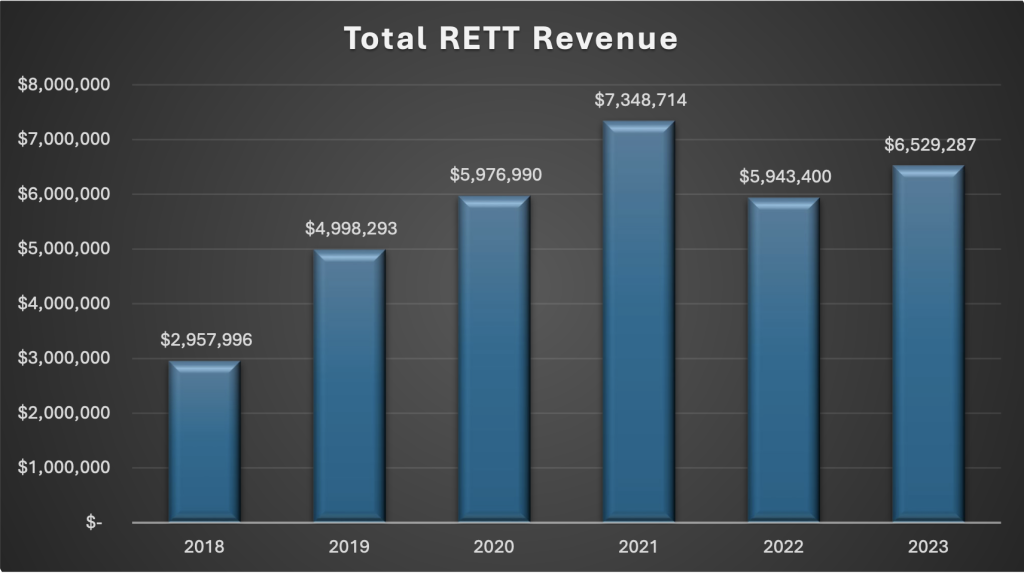
The numbers suggest that while homes are still being purchased in Avon, few buyers intend to use the location as their primary residence. In 2023, Avon approved just 10 primary residence exemptions to its Real Estate Transfer Tax, and since 2019, the town has only approved 11 exemptions for homes priced under $700,000.
“It’s also a little sobering that what’s really happening is that most people are priced out,” Heil said. “Avon used to be a place to buy, so we’re seeing much fewer transactions because people are priced out. On the other hand, we’re seeing much more on the community housing, deed-restricted side, and I think that trend will only continue,” he said.
Are the exemptions enough?
Given the high cost of purchasing a home in Eagle County — the median price for a townhome is nearly $1.4 million and approaches $1.8 million for a single-family home or duplex — some council members questioned whether even the new proposed exemption numbers were enough.
“I’m just wondering if the numbers are too low, in terms of the exemptions that we’re giving,” said Rich Carroll, Avon Town Council member.
Heil answered Carroll’s question with a counterargument.
“When we get to the $1 million to the $1.2 million, it’s really not an affordability issue, it’s more of a ‘welcome to Avon’ gesture,” Heil said. “Paying it or not paying it, or having half of it exempt, isn’t going to make much of a difference on someone who is able to purchase a $1.2 million house.”
Carroll also asked that a market-based formula for determining all of the exemption numbers be developed and updated regularly.
“I think there needs to be some consistent methodology in how we determine these exemptions,” Carroll said.
Other council members agreed with that suggestion.
Tamra Underwood, Avon mayor pro tem, suggested continuing for the time being with the presented numbers but creating a more consistent schedule for reviewing the exemption amounts.
“I would ask that we move forward with these numbers but then leave it to our town attorney that every even year, one of our departmental goals of finance should be to review it and update it and every two years, so that we’re keeping up, so that we don’t let it get stale like it did, because that probably did hurt some people, and that’s (the) opposite of what we’re trying to do here” Underwood said.
With the support of the council, Avon town staff will move forward with the updates to the Real Estate Transfer Tax exemption, and work toward a potentially more scientific model for updating the tax exemptions more regularly in the future.