Bookings, revenues drop as warm winter stalls tourism to Colorado
Colorado’s near historically dry winter means some skiers are setting their sights on other destinations — meaning lower bookings and revenues for mountain resorts


Chris Dillmann/Vail Daily
When the snow underperforms, so do luxury bookings.
This year’s winter has been underwhelming for Colorado. As the state’s near historically dry conditions draw fewer bookings to the state’s resort destinations, many are reporting lower occupancy and revenues.
While other western states like California, Nevada, Wyoming, Idaho and Montana have also seen less-than-average snowfall for the season, severely dry conditions and warm temperatures in Colorado have taken a higher toll on the state’s mountain lodging properties, according to Inntopia’s February market briefing report. Meanwhile, improved conditions in January among the other states have lured more skiers and visitors to their resorts.
“The other (western states) are actually falling short of average or normal snowfall, but they are doing better than Colorado and Utah,” said Tom Foley, director of business intelligence for Inntopia, a resort ecommerce and booking provider.
Even as open terrain has increased across participating regions, that doesn’t always directly translate into more interest from skiers due to additional factors like the quality of coverage, crowding and difficulty level, the report states. Some resort locations have resorted to advertising other outdoor and indoor activities to attract visitors.

Support Local Journalism
“The marketing efforts that are being put in place are having to be really dynamic and really nimble. There’s a bunch of messaging that has nothing to do with skiing, that’s saying, ‘Come on up, do a few runs. But by the way, mountain biking happens to be really good right now,'” Foley said. “A lot of the call to action now includes not just skiing, but off-mountain things to entice people to come up, which is unusual at this time of the year.”
Colorado vs. the rest of the West
Out of Inntopia’s 17 participating mountain destinations, approximately 60% comes from Colorado and Utah resorts, both of which saw “strikingly different” market trends compared to the rest of the West.
When looking at January data for all seven participating states, the impacts of light snowfall on winter tourism are predictable: overall seasonal occupancy dropped, daily rates softened and revenues dipped for the full western mountain region. The average daily rate dropped 4.2% for nights booked in January for arrivals from January through April and, when coupled with the lower occupancy, resulted in an aggregated $17.8 million decline in revenue for the month.
When separating Colorado’s data from the rest of the region, however, the losses are much more pronounced.
Data collected by DestiMetrics reveals occupancy in-the-bank and on-the-books for November through April — what is considered the winter season for tourism — is down 6.7% compared to last winter for Colorado and Utah, considerably below the slight 0.5% decline in the rest of the region.
Even in January alone, Colorado and Utah saw a 22.7% decline in occupancy pace, a dramatic plunge from the 2.6% decline recorded in December for arrivals in January through June. In comparison, mountain destinations in Inntopia’s other five western states enjoyed a strong 21% gain in occupancy pace — an improvement from the 7.3% decline in December.
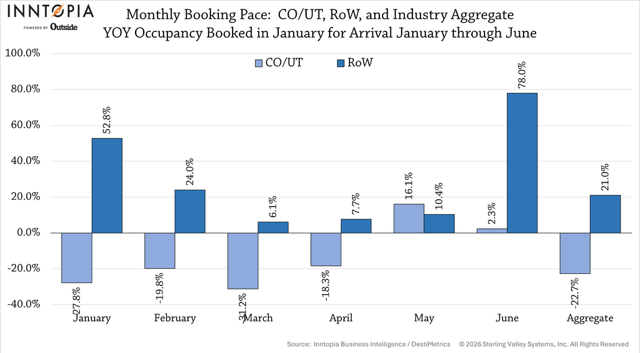
Compared to last year, bookings to Colorado are down 27.8% for the month of January and an even steeper 31.2% for March arrivals. January arrivals for the rest of the western region are up a whopping 52.8%, the report states.
“Snow is the story,” Foley wrote in the report. “While Colorado and Utah resorts have added terrain in the last month, the lack of natural snow is taking a toll. And while the rest of the West is also struggling with very warm temperatures and a lack of snow, an earlier snowpack and some reasonable early and mid-month snowfall has made a huge difference to both the consumer and the resorts’ ability to capture them.”
Reservations made in January were either for immediate visits — arrival that same month — or for much further out, with arrivals scheduled for May or June. Foley added that more people are also cancelling their bookings, though cancellations are having a smaller impact on occupancy than low bookings overall.
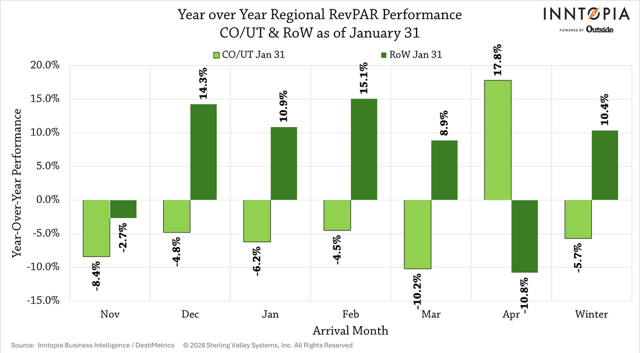
While Colorado and Utah did see some rate strength during the winter season — up a slight 1% from November through April — other western resorts capitalized on better snow to grow their average daily rate by 11%.
The impacts of these rates on revenue were almost immediate: Revenue for mountain resorts in Colorado and Utah are down a sharp 5.7%, compared to the 10.4% gain experienced by the rest of the region for the winter season.
In terms of absolute occupancy, though, Colorado is still outpacing all other states thanks to its wider inventory. Paid occupancy for January finished at 61.7% for Colorado and Utah, while the rest of the west finished at 55.7%, Foley said. Occupancy is also affected by the fact that there are more units available for rental in Colorado this year compared to last, which can suppress year-over-year occupancy rates.
“We think it has a lot to do with folks just not using their units, putting them in the rental pool, hoping to capture some revenue from it because bookings are down and they’re not looking at fabulous conditions,” Foley said. “Conversely, when we look at the rest of the West, we actually see that there are fewer units … available for rental. That actually is helping to bolster this year’s occupancy numbers.”
Foley said it’s possible there are fewer units available in other western states because owners are using their own units as snow conditions improve instead of putting them on the rental market and traveling somewhere else, though it’s too early to say for certain what the cause is.
“It is very much a supposition that it has to do with owners going to where the conditions are better to get their ski on … but more research is needed to see if the pattern continues,” Foley said.
Visitors set their sights on more affordable options
Booking data for January also shows economy properties are posting some modest gains compared to the moderate and luxury sides. Despite still being down year-over-year, economic properties across Inntopia’s participating destinations made up some lost ground on both occupancy and revenue during the month of January.
The average daily rate for economy properties up to $400 per night rose 0.8% with occupancy down 4.2%, the smallest decline in seasonal occupancy among the three tiers, according to the report. Occupancy for moderate properties priced from $401 to $750 per night dropped 7% for the month and luxury properties over $750 per night captured posted a 4.9% decline in occupancy despite a 2.9% increase in daily rates.
“The hypothetical question is, do economy properties benefit from poorer conditions where others might not?” Foley said. “People may be looking at poor conditions and saying, ‘I’ve got a kind of a subpar ski experience coming, I think I’m not going to spend as much money on my lodging.'”
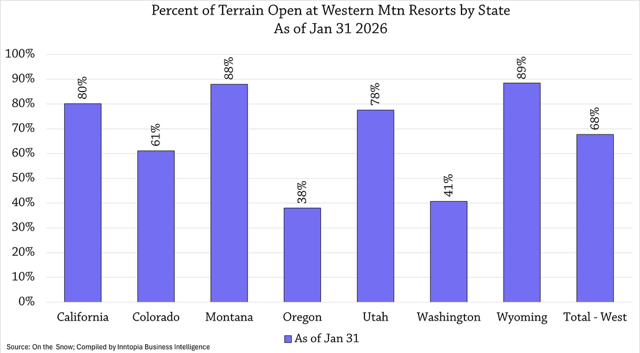
When a ski resort only has up to 60% of its terrain open, Foley added, odds are that black diamond runs are not open, since they’re typically the last to open and first to close as conditions worsen. This could also be a deterrent for skiers that would typically book more expensive stays.
“We know for a fact based on a study we did last year that advanced skiers, those who use (black diamond) runs, stay predominantly in high-end moderate or luxury lodging. And it may well be that with their terrain closed, they’re just not skiing. They’re just not going up to the mountains,” Foley said.
Another notable trend is the amount of time visitors are spending in resorts. Inntopia’s DestiMetrics data shows length-of-stay is currently at an aggregated 3.03 nights for the winter season so far — up .10 nights from the same period (November through January) last year.
“It seems small but that .10 improvement spread over tens of thousands of reservations really adds up,” Foley wrote in the report. “And longer stays are more efficient for lodging properties by extending the time between check-in and check-out as well as time spent on housekeeping.”
Not unlike what western resorts have seen over the past year, international visits remain down. Overall bookings from international markets fell 34% in January, driven by deepening declines from Western Europe, Oceania and Mexico. Canada saw some improvement by a slight 0.7%, but remains down 40.8% from last season.
“This is a widespread and profound issue that is impacting everything from coast to coast,” Foley said. “The only place where that is being mitigated perhaps is in the northeast, where conditions are good.”
Summer bookings are looking good … so far
As Colorado prepares to celebrate its 150th anniversary with events around the state, the question becomes whether summer tourism will help offset some of the visitation lost during the winter months. Fortunately, summer bookings are off to a good start.
“Everything booked in January was down as far as winter arrivals go, but bookings for arrival in May are up 16%. Bookings for arrival in June are up 3%. That’s people looking downfield,” Foley said. “Occupancy for the summer at this point is up just over 8% and (average daily rate) is pretty much in line with inflation, so the summer is looking strong. That may be — but we don’t really know yet — a benefit of a poor snow season.”
Room rates are typically lower during the summer and don’t drive the same revenue push as winter, so only time will tell if resorts will be able to make up some of their lost winter revenue.