Colorado joins nearly 2 dozen other states urging U.S. Postal Service to drop plan to restrict mail-in voting
Agency’s plan to implement President Donald Trump’s executive order to limit mail-in ballots remains, despite being struck down by federal judge

Robert Tann Follow

Chris Dillmann/Vail Daily
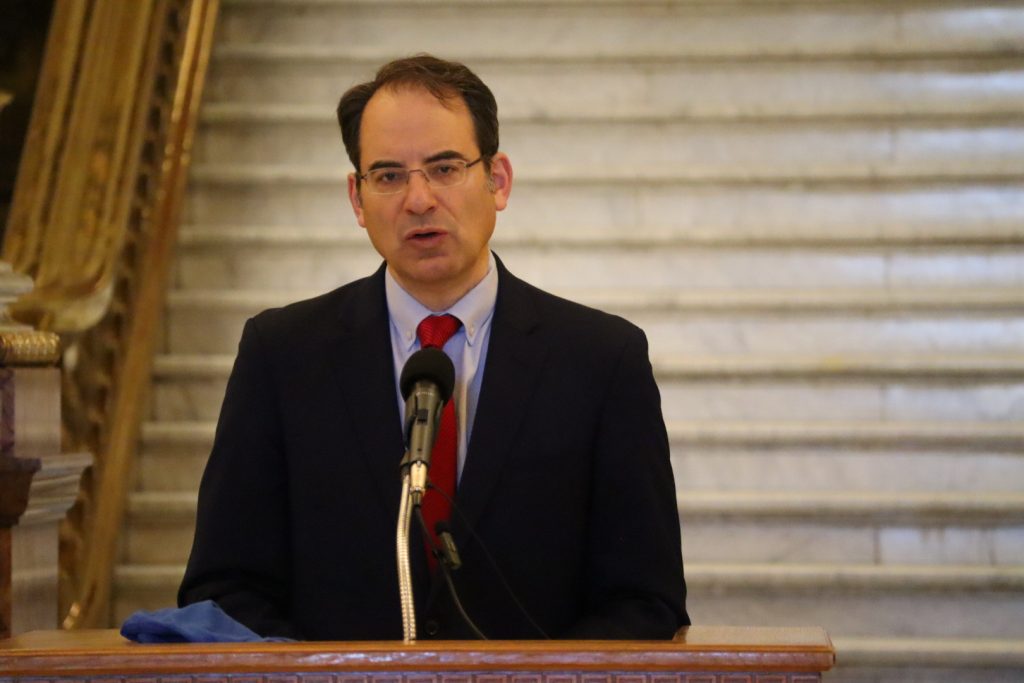
Colorado Attorney General Phil Weiser, alongside lawyers from nearly two dozen other states, is urging the U.S. Postal Service to abandon efforts to fulfill President Donald Trump’s executive order that aims to restrict mail-in voting for the 2026 midterm elections.
Trump signed the order on March 31, directing the U.S. Department of Homeland Security to compile a list of U.S. citizens based on federal databases and requiring the Postal Service to send mail ballots only to voters on that list.
The order places new requirements on how mail-in ballots can be sent to “enhance election integrity.” That includes mandating that states use unique identifiers on ballot envelopes, such as barcodes, “reducing the risk of fraud and protecting the integrity of Federal elections,” the order states.
It also directs the U.S. Attorney General to prioritize investigating and prosecuting state and local officials who send ballots to people who are deemed not eligible to vote in federal elections.
Voting rights groups opposed the order, which they characterized as federal overreach, while state and local election officials warned that complying would be a logistical challenge.

Support Local Journalism
In response to a lawsuit filed in April by Colorado and nearly two dozen other states, a federal judge on July 25 struck down the order, ruling that its provisions “unconstitutionally violate the separation of powers.” The Constitution gives states the authority to run elections and Congress the power to pass election laws.
The Postal Service, however, has not withdrawn its proposal to send ballots only to voters on an approved federal list, despite the judge’s ruling. Weiser, alongside Democratic attorneys general for 22 other states and Washington, D.C., submitted a joint letter to the Postal Service on July 2 opposing the plan via the agency’s open comment process.
In the letter, they argue that the proposed rule violates the federal judge’s recent order and conflicts with the Postal Service’s governing power and other federal election laws.
“This is another unlawful attempt by the Trump administration to seize control of elections that are administered by the states,” said Weiser, who is also the Democratic nominee for Colorado governor this year, in a statement. “Colorado is a national leader in secure, accessible elections, and we won’t stand by while the federal government tries to rewrite the rules and create new barriers for eligible voters.”
Colorado passed its mail-in voting law in 2013, sending mail ballots to every active registered voter in the state. Though voters still have the option to vote in person at polling centers, the vast majority of Coloradans choose to return their ballot by mail or at a drop-off box. Mail-in voting in Colorado has also been linked to an increase in voter turnout and accessibility, particularly among low-propensity voting groups
Trump has repeatedly claimed that voting by mail has led to mass fraud, saying that “cheating on mail-in voting is legendary” during a press conference at the White House shortly before signing the March 31 executive order.
A 2025 analysis by the Brookings Institution found that cases of fraud involving mail-in voting are very rare, with anywhere from six to 46 cases of mail-in voting fraud identified during the 2016, 2018, 2020 and 2022 general elections. That translates to about four instances of mail-in voting fraud for every 10 million mailed votes.
Trump is also pushing Republicans in Congress to pass the Safeguard American Voter Eligibility, or SAVE Act, which would require voters to provide specific documents to prove their citizenship. The legislation would also restrict mail-in voting, limiting it to people who are not able to vote in person because of a disability, military deployment or other reasons.
Trump and his supporters have argued the legislation is necessary to prevent election fraud, while opponents, including voting rights groups, say the provisions could suppress turnout in elections by putting up more barriers to voting.