Who is funding Republican and Democratic candidates in Colorado’s 3rd Congressional District race?
Notable donors and PACs are helping to shape the race for Republican Rep. Jeff Hurd’s seat
Robert Tann Follow
Courtesy photos
In the race to represent Colorado’s 3rd Congressional District, Democratic candidates are relying almost entirely on small donors and self-funding, while the Republican incumbent has raised a significant chunk from political committees and GOP warchests.
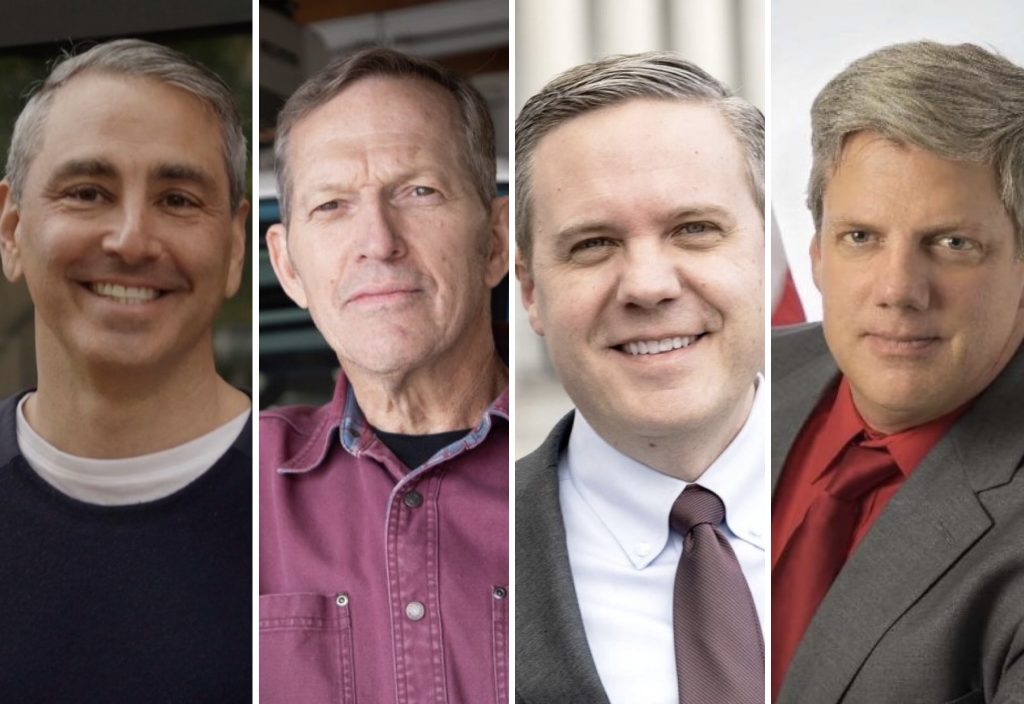
Voting is underway for the June 30 primary, in which Democrats Alex Kelloff and Dwayne Romero are vying to unseat Republican Rep. Jeff Hurd, who is facing his own primary challenger, former state lawmaker Ron Hanks.
The sweeping district stretches from the northwestern corner of Colorado throughout most of the Western Slope and also swings east to include Pueblo. While roughly half of its registered voters are unaffiliated, the district favors Republicans and hasn’t been represented by a Democrat since 2011. Hurd won his election in 2024 by nearly 20,000 votes.
Here’s a look at where fundraising stands for this year’s candidates, and where the money is coming from.
Alex Kelloff
Kelloff entered the race for Hurd’s seat in April 2025 and currently lives in the Aspen area. A businessman who co-founded Armada Skis and spent decades in the telecommunications industry, Kelloff’s family roots on the Western Slope date back to the 1890s.

Support Local Journalism
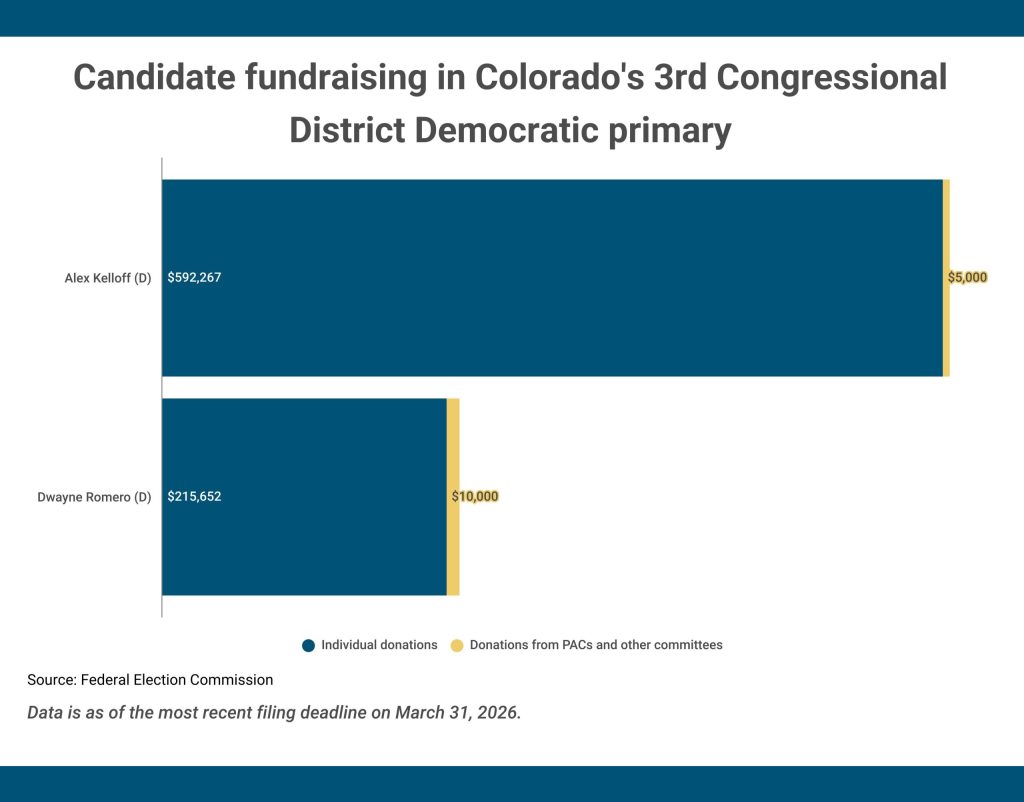
As of the end of March, the most recent filing deadline for congressional candidates, Kelloff had raised $1,047,267, more than twice that of his Democratic challenger, Romero. Of half of Kelloff’s funds — $592,267 — came from individual contributions, according to his filings with the Federal Elections Commission.
Kelloff has spent $589,205, with listed expenditures including payroll, travel, digital advertising and campaign research and consulting. He has raised $557,492 from Colorado-based donations, not including his own money. Another $450,000 raised by Kelloff was from money he loaned to his campaign.
Kelloff also received $5,000 from Common Ground PAC, a political action committee that supports more moderate Democrats running for Congress. PACs pool donations to help elect political candidates and support or oppose ballot measures, and are typically formed around shared business or ideological interests.
According to Common Ground’s website, the group is focused on “electing leaders that are focused on promoting economic opportunity, not partisan politics.” The PAC is led by U.S. Sen. Tim Kaine, a Virginia Democrat.
Notable donors to Kelloff’s campaign include former U.S. Rep. John Salazar, the last Democrat to represent the 3rd Congressional District, who served from 2005 until 2011. Salazar donated $500.
Kelloff also got $100 from Diane Mitsch Bush, a former state representative and Routt County commissioner, who was the Democratic nominee for the 3rd Congressional District in 2018 and 2020. Mitsch Bush lost both races.
Dwayne Romero
Romero is a 30-year Aspen-area resident who owns a real estate management company, Romero Realty. He is a former U.S. Army Ranger who has served multiple terms on the Aspen City Council and the Aspen School District Board of Education.
Romero, who jumped into the Democratic primary for the 3rd Congressional District in early March, has raised $505,781, of which $215,652 came from individual donations. He has spent $35,554, listing expenses like travel, software and consulting.
Romero raised $128,953 from Colorado-based donors, not including his own money.
He also took out $280,000 in loans for his campaign, and received $10,000 from Win the Center, a PAC founded by former Aspen City Council member Adam Frisch, a Democrat who nearly unseated Republican Rep. Lauren Boebert in 2022.
Boebert, who was running to represent the 3rd Congressional District for a second term, held onto her seat that year by just 546 votes. Frisch was set for a rematch with Boebert in 2024 until she switched districts, allowing Hurd to become the Republican nominee and eventual winner.
Win the Center is focused on electing moderate Democrats running in Republican districts, like Frisch. The group’s website states that most Americans are centrist and “that’s where Democrats must compete and win.”
Romero received a $1,000 donation from Frisch, as well as $2,500 from Robin Hickenlooper, the wife of Sen. John Hickenlooper. Romero in 2011 worked for Hickenlooper, who was Colorado’s governor at the time, serving several months as his economic development director.
Jeff Hurd
Hurd, a Republican who is based out of Grand Junction and served as an attorney before being elected to Congress, is running for a second term.
Hurd is being challenged for the Republican nomination by Hanks, a former Colorado lawmaker who served in the state House from 2021 to early 2023. Hanks entered the race in April following the most recent campaign finance deadline. He has yet to report any fundraising or spending to the Federal Elections Commission.
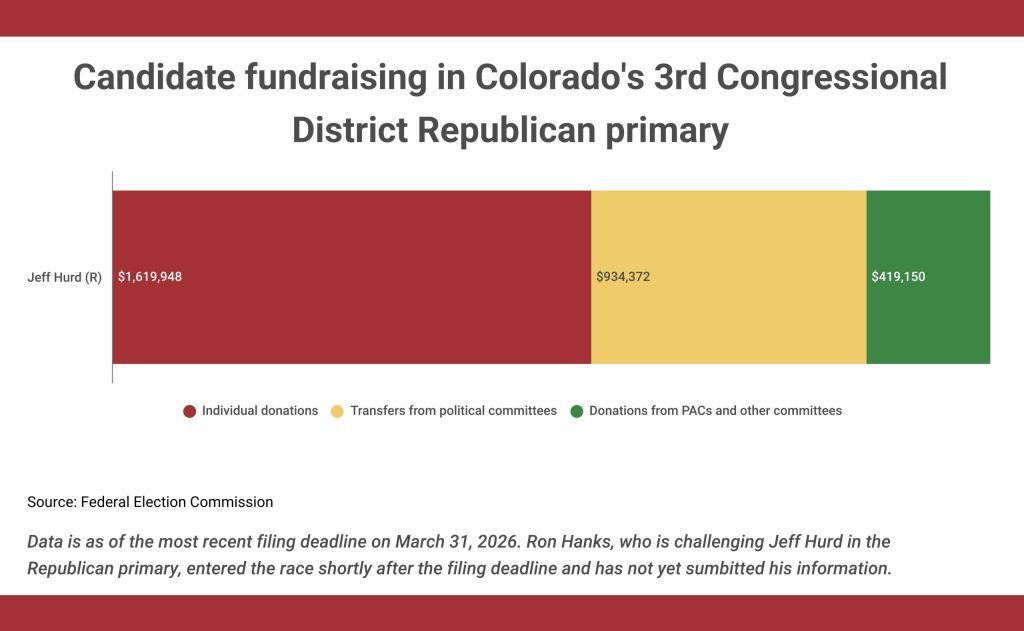
Hurd has raised $2,996,529, of which $1,619,948 has come from individual donations and $1,100,962 has been raised in Colorado outside of his own money. Hurd has spent $1,068,481 on expenses such as consulting, digital advertising, lodging and travel — including airfare.
Nearly half of Hurd’s funding, $1,353,522, has come from either PACs or committees formed to help Republicans keep and expand their majority in the U.S. House.
Hurd received $525,571 from Grow the Majority, a fundraising committee formed by House Speaker Mike Johnson, a Louisiana Republican, to funnel money to House Republican candidates. Hurd also received $302,987 from Defend Our Majority, a similar fundraising group that aims to protect Republican incumbents in the House.
Hurd raised a total of $419,150 from PACs and other committees. Those include PACs aligned with industries such as healthcare, real estate and oil and gas.
Hurd received $3,500 each from PACs associated with the health insurance company UnitedHealth Group and the American Hospital Association. He also received $3,000 and $2,000, respectively, from PACs associated with the National Association of Realtors and the Associated Builders and Contractors.
Other PAC contributions include $1,000 each from the Diversified Oil and Gas PAC, the Natural Fuel Gas Company PAC and the American Gas Association PAC, as well as $1,000 from a PAC associated with the National Rifle Association. Hurd also received $62,500 across multiple donations from the American Israel Public Affairs Committee, which lobbies for U.S. support for Israel.
Among Hurd’s notable individual donors is Philip Anschutz, a business mogul whose enterprises span energy, sports, entertainment, news and other industries. As of 2025, Anschutz had a net worth of $16.9 billion and was the richest individual in Colorado, according to Forbes.
Anschutz, who is a high-profile donor of conservative candidates and causes, gave $7,000 to Hurd’s campaign.