Coloradans are seeing some relief at the pump as gas prices trend downward, but will it last?
Average gas prices in Colorado have been falling for over two weeks, but the trend has yet to catch up to Western Slope service stations
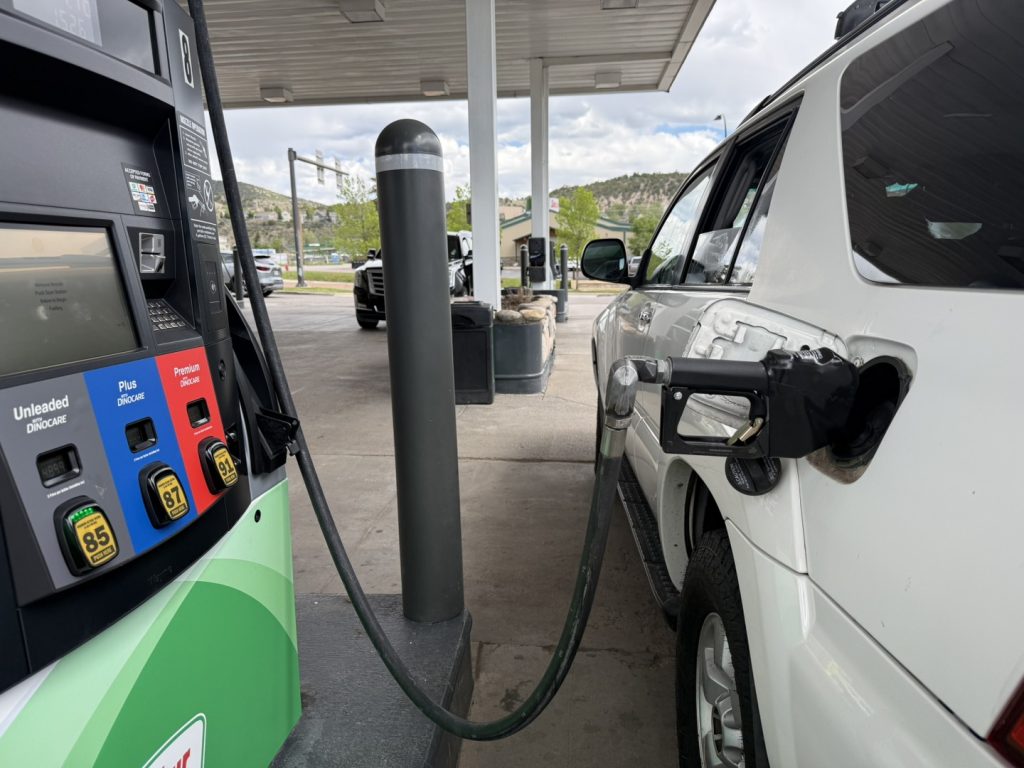
Ali Longwell/The Aspen Times
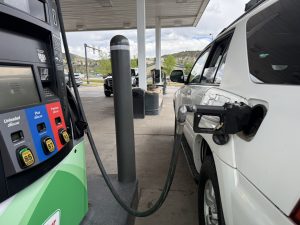
Following months of climbing gas prices, Coloradans are seeing some relief at the pump just in time for summer’s peak travel season. For Western Slope counties, however, this relief has been slow to arrive.
Gas prices soared to multi-year highs in May, with GasBuddy’s vice president of petroleum analysis Patrick De Haan predicting that Colorado was on track to surpass its $5.02 record for regular unleaded gasoline, set in June 2022 amid heightened post-pandemic demand and supply constraints driven by Russia’s invasion of Ukraine.
“With today’s hike in Colorado, it’s likely the state is on its way to a new all-time record for gas prices. The previous record was $4.89/gal in 2022, and once averages catch up to today’s spike to $4.99, I believe a new record will be set,” De Haan wrote on X on May 18.
The new record never materialized. Instead, gas prices in Colorado have been on a slow decline over the past two weeks, along with the rest of the country.
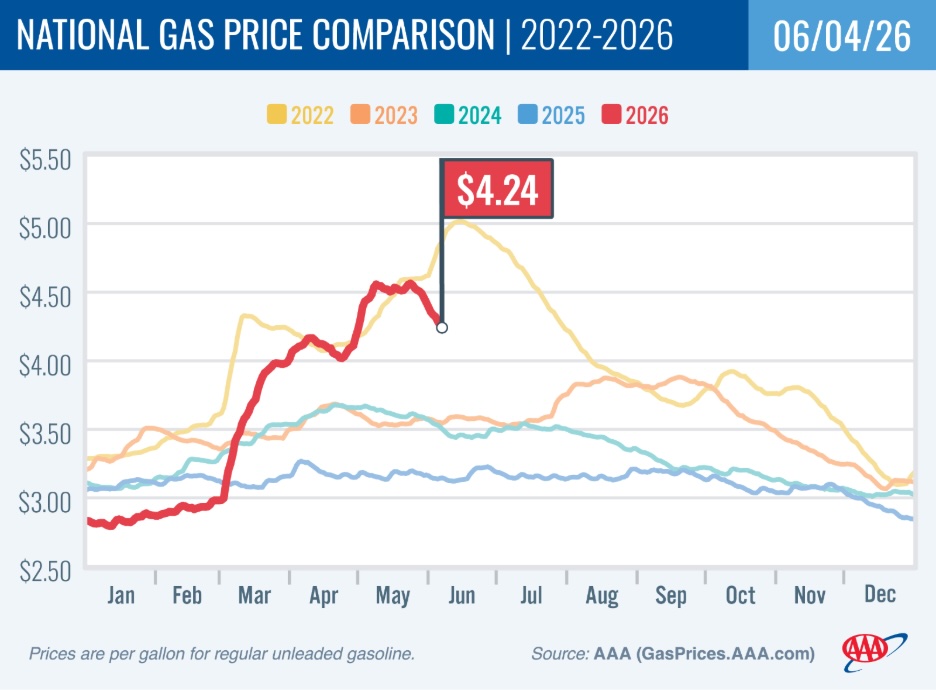
The national average for a gallon of regular gasoline fell 16 cents to $4.216 on June 8 compared to a week prior, marking more than two weeks straight of decline, according to a news release from the American Automobile Association.

Support Local Journalism
In Colorado, average prices are sitting at around $4.15 as of Monday, June 8 — down 19 cents from one week ago. This puts the state barely below the national average, thanks to Colorado seeing a more significant drop in prices compared to its western neighbors.
Skyler McKinley, the Colorado regional director for the American Automobile Association, said the state’s escape from the higher half of the price scale is partially due to “some slowdowns in production locally that we’ve now caught up to.” This, he added, has prompted broader talk in the Colorado oil industry about state-specific impacts to production.
“That also explains why the Colorado price has fallen and now remains roughly level with the national average despite having been above it,” McKinley said.
The drop in prices across the country follows changes to crude oil prices, which dipped below $100 per barrel in May after experiencing its biggest monthly drop ever. As of June 4, U.S. crude oil inventories are around 3% below the five-year average for this time of year, though gasoline demand has also decreased.
McKinley said the drop in crude oil prices largely stems from hope among speculators and major oil tanker operators that more ships will soon be able to traverse the Strait of Hormuz. News headlines surrounding the U.S.-Israel war with Iran are what will ultimately determine whether prices continue to drop, or spike back up again.
Because uncertainty lingers over when the Strait of Hormuz will fully reopen and resume traffic, the news release said oil prices will likely not decrease dramatically as summertime gasoline demand rises. Seasonal pressures have historically caused prices to march upward toward the end of June and into July, which could happen again independent of the war, McKinley said.
“Those trends are probably still at play, but they’re not as meaningful in moving the price of crude oil as a headline that suggests that peace is near, or that a conflict shall continue,” he said. “This is one of the great paradoxes of the global economy. What you pay in Pitkin County is driven in part by what happens in Iran. This is why it behooves (drivers), I think, to pay attention to the headlines.”
Unfortunately for Western Slope drivers, the drop in average gas prices hasn’t caught up with most rural towns. As of June 8, Garfield, Eagle, Routt and Pitkin counties are still charging prices between $4.78 and $5.72 for regular, unleaded gas.
Glenwood Springs currently lists an average per-gallon price of $4.80, down 9 cents from one week ago. While McKinley said prices will “trend downward eventually” in Western Slope counties, the decrease will likely be slower.
Summit and Grand counties are the exception, where average gas prices are sitting at $3.86 and $4.45, respectively.
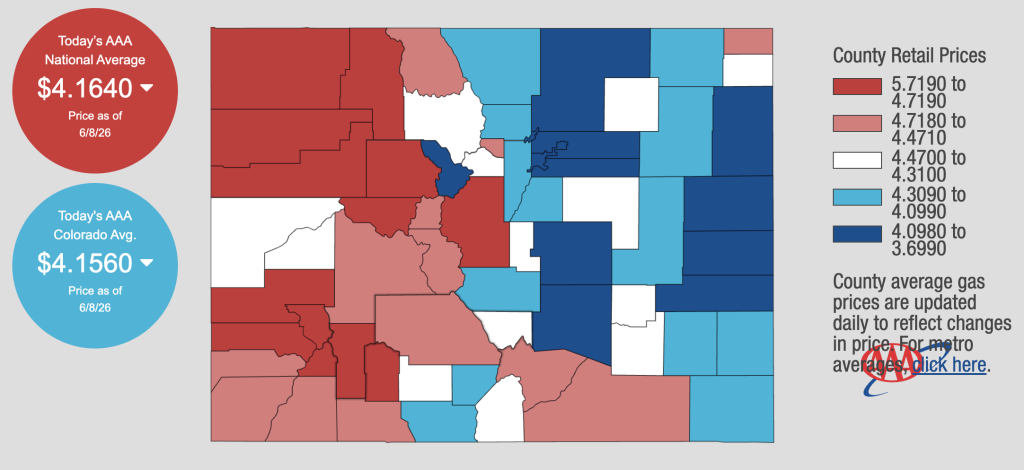
Gas prices are typically more expensive on Colorado’s Western Slope due to a variety of factors — namely increased costs from the labor and resources required to transport gasoline through the mountains and less competition between service stations in rural areas.
Another reason has to do with the lower speed at which gas drains from tanks in towns with smaller populations. Service stations in these towns are often already paying for gas at a higher rate and have to factor in slower revenue flow in their prices, McKinley said.
“You’ll always be more expensive than the Front Range. When it comes to the rate at which prices fall, you’ve got all that inertia in the way, and in some cases it’s the Rocky Mountains,” he said. “There’s not a race to lower prices because they’re all trying to get made whole on what they paid.”
McKinley, who owns the Oak Creek Tavern, said he currently pays close to $5.20 for gas in south Routt County.
“It goes back to that factor — there’s only one service station in my town,” he said. “There’s no competition, and so they can mark up for that convenience factor.”
Unstable gas prices over the last several months have created a renewed interest in electric vehicles, McKinley said. A similar trend occurred in 2008 when the Great Recession created a surge in demand for fuel-efficient alternatives, speeding up the development of electric and hybrid vehicles.
Colorado is currently listed as one of the top 10 least expensive states for public charging per kilowatt hour at 37 cents. Xcel’s summer rate hike, however, is expected to translate to higher prices at charging stations. Additionally, the utility company’s proposed settlement would grant its largest electric rate increase ever, raising the average monthly household bill by roughly 6%.
McKinley said current prices are not anticipated to have an immediate impact on domestic summer travel. This is good news for the many tourism-based economies on Colorado’s Western Slope that are relying on an active summer to make up for lost revenue from the slow winter season.
“Folks in the high country … we’re all mindful that we want it to be a robust summer to make up for a lacklustre winter,” McKinley said. “A leading indicator will be if customer counts are lower because of gas prices, (but) I have not seen that happening in our data yet.”