Bill expanding Colorado’s ‘red flag’ gun law sails through state Senate, heads to House
Measure is poised to pass the Democratic-controlled House, teeing it up for Gov. Jared Polis’ signature

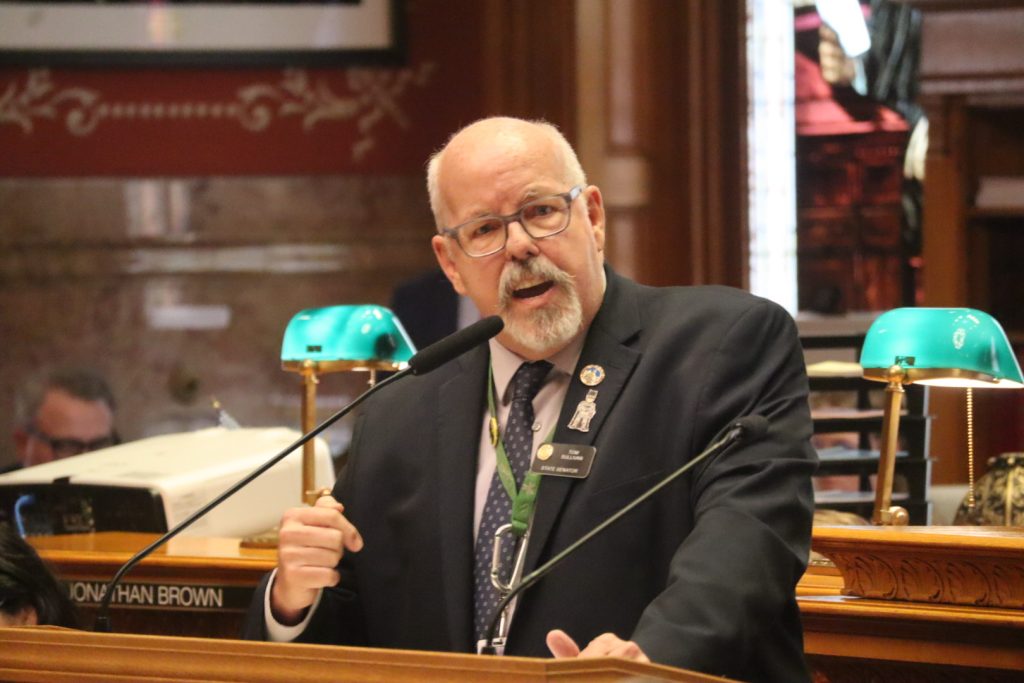
Robert Tann/Vail Daily
The Colorado Senate voted nearly along party lines Tuesday to pass a bill expanding the state’s “red flag” law that lets judges temporarily remove someone’s guns.
Senate Bill 4 now heads to the House, where Democrats hold a 43-22 majority and are expected to pass the legislation amid Republican opposition. That means the bill is all but assured to reach Gov. Jared Polis’ desk.
The measure expands a 2019 law that allows law enforcement officers and family members to petition a judge to remove someone’s firearms for up to one year if they believe that person is a threat to themselves or others. The petition is known as an extreme risk protection order.
The red flag law was updated in 2023 to add teachers and healthcare professionals, like doctors, to the list of people who can file a petition. This year’s bill would further broaden the scope by adding entities, not just individuals, to that list, including health care and behavioral health treatment facilities, K-12 schools and colleges.
Polis’ office signaled the governor supports the bill, with spokesperson Eric Maruyama saying in a statement, “Colorado’s red flag law has shown success since its implementation in 2020, and the governor is open to finding ways to further strengthen it.”

Support Local Journalism
Proponents say the measure will save lives by both preventing gun violence and suicide.
“The people in our state, in my community, are asking us to do more,” said Sen. Tom Sullivan, D-Centennial, during debate on the Senate floor Tuesday. “… We’re doing more. We’re saving lives. We’ll continue to do that.”
Sullivan, a prime sponsor of SB 4, has championed several gun control measures in the state legislature, including the original red flag law. His son, Alex, was killed in the 2012 Aurora theater shooting, and Sullivan has made reducing gun violence his chief concern since first being elected to the Senate in 2018.
The bill faced a smoother path through the Senate compared to some of last year’s more sweeping gun control measures.
A 2025 bill sponsored by Sullivan that sought to ban the sale of most semiautomatic guns resulted in a roughly 8-hour debate that began the afternoon of Feb. 13 and lasted until around 2 a.m. on Feb. 14. It also faced initial skepticism from Gov. Jared Polis, prompting a major amendment to secure his signature. Even with the amendment, which allows people to buy guns so long as they undergo training and acquire a permit, the bill lost five Democratic votes in the Senate.
By comparison, the bulk of SB 4’s floor debate, most of which happened on Monday, lasted a few hours, and only one Democrat, Sen. Nick Hinrichsen of Pueblo, ultimately voted against the bill Tuesday. It also received minimal amendments.
Senate Republicans were uniformly opposed to SB 4, which they said was an infringement on Second Amendment rights. Republicans also argued the bill would lead to an increase in unfounded petitions and add to courtroom costs.
“Under the guise of public safety, it threatens to expand the already burdensome Extreme Risk Protection Order system in ways that will inflict unnecessary harm on innocent citizens, strain our taxpayer dollars and erode the very fabric of trust in our institutions,” said Sen. Lynda Zamora Wilson, R-Colorado Springs.
An analysis of SB 4 by the nonpartisan Legislative Council Staff notes the state already allocated additional resources for departments in 2023 to handle more petitions after the law was expanded to include teachers and health care professionals. The analysis assumes that giving petitioning power to entities and employers of community members who can already file a petition will have a minimal fiscal impact on the state.
State data shows that expanding the red flag law did not lead to a surge in new petitions.
Between 2022 and 2023, the year the law was expanded, the number of petitions rose from 156 to 171. They decreased slightly to 164 in 2024, according to statistics from the Colorado Office of Gun Violence Prevention.
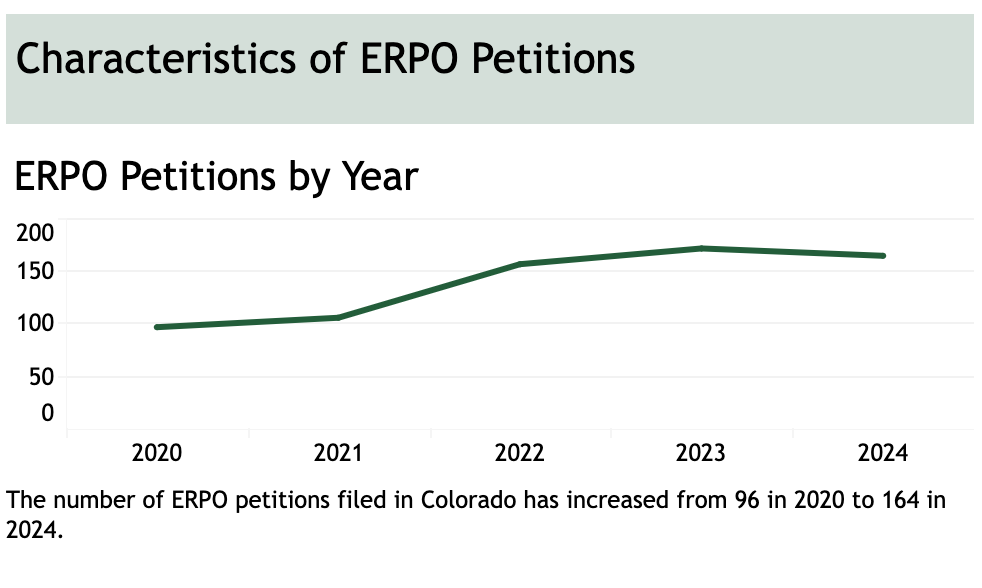
There were 692 petitions filed in total between 2020 and 2024, 478 of which resulted in temporary firearm removal for at least two weeks. Petitions from law enforcement also have a much higher chance of approval. As of 2024, more than 80% of law enforcement petitions have been approved, compared to just 22% for non-law enforcement petitioners.
For unsuccessful petitions, nearly 70% were denied because they failed to meet the burden of proof.
Sullivan said Republicans have created a “fear factor” around the state’s red flag law by claiming it will lead to broad gun confiscation of law-abiding citizens. He said the data doesn’t support that narrative.
“This is the same rhetoric we heard in 2019,” Sullivan said.
Sullivan is sponsoring another measure, Senate Bill 43, alongside other Democrats, that seeks to ban gun barrel sales by non-federally licensed firearm dealers. The bill is awaiting its first hearing.