Colorado’s snowpack takes ‘massive nosedive’ amid a ‘record-smashing’ heatwave
As nearly the entire state set record-high March temperatures, one Colorado mountain town crushed its previous all-time monthly high by 8 degrees

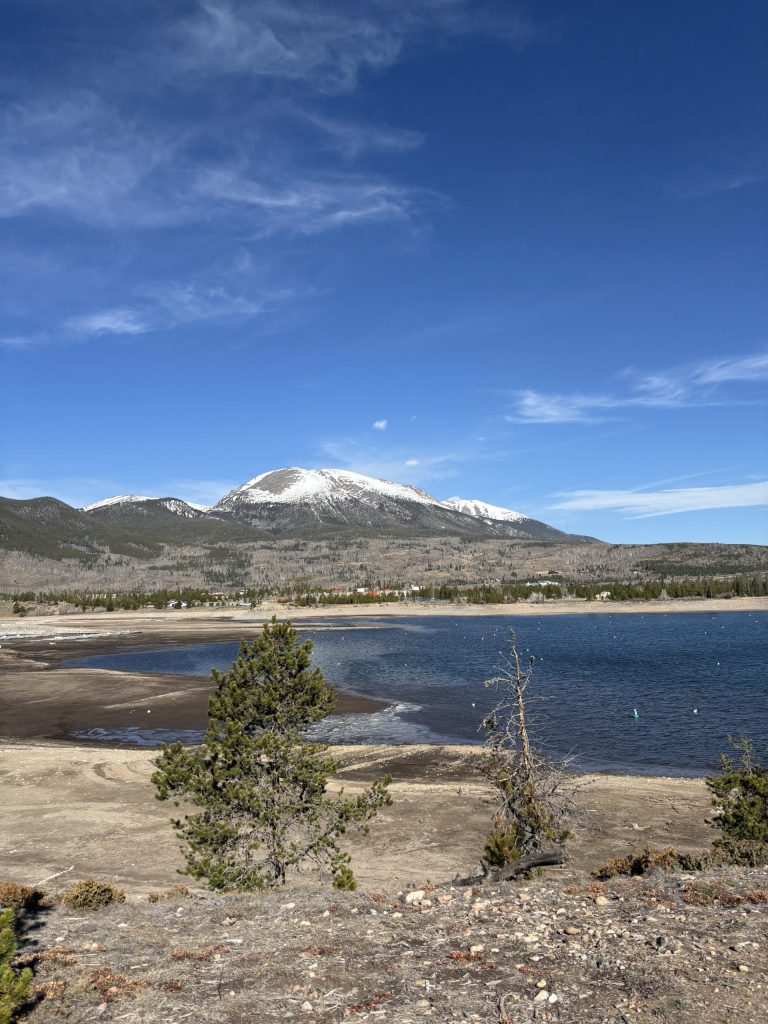
As Colorado’s snowpack tracked near record-lows all winter long, state climatologists pointed to two previous winters that had potentially been worse than this year: the seasons of 1976-77 and 1980-81.
Now, after an “unprecedented” spring heat wave, the Colorado Climate Center says the state is probably experiencing its worst snowpack on record for this time of year, worse even than those two historically bad seasons for snowfall.
“Throughout much of the winter, the story has been that this year’s snowpack is very bad, but it hasn’t been quite as bad as the winters of 1976-77 and 1980-81,” Colorado Climate Center Engagement Climatologist Allie Mazurek wrote in a blog post. “However with last week’s rapid early-season melting, conditions have deteriorated further.”
Colorado’s modern snow telemetry, or SNOTEL, system has indicated for most of the season that the snowpack is the worst in decades in many parts of the state. However, that system only dates back to the early 1980s, and doesn’t include those two historically low-snow winters.
So, to make comparisons to 1976-77 and 1980-81, climatologists have relied on snowpack data that has been collected manually since the 1930s, through a technique known as snow courses. Snow courses have been taken on the first of each month at several locations in Colorado for decades.

Support Local Journalism
While February and March snow course data suggested that this winter had only the second or third worst snowpack on record in most parts of the state, Mazurek said that the April 1 snow course data could show the lowest snowpack on record for this time of year in Colorado.
“We’ll wait for official confirmation from snow course data at the end of the month,” she said, “but current data suggests that we’re now sitting at Colorado’s worst snowpack on record, surpassing the winters of 1976-77 and 1980-81.”
Spring heatwave smashed records across Colorado
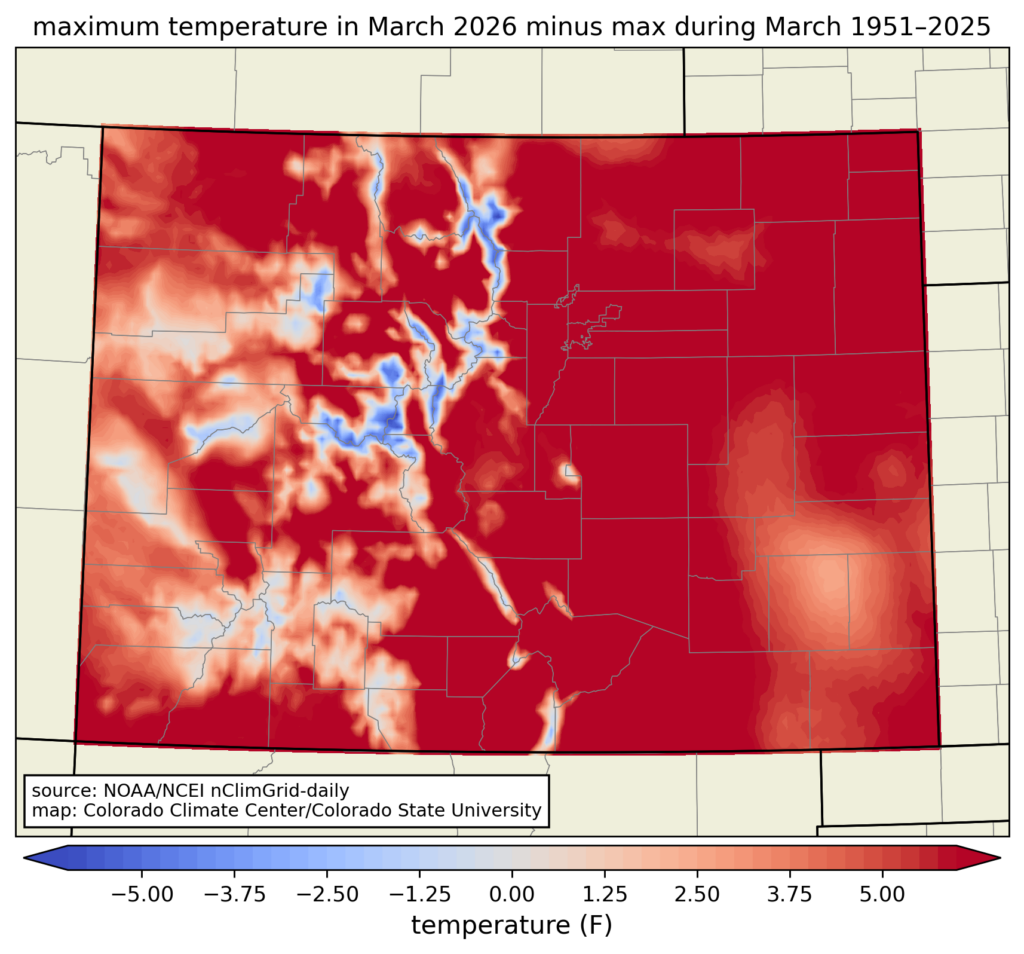
The heat wave that Colorado, and much of the West, experienced through the tailend of March has been “record-smashing, extraordinary and impossible to ignore,” Mazurek said. For pretty much all of Colorado, she said the heatwave brought the warmest March temperatures ever recorded.
During the height of the heatwave, from about March 18-21, locales across Colorado smashed all-time record high temperatures for the month of March, often by 5 degrees Fahrenheit or more, according to the blog post.
“The kind of heat that we saw last week across Colorado is more typical of June or even July,” Mazurek said.
National Weather Service data shows that one weather station in Dillon with a record dating back to about 1910 set an all-time March high of 71 degrees twice this month. That’s 8 degrees higher than the previous all-time March high of 63 degrees set in 2012.
Crested Butte and Fort Collins, meanwhile, demolished previous all-time high March temperatures by 10 degrees, according to the Colorado Climate Center. Steamboat Springs this month also set a new monthly high temperature of 76 degrees, six degrees above the previous record of 70 degrees.
Putting “an even bigger exclamation point on these incredible records,” Mazurek noted that most of the Front Range and parts of the San Luis Valley not only set all-time records for March, but also saw warmer temperatures than their all-time records for April.
The all-time March record for Colorado of 96 degrees at Holly in 1907 was not broken — but it was tied at numerous locations across the state, including La Junta, Burlington, Campo and Walsh, she said.
The “long-lasting, remarkable heatwave” that Colorado experienced this month was “far beyond anything we’ve ever seen in March,” Mazurek said. She noted that not only was it significantly hotter than it had ever been, the heatwave also lasted for over a week, with “each day being warmer than the last” during its height.
At the Dillon weather station, for example, the high temperature first broke records when it hit 65 on March 19. Then, temperatures continued to climb for days. On March 20, it hit 67 degrees. The next day, it hit 70 degrees. On March 22, the high temperature peaked at 71 degrees.
The record-warm temperatures didn’t stop there. Over the 12-day period between March 19 and March 30, the daily high temperature in Dillon only dropped below the previous record of 63 degrees on two days, according to the National Weather Service data. The high temperature hit 71 degrees for a second time there on March 26.
With almost the entire Western U.S. trapped under the same record-shattering heat dome, climate scientists have found that the heatwave would have been “virtually impossible without human-induced climate change.”
Heatwave fueled rapid snowpack meltoff
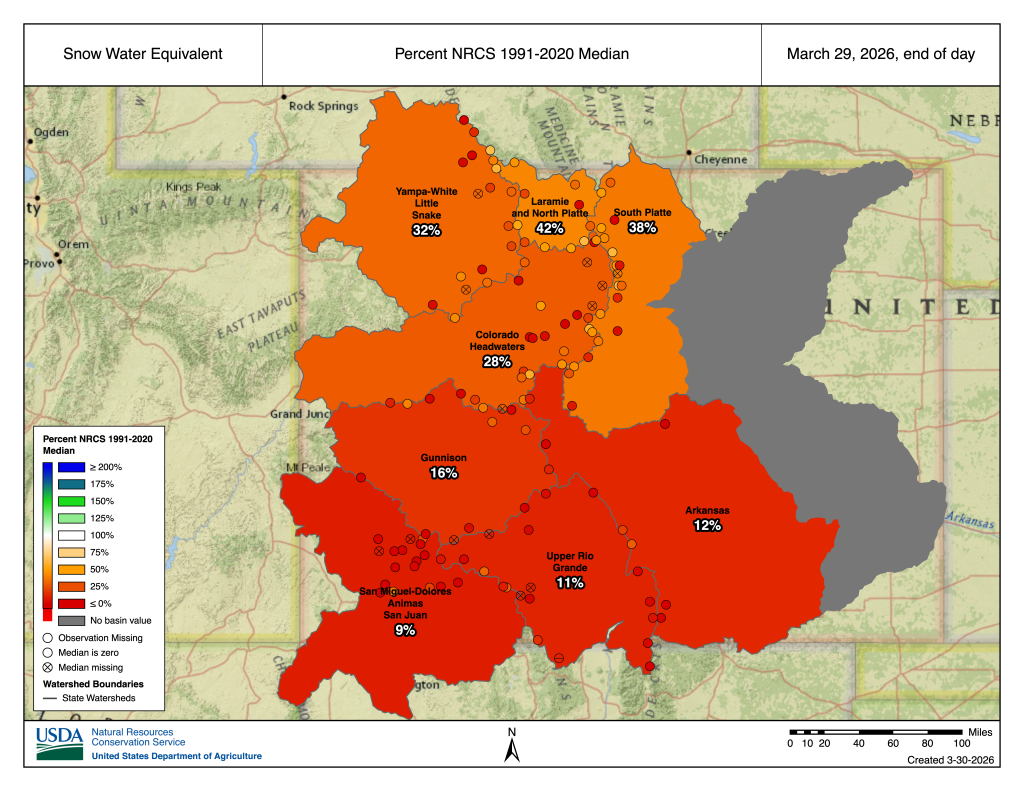
With Colorado’s snowpack already sitting near historical lows nearly all winter, Mazurek said the extended period of extremely hot temperatures this month has “exacerbated an already bad situation” as it has fueled a rapid melt off.
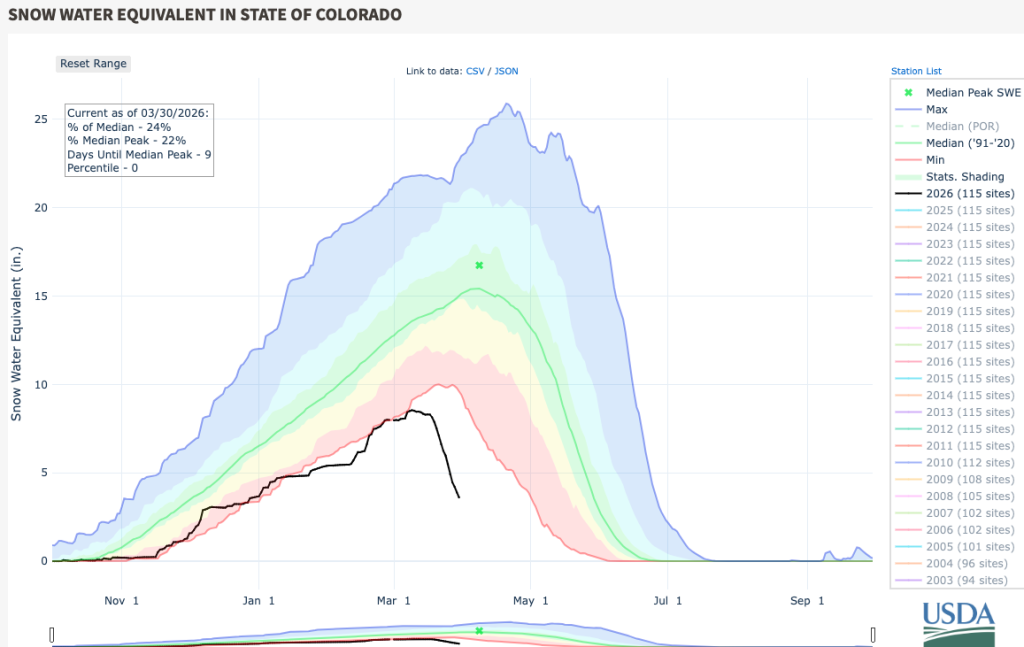
On average, Colorado’s snowpack peaks on April 7, so the state should still be adding to its snowpack throughout the month of March, Mazurek said. But this year, she said that the state’s snowpack has probably already peaked and the heatwave has driven a “massive nosedive” in the state’s snowpack.
“We typically don’t see snowpack melt this quickly until May,” Mazurek said, “so to observe this trend so early in the season is highly concerning.”
Over the roughly two-week heatwave, the snow telemetry data shows that Colorado’s statewide snowpack has declined by more than 50%, losing just shy of 5 inches of snow-water equivalent, from a peak of 8.5 inches. Statewide, the snowpack for this time of year is just 24% of normal, according to the data.
In part due to the low snowpack, drought conditions are continuing to spread across Colorado. More than 75% of the state is experiencing at least moderate drought, or Level 1 of 4, while the northwest corner of Colorado is experiencing extreme drought, Level 3 of 4, and exceptional drought, Level 4 of 4, according to the latest U.S. Drought Monitor report.
Mazurek noted that the “consequences from the low snowpack are growing.”
Colorado Gov. Jared Polis has activated that state’s Drought Task Force for the first time since 2020 and some water managers, like Denver Water, have begun to implement water restrictions for their customers.
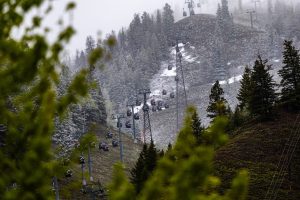
Across the mountains, ski areas are closing early due to the melting snowpack and communities are preparing for a wildfire season that could be made more dangerous by the drought conditions.
Looking ahead, Mazurek did note “one piece of potential good news” — Colorado could be in for a pattern shift that could bring more precipitation. According to the National Weather Service, the state has above-normal chances of precipitation over the next two weeks.
“While the moisture won’t be nearly enough to make up for the major deficits we’ve seen accumulate over the last several months, I think we can all agree that we’ll take anything we can get,” she said.