Wolf activity condenses in northwest Colorado as one wolf explores in the south
As denning season is underway, the agency has not confirmed any new breeding wolves

MonthlyCollaredWolfActivityAreaMap_March2026_Final
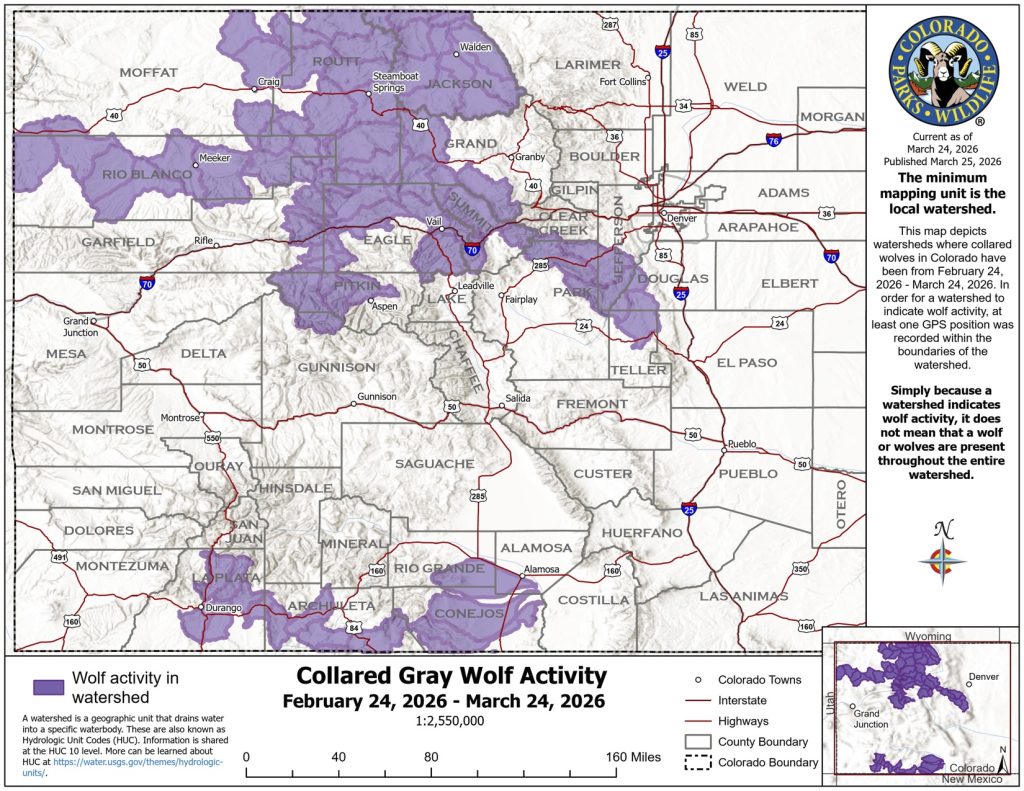
As denning season begins, Colorado’s collared gray wolf activity has condensed into pockets of the state’s northwest and southwest counties.
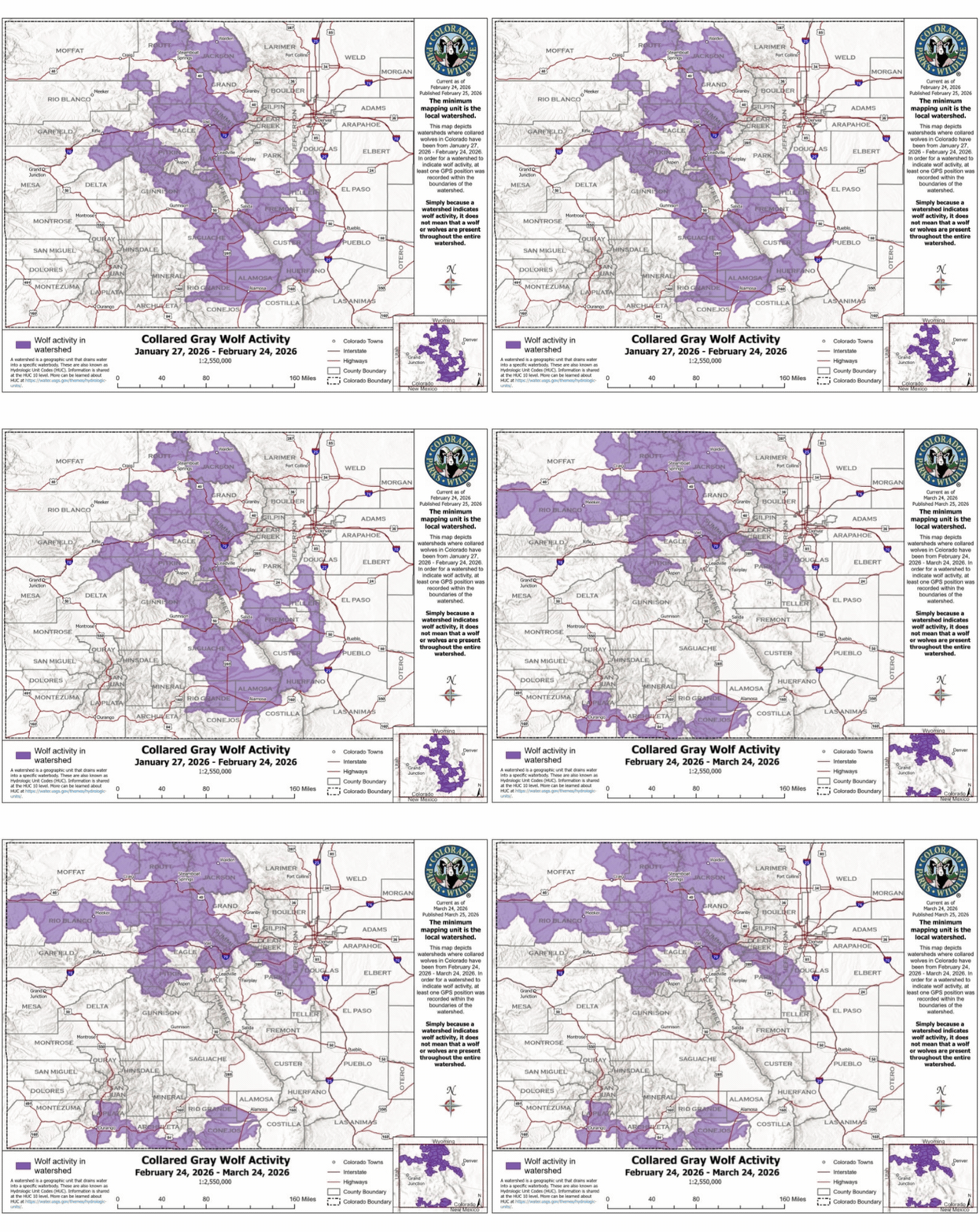
This is according to Colorado Parks and Wildlife’s latest wolf activity map, which shows the watersheds where the state’s collared wolves were located between Feb. 24 and March 24. Compared to the previous month, the activity appears to be isolated into the northernmost and southernmost regions of the Western Slope, with no movement highlighted through the middle of the state.
In the northwest, activity continued in watersheds touching parts of Rio Blanco, Routt, Jackson, Grand, Summit, Eagle, Pitkin and Garfield counties. In Rio Blanco and Moffat counties, this activity stretched further west than the prior month, including a watershed touching the Colorado-Utah border. In the northernmost stretches of Routt, Jackson and Moffat counties, this included more watersheds bordering Wyoming than in February.
According to Parks and Wildlife, one wolf was moving through watersheds near Colorado’s tribal lands in the southwest. The map shows activity in a pocket of southwest Colorado, brushing up against watersheds bordering the state of New Mexico. This included watersheds around Durango in La Plata County, as well as those stretching between Archuleta, Conejos and Rio Grande counties. The agency reported similar activity by a single wolf in January.
The agency has an agreement with the Southern Ute Indian Tribe that guides management of the gray wolves on the tribe’s lands, spanning La Plata, Archuleta and Montezuma counties along the New Mexico border. The agency does not have an agreement with the Ute Mountain Ute Tribe and its tribal land within Montezuma and La Plata counties, but has reportedly been finalizing the agreement for several months. These agreements will also apply to the Brunot Treaty Area, which spans 3.7 million acres in the San Juan Mountains.

Support Local Journalism
In addition to these Western Slope counties, the March activity map shows some gray wolf activity in watersheds brushing up against the Front Range, including in Park, Jefferson, Douglas and Teller counties. Parks and Wildlife reported that “no wolves have crossed I-25 or spent time near urban centers.”
If a watershed is highlighted, it means that at least one GPS point from one wolf was recorded in that watershed during the 30-day period. GPS points are recorded roughly every four hours.
The map only shows activity within the state of Colorado. If Colorado’s gray wolves leave the state, different rules apply depending on where they go. Parks and Wildlife has an agreement with Utah, New Mexico and Arizona in which any gray wolves from Colorado that enter these three states can be captured and returned to the agency. Only one wolf has been returned this way after traveling into New Mexico in December.
Wolves that travel into Wyoming lose their federal and state protections and can be hunted in the vast majority of the state. Three of Colorado’s collared gray wolves have died in Wyoming, including two that were legally hunted and one that was killed by the U.S. Wildlife Services after it was tied to the death of five sheep.
An update on Colorado’s wolf population
Parks and Wildlife said that the map shows both “broad movements” from some wolves, while others in packs that have established territories are moving less widely.
In March, the King Mountain wolf pack’s matriarch died, six weeks after the pack’s patriarch died during a collaring operation in Routt County. The pack reportedly had four pups, one of which is collared. Luke Perkins, a public information officer for Parks and Wildlife, said it remains to be seen whether the pups will stay together or separate following both adult wolves’ deaths.
“The almost full-grown pups are nearly a year old, have been learning how to hunt from the adults this winter, and will continue to hone those skills,” Perkins said. “CPW will continue to monitor the one pup in the pack that is collared, but is reliant on field observations to confirm the status of the pack as a whole.”
The King Mountain matriarch’s death was the third this year and the 13th of the 25 wolves Colorado has translocated as part of its gray wolf reintroduction effort.
Of the 12 surviving reintroduced wolves, six are part of a breeding pair. Eight are female and four are male. The four surviving wolves born to the Copper Creek pack in 2024 — three males and one female — have reportedly dispersed from their pack. This could mean there are at least 10 dispersing wolves in Colorado. These counts do not include the number of pups born in 2025, which Parks and Wildlife has said will be reported in the next annual wolf report.
The map also coincides with the start of wolves’ denning season, which typically begins in mid-March and can peak in April and May.
The wildlife agency said as denning begins, it is “working closely with producers to proactively deploy various resources on operations with localized wolf activity nearby,” including four deployments of fladry — or bright colored flags meant to deter wolves from attacking livestock — in northwest Colorado and “multiple others” being planned.
The state’s four known packs are all located in northwest Colorado: the Copper Creek Pack in Pitkin County, the King Mountain Pack in Routt County, the One Ear Pack in Jackson County and the Three Creeks Pack in Rio Blanco County.
Perkins said that the agency has not confirmed any additional breeding pairs this spring, as of March 25.
In 2025, the agency waited until the end of denning season in May to announce that it was tracking possible den sites. The agency confirmed in June that there were three new wolf packs in addition to the existing Copper Creek pack.