Opening of Avon Whole Foods slated for fall 2027, developer estimates
Avon reviews progress for 40-acre parcel of Village (at Avon)

Town of Avon/Courtesy image
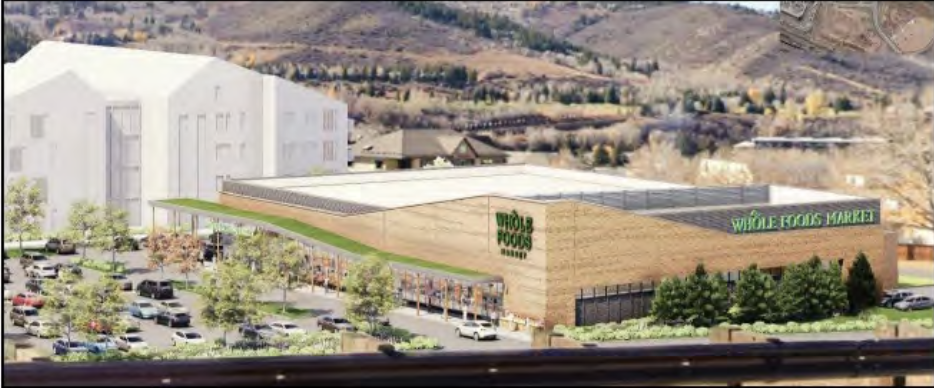
Dirt has been moving at the west end of the Village (at Avon) for months in preparation for construction to begin on the 6-acre parcel that will bring a Whole Foods to Avon in fall 2027.
The Village (at Avon), which is owned by the land investment company Traer Creek, was annexed into Avon in 1998. In its entirety, the property spans 1,800 acres and includes the 244-unit Buffalo Ridge affordable housing complex, the Walmart Supercenter and the Maverik gas station.
Two projects currently under construction on the east end of the Village (at Avon) — the 242-unit Bosk Apartments and the early learning center partnership between Avon and the Vail Valley Foundation — have garnered recent attention.
But the west end of the property has also generated buzz as the future home of a Whole Foods. That 40-acre section of land has been subject to hard work by architects, developers and town of Avon staff for years, and it is finally beginning to take shape.
Matt Pielsticker, Avon’s community development director, delivered a high-level review of the planning activities in the west end of the Village (at Avon) during the Sept. 23 Avon Town Council meeting.

Support Local Journalism
Planning area A and beyond
The parcel between Chapel Square and the Piedmont Apartments has been further broken down into several planning areas. Planning area A, spanning nearly 40 acres, is on the western end of the property. Phase I of construction will encompass the westernmost 6 acres and include the 26,000 square-foot Whole Foods, a condominium building with 120 units, two retail pads and a parking lot. The plan is to begin construction on phase I in June or July.
“We’re still going through our planning and permits,” said Jay Eck, principal and managing director at Kensington Development Partners, the Denver-based developer that is managing the 40-acre parcel. “I think Whole Foods’ projected opening is fall of (20)27 right now. Subject to change.”
Council member Lindsay Hardy voiced concern that the structure of the condominium building in phase I limited the town’s walkability.
“I am disappointed that this building to the south of Whole Foods abandons the original Avon 2020 design concepts that had shops below and apartments above on Chapel Place,” Hardy said.
Hardy also suggested installing geothermal under the parking lot to serve as a power source for Whole Foods, “considering how much refrigeration is necessary within a grocery store,” Hardy said.
Phase II of the project, located to the east of phase I, will feature a “promenade” built in a town center style and intended to be mixed-use and pedestrian-oriented. An underground garage will be topped with retail, apartments, condominiums and hotels.
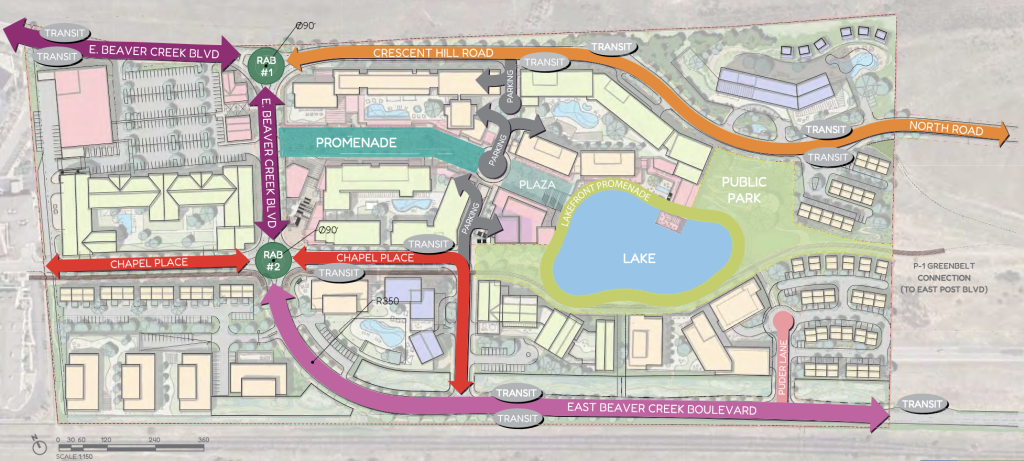
“This is very conceptual,” Eck said.
“There are some general plans around creating best-in-class retail that would be the heartbeat of phase II,” Eck said.
Past phase II, plans include a 2-acre lake, public park space, more apartments, condominiums, hotels and retail space.
The development agreement has 0.6 acres designated for the lake, which means the 2-acre proposal will need council approval.
The area with the lake is “probably phase III,” said Eric Heil, Avon town manager. “I think in the next year’s time, that probably comes to council.”
The entire plot will be linked through a set of roads, sidewalks and bike paths designed to promote easy mobility on the north and south side of the development. A multi-use recreation path will run from Chapel Square through the valley floor of planning area A to the Piedmont and Bosk Apartments. Bus stops have already been established within the transportation layout.
“I think it’s a very good road plan,” Heil said.
On Wednesday, a temporary road connected to East Beaver Creek Boulevard will be paved through the property.
Avon’s Planning and Zoning Commission has reviewed a referral of phase I, and phase I is also halfway through the Village (at Avon)’s design review process.
Avon has limited review over the private aspects of projects in the Village (at Avon). Unlike in other areas of town, the Planning and Zoning Commission cannot effect or enforce changes like it can in other areas of town.
The developer, however, will need Town Council approval for a planned unit development amendment for a zoning change, building height change, dimensional change, density change or use change. Heil said he expects to see a PUD amendment for the property come before the council in late 2025 or early 2026.
How will this construction be funded?
Included in the Village (at Avon) annexation agreement, Avon established a tax credit obligation to Traer Creek. The town provides a tax credit for the developer’s expenditures on public infrastructure as long as the developer imposes a public improvement fee that matches the town’s taxes and uses those funds to pay for public improvements. The town’s 4% sales tax, 4% lodging tax, 2% real estate transfer tax and $4,000 per single-family equivalent water tap fee are all included in the tax credit.
The tax credit runs until the debts on public improvements in the Village (at Avon) are improved.
“Getting the infrastructure in to allow development to move forward to start generating more revenue will really, probably by two to three decades, the ultimate payoff of Avon’s tax credit obligation,” Heil said.
The developer has the right to issue up to $96 million in capital and principal to pay for public infrastructure. Last week, a new round of bonds was issued.
“We’re at the top of the hill with issuing debt, and now we can start looking at the downhill side of payoff schedules and modeling how that might look,” Heil said.
The combined tax credits currently amount to about $6 million. “We believe with this next phase it will probably jump up another million in revenue that gets paid,” Heil said.
The more development there is, the faster the rate at which the town’s obligation is fulfilled.
“I don’t think I’ll see it in my career, but there will be a day when that’s fully satisfied and Avon’s general fund is going to jump up by whatever the amount the tax credit is at that time,” Heil said.
Town staff is also working on how to use the tax increment financing dollars generated in the Avon Downtown Development Authority to help with the construction of a park within the development.
“It’s not like we have another $6 to $10 million laying around to build a park in five years,’ Heil said.

Where will the water come from?
When the Village (at Avon) was established, it was allocated about 170 acre feet of water, with 60 acre feet of raw water, according to Heil.
“We’re trying to work on extending a separate raw water irrigation system that would not only fill the lake (in phase III) but would irrigate all of the town park and streetscape,” Heil said.
The system may go so far as to have its own meters “as long as we have capacity, and I think there is capacity, that we can serve the private lot development irrigation,” Heil said.
This would enable the irrigated areas of the Village (at Avon) to operate separately from the Upper Eagle Regional Water Authority, putting less strain on the authority’s system.
“Which is really better,” Heil said.
For treated water, the Village (at Avon)’s water rights work differently from most developments in Eagle County. The water was dedicated up front, and the water bank now has “a guarantee to serve what the consumptive use is of that water right that’s dedicated,” Heil said.
The water bank system is “a work in progress,” Heil said. “Right now, they’ve used about 25% of their water and they’ve done about 25% of their overall development, so it’s roughly on track.”