To understand the future of climate change, this paleoclimate expert looks at the past

Kate Kampner/Vail Daily
“It is indisputable that human activities are causing climate change. Human influence is making extreme climate change events … more frequent and severe,” the Intergovernmental Panel on Climate Change declared in 2021. To them, it was clear: Extreme climate events are linked to human-caused climate change.
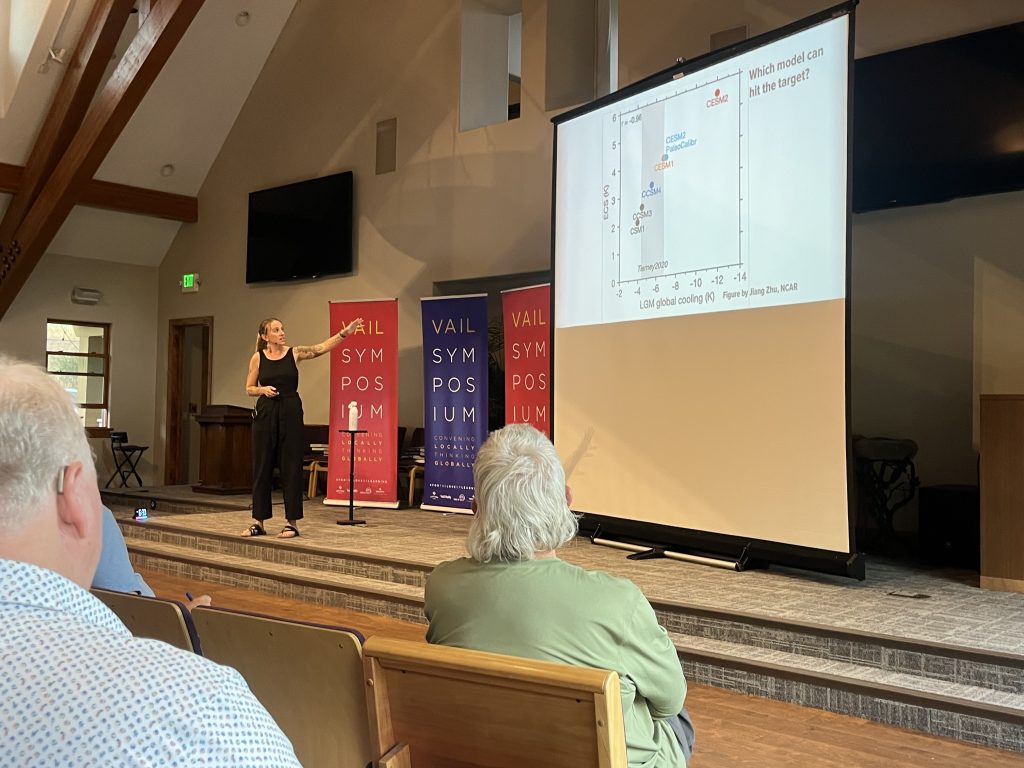
How did they know this? In part, by looking at the past, with the help of Jessica E. Tierney, a University of Arizona professor who was a lead author on the IPCC Sixth Assessment Report. Part of her research is looking back at climate changes in geological history to understand the capabilities of the Earth’s climate system. On Tuesday, at the Vail Symposium, she told a packed house at Eagle River Presbyterian Church that trying to understand climate change by observing only the last few decades is like trying to understand the rules of a game after watching a few plays.
“The only way we can get (the full range of climate change) is to go deeper into the past, to look at what happens to the planet when it experiences bigger climate changes,” she told the crowd.
So how do researchers go beyond the written record?
“We don’t have time travel machines, but we do have natural archives that record climate change in them in different ways,” Tierney said. The most familiar, she said, are tree-ring width, which can show how temperatures and drought have changed.

Support Local Journalism
Coral rings, cave stalagmites, sediment accumulated at the bottom of oceans or lakes, all have bands of evidence and can be dated through various chemistry methods to look at temperatures. Ice cores, she said, stand out as ancient databases. The cylinders drilled out of glacial ice capture ancient air. Tierney explained that when snow falls on the ice sheet and solidifies into ice, it can capture the bubbles of the atmosphere and can allow researchers to measure CO2 concentrations from thousands of years ago.
“The ice cores give us this really important context about how different human-caused climate change is from the natural climate cycles that dominated in the ice age world,” she said.
All of this data gathering from natural sources can help make future projections with computer models, constraining key metrics of climate change, improving climate models and revealing patterns of temperature and precipitation regionally.
This ancient climate data has also predicted how the summer monsoon season may change. To understand this, Tierney and her team looked for answers through leaf wax. By analyzing the chemical makeup of the wax, some of the chemical signals can change depending on the rainfall and moisture the plant experienced. By learning about past monsoons, they can make predictions about the future ones.
“Past climates have this range of change that we can use to test our climate models to find out how the Earth behaves in radically different climates,” she said.
In another project, her team was asked to reconstruct the temperature of the planet back to 485 million years through various geological information. What it found was that the Earth’s current temperature is a lot cooler than in the past, which Tierney said excited many climate change skeptics or deniers. However, she said, that doesn’t mean the current changing climate isn’t a problem. She explained human-caused climate change is warming the planet at a much faster rate.
And while the speed of climate change is alarming, Tierney said, there is hope. She explained how there’s been a lot of work being done worldwide in the past ten years that has lowered the bar of when the planet could hit a three-degree temperature increase.
“We’re on the right track globally,” she said. “I like to remain hopeful, and I think we can continue on a positive path.”
Following the presentation, Tierney took time for a Q&A, which showed just how her words connected with locals.
“I get the sense that people are really interested in it because they see that happening here and affecting the future,” she said following the event. “In the West, I think people really — they get it. We feel a lack of water, a lack of snow, warmer temperatures; I think the questions reflect that.”
Kim Langmaid, founder of Walking Mountain School and professor of integrated sustainability at Colorado Mountain College, said it’s important to think about the past and how current actions are shaping the future.
“I think what is super important about what I’ve heard here is that when we’re thinking about climate change, we’re typically thinking about what’s going to happen in the future in the next 50, 100 years,” she said. “In order to understand the life circumstances of future generations, we need to look at the past.”