Vail artist Gonzalo Pizarro finds form in fragments
Local has received international renown for transforming strandboard construction material into fine art

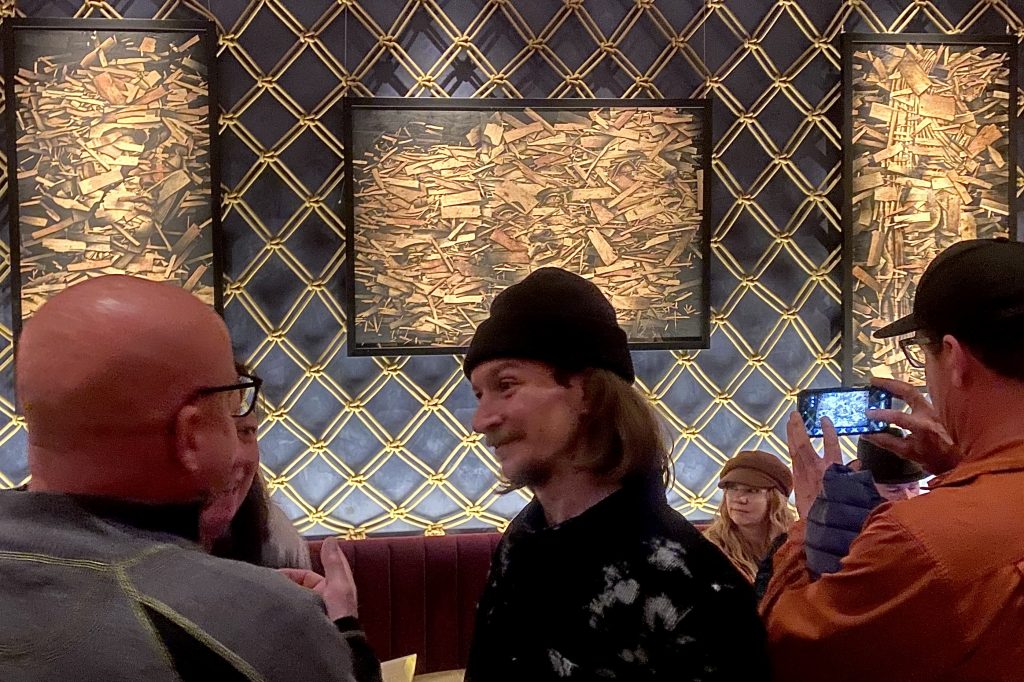
John LaConte/Vail Daily
When local artist Ben Belgrad first encountered Gonzalo Pizarro’s work at a Vail-area art fair a few years ago, the setting was modest.
There among dozens of other artists, Pizarro was attempting to showcase a new style he had been developing, in which ink and charcoal were used to reveal images in sheets of the construction material known as “oriented strandboard” or OSB.
Much of Belgrad’s professional career has been spent observing the work of other creatives through his Minturn business Drinking Vessels, a studio that allows artists from around the world to make signature glass pieces. Belgrad said he immediately recognized something special in Pizarro’s work, so he was not surprised when the rest of the art world took notice of him, as well.
In January of 2025, a time-lapse video of Pizarro creating one of his pieces went viral, garnering 17 million views. Another post then racked up 20 million a few months later. Hundreds of thousands of people followed him, and his posts started seeing so much engagement it was impossible to keep up.
Almost all of the feedback was positive. Street art pioneer Justin Bua — who has found a second career as a fearless critic known for fulminating against contemporary art — gave Pizarro one of the best reviews he has ever posted, saying Pizarro’s style of revealing figures in the strandboard “echoes Michelangelo’s philosophy of liberating forms trapped within the marble.”

Support Local Journalism
Art galleries from across the globe reached out to Pizarro, hoping to contract with him. He eventually inked a deal with Artist Replete, a leading contemporary and street art gallery in Chicago. Matthew Moore, Artist Replete’s founder and creative director, said his reaction to Pizarro’s work was similar to Belgrad’s.
“I had never seen anything like it before,” Moore said. “I look at art every day, and as soon as I saw that I said, ‘this is rare.'”
Moore reached out to Pizarro and was thrilled when he responded, saying Pizarro must have been getting bombarded with messages.
“We feel very lucky,” Moore said. “I think it’s a testament to the strong roster of artists we have at the gallery that Gonzalo felt his work would be a good fit with us.”
After quickly selling Pizarro’s existing pieces, the gallery moved into commissions.
“We had people spending $18,000 on commissions right away, and for an artist with a brand new process, that is a lot to us,” Moore said.
Pizarro was willing to accept commission suggestions that came with a loose idea — the form of an animal or a human, for example — but was also turning down a number of people offering “crazy money” for things he didn’t want to do, Moore said.
“He had people asking for Pokemons,” Moore said.
In April of 2025 Pizarro was invited to attend ArtExpo New York, one of the world’s largest fine art trade shows. Several of his pieces were lost in the mail and never reached his booth, so he took the opportunity to make another viral moment out of the problem by using pieces of OSB board to write “UPS lost my art.”
The package — three pieces valued at approximately $50,000 — remained lost for nearly two months following the show, but was finally returned to Pizarro. When it arrived, Moore suggested that it was time for Pizrarro to host a show of his own, showcasing those pieces and others.
“I said you should do a solo show — you haven’t really done one yet and we have the gallery in Chicago, we have all of our clients who could attend,” Moore said. “He said ‘I’ll do one, but it would mean a lot to me if we could do it in Vail.'”
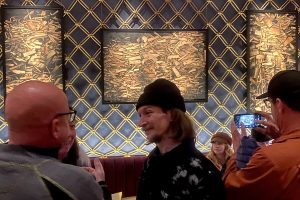
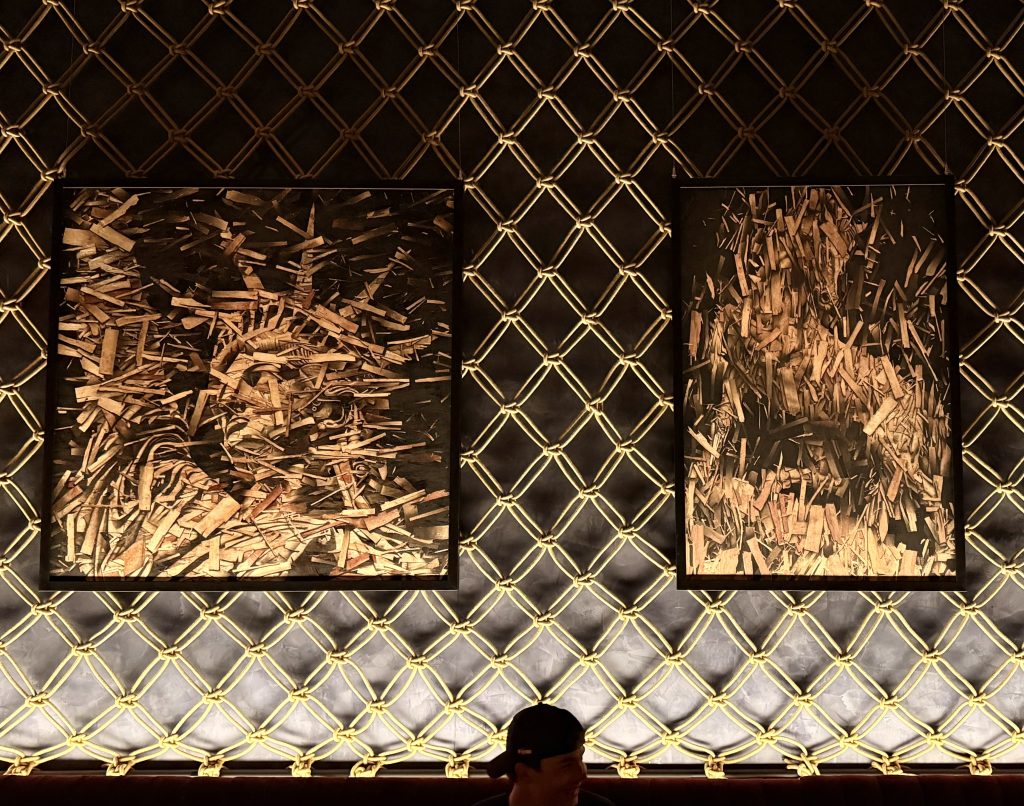
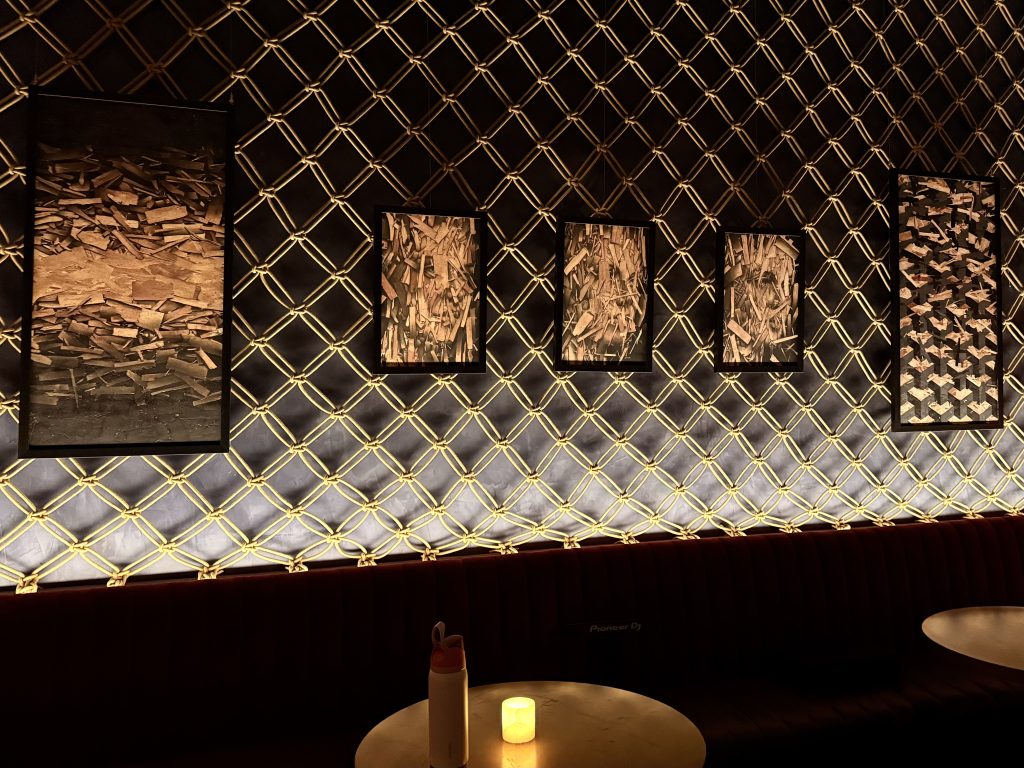
Moore found the Chasing Rabbits venue and set up the exhibition for March 27-29; it was the first time 10 of Pizarro’s works could be viewed at the same time in a public space outside of the Artist Replete gallery. The venue was packed last Friday, and within a few hours of opening, one of the pieces on display had sold for $14,500. The buyer was from the Front Range.
“A lot of people came in from Denver who said ‘we’re big collectors, we saw this was happening and we had to see it in person,'” Moore said.
Among those in attendance was Ben Belgrad, who said a few words to the crowd about Pizarro’s journey as an artist.
“I’ve been a huge fan of Gonzalo’s work since I first found him at Nottingham Park three summers ago, under a tent with a table and three pieces,” Belgrad said. “I’m so excited that this show is happening.”
The making of a method
Pizarro was raised in Argentina, where his father was an architect.
“When I was a kid, I went with him to a lot of construction sites,” Pizarro said last Friday. “And I was always taking treasures, which, for me, of course, were the leftovers. I was taking those things home, and for some reason I always found something interesting about OSB, maybe the different wood chips and the different colors and textures that it has, this unpredictable pattern.”
Pizarro grew up to be an architect like his father, but was more interested in skiing and doing art. After more than a decade of living the “never summer” lifestyle — following winter from the southern hemisphere to the northern hemisphere (Argentina to Vail) and back again — Pizarro decided to move to Vail permanently three years ago and dedicate himself to becoming a full-time artist. He had started to develop his OSB style a couple of years earlier and, working full-time from his small studio in West Vail, found a welcoming atmosphere to thrive creatively.
“Vail is a place that supports artists,” he said. “The town in general has a lot of art and programs that are growing.”
No longer viewing OSB as a throwaway material from construction sites, Pizarro began seeking out the best specimens from Home Depot in Avon and Alpine Lumber in Silverthorne.
“Sometimes I get the board that has a special wood chip that catches my eye,” he said. “Other times I say I’m going to get this board and figure it out later, because it takes many hours of just looking at it.”
Pizarro said from start to finish, his completed OSB creations usually require more than 100 hours of work. He calls that work “solving” the project.
“Every square centimeter of the piece needs to be solved,” he said.
Pizarro describes his effort to solve his pieces as a negotiation.
“All the wood chips are already pressed together, so I can not modify anything; I have to work with what’s already there,” he said. “So my works are a negotiation, a negotiation where I always win.”
By 2025, when his viral moment came, Pizarro had his style perfected. And while the post that made him famous was truly his own — not a repost — it was the advice of a repost account that skyrocketed the video into the millions of views.
“They told me we can share your stuff, but we’re going to need a video of the process,” Pizarro said.
Understanding an artist’s process often brings a deeper level of appreciation to the work, and can mean the difference between a piece that is discussed or dismissed in history books. Georges Seurat’s “A Sunday Afternoon on the Island of La Grande Jatte” is a forgettable image until the viewer realizes it’s composed of tiny dots. Jackson Pollock’s drip technique wasn’t recognized as a radical new way of creating paintings until film footage revealed the unusual physicality behind them.
And Gonzalo Pizarro’s OSB style didn’t become a sensation until Instagram showcased his process to tens of millions of scrolling smartphone users.
“I uploaded it myself, to my own account, before sending it to (the group that requested the video), and it went viral before they even put it up,” he said. “I really couldn’t believe it.”
Pizarro immediately became the world’s first artist to be inexorably connected to OSB as a medium. The fragmented forms that emerge from the wood have carried Pizarro to the pinnacle of art achievement — owning a totally original and well-respected technique.
“When someone sees one of his pieces, they instantly recognize that’s a Gonzalo,” Moore said. “That’s rare for any artist.”
Moore said OSB has started to get noticed as a medium for artists following Pizarro’s breakout, but no one has yet to master it the way he has.
“He will forever be known as the godfather of the OSB style,” Moore said.
Pizarro said his exhibition in Vail was titled “Anatomy of a Fragment” because his works require every piece of the OSB to be scrutinized.
“Every fragment needs to have a meaning,” Pizarro said.
Pizarro said working within the rigid confines of the OSB often makes him reflect on how we, as humans, deal with the things that we can not change.
“We have this illusion that everything is under control, when it’s really not,” he said. “Think of how many things that we can not change on a daily basis. So the board becomes reality, and I am living that reality, trying to get the best of what I can not change.”