Colorado Supreme Court hears case of snowboarder who sued Vail Resorts claiming he was struck by a snowmobile, then bought another Epic Pass
John Litterer sued Vail Resorts claiming he was hit by an employee driving a snowmobile at Breckenridge Ski Resort in 2020. Then he bought an Epic Pass again the next season.

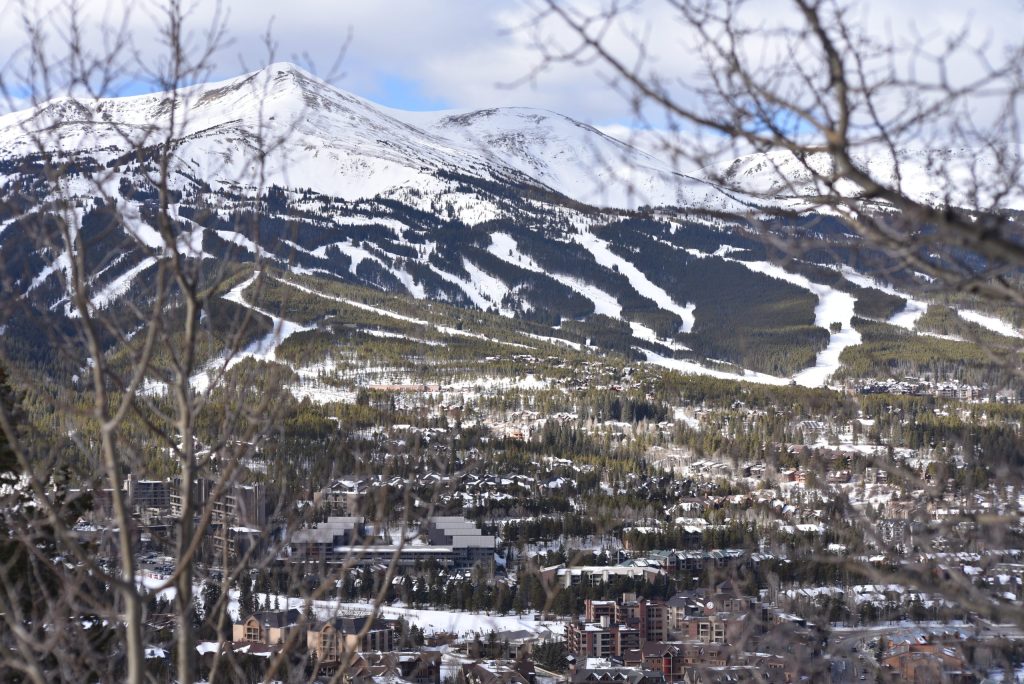
Kit Geary/Summit Daily News
Editor’s Note: This article has been updated to correct the spelling of Vail Resorts’ lawyer Michael Hofmann’s name.
The Colorado Supreme Court had tough questions for lawyers representing Vail Resorts and a Texas man suing the ski company after he was hit by an employee on a snowmobile at Breckenridge Ski Resort.
The Supreme Court heard oral arguments in John Litterer v. Vail Summit Resorts Inc. on April 16 at a high school in Holyoke. The case could further test the limits of the liability waivers ski resorts require customers to sign when buying passes. It comes two years after the state’s highest court ruled in another case, Miller v. Crested Butte, that the blanket waivers do not protect resorts in all cases when a customer is injured.
Litterer sued Vail Summit Resorts Inc., a subsidiary of Vail Resorts, which owns the Epic Pass, six ski resorts in Colorado and dozens across the U.S. and the world. He claims he was hit by an employee driving a snowmobile around a “blind corner” at Breckenridge in 2020.
Complicating the case is that Litterer twice clicked through online waivers agreeing he would not sue Vail Resorts: first, when he purchased the Epic Pass for the 2020-21 season, the year he was injured; then, when he purchased an Epic Pass for the 2022-23 season after he had recovered enough to snowboard and while his litigation was still ongoing.

Support Local Journalism
The Supreme Court agreed to hear Litterer’s case after the Summit County District Court and Colorado Court of Appeals had both dismissed it, determining that Litterer gave up his claims to sue when he signed the liability waiver during his second pass purchase.
During oral arguments, the Supreme Court justices focused many of their questions on the second liability waiver Litterer signed and the extent to which he should have known what he was signing.
Trent Ongert, an attorney representing Litterer, argued his client did not intend to dismiss his active lawsuit when he bought the second Epic Pass and that the language of the liability waiver was “too broad” to be enforced.
Vail Resorts’ attorney Michael Hofmann, however, said the language of the waiver was clear that Litterer agreed to waive his existing lawsuit when he bought a pass — and ruling otherwise could create issues for contract law in Colorado.
The Supreme Court typically issues written opinions within nine months of oral arguments.
Case could ‘expand or clarify’ landmark Miller v. Crested Butte ruling
Ongert opened his argument by noting that the Supreme Court in 2024 ruled in the case Miller v. Crested Butte that a ski resort’s blanket liability waivers cannot protect resorts when they are violating state laws or regulations.
In Miller, a jury found Crested Butte negligent for violating state regulations, including chairlift safety rules, after a 16-year-old girl was paralyzed after a 30-foot fall from a chairlift at the Vail Resorts-owned ski area. The case upended a decadeslong understanding that liability waivers protected ski resorts from essentially all injury-related lawsuits in Colorado.
Similar to the Miller case, Ongert argued that the Breckenridge employee was in violation of the state’s Snowmobile Safety Act when he hit Litterer, meaning the liability waivers Litterer signed cannot protect Vail Resorts from the “negligence per se” claims the lawsuit asserts.
“It is up to the court. The legislature is not going to act here,” Ongert said. “The legislature has ignored every recent attempt to enact laws that enhance skier safety and ski area accountability.”
Several justices questioned whether it was the role of the courts to weigh in where the Legislature has not.
“We’re not a policy-making branch,” Justice Brian Boatright said. “Why? Why do we dip our toes into that, then?”
Ongert said this case is a chance for the court to “expand or clarify” the Miller ruling. He said the court could “extend the same reasoning” that claims alleging someone was injured as a result of law violations aren’t covered by the waivers.
But Boatright said “that’s different” because in Miller, the plaintiff signed the liability waiver before suing, while in this case Litterer signed a second liability waiver while his litigation was ongoing.
The liability waiver reportedly stated that the customer agrees to “give up any and all claims and rights I may now have against” Vail Resorts or the ski resort, “including those not mentioned in this release and those resulting from anything which has happened up to now.”
Chief Justice Monica Marquez said that while language is “extremely broad,” it is also “pretty plain language.”
“How could that not put Mr. Litterer on notice?” Marquez asked. “He’s certainly aware of his own lawsuit.”
Justice Richard Gabriel added, “Is it just a lack of specificity, or is it also that it’s contained in a document that most people don’t read carefully and expect to be more about assumption of risk by skiing?”
Ongert said that he doesn’t know whether or not Litterer read the agreement before “clicking through” to sign it, but argued that the court’s ruling in Miller means that liability waivers can’t shield ski resorts from the types of claims made in this case.
“The entire release is invalid as far as we’re concerned,” Ongert said. “It’s too broad, it releases the wrong types of claims, and there’s no severability clause — and it’s been that way for quite some time.”
Vail Resorts’ lawyer concerned about ‘destabilizing’ contract law
Hofmann noted that Colorado is a “freedom of contract state,” meaning state law allows parties to voluntarily create contract terms without government interference, and that “the rights of adults to enter into contracts is well established.”
The waiver “is not that broad” and is meant to “honor” the ruling in Miller by stating that it applies only to the “greatest extent permitted by the law,” Hofmann said. He added that he interprets the Miller ruling to mean that liability waivers can’t dismiss certain legal claims that “don’t exist yet,” not that waivers would not apply to existing claims.
“Those are two different things,” Hofmann said. “I think the law allows people more freedom to release existing claims, because at that point, you know what has happened, you know what the injuries are, you know the merits and demerits of your claim, you know what you’re getting in exchange, and the person can make a fully informed decision.”
Justice William Hood III said it “seems fundamentally unfair” to expect someone buying a ski pass to anticipate that the waiver covers more than the assumption of risk the customer undertakes when partaking in the sport. Pointing to the waiver’s language that the customer agrees to dismiss any future or existing claims, Hood said “I think most folks would say that feels like Vail pulling a fast one.”
But Hofmann said nothing in the liability waiver should have caught Litterer by surprise, since he was already suing Vail Resorts over the specific issue of the liability waiver and its language.
“Who would know better that there’s a release and what it provides than someone who’s already sued us over it?” he said.
Vail Resorts isn’t trying to “trick people” to sign its liability waiver without reading it, Hofmann said, noting there is a warning at the top of the waiver that states “this is a release of liability waiver of certain legal rights, including the right to sue.”
He added that most companies “can decline to do business with someone who’s suing it” and Litterer had other ski companies to choose from.
If the Supreme Court were to rule that the waiver didn’t apply to Litterer because he didn’t read it or was unaware of the terms it contained, Hofmann argued that could have ripple effects on how contract law works in Colorado beyond just the ski industry.
“I think it is destabilizing the contract law — and this is a contract — to say, we’re going to adopt a rule that adults don’t need to read things, we expect them not to read things, and we’re going to let them walk away because they haven’t read it,” he said.