Water rates are going up for some Eagle County residents in 2025 — and down for others
Eagle River Water & Sanitation District to change the water bill formula for multi-family, commercial, mixed use accounts for multi-family, commercial, mixed use accounts to adapt to rising costs, encourage conservation


Zoe Goldstein/Vail Daily archive
This year, like last year, water rates are changing for certain Eagle River Water & Sanitation District customers. While last year, the rate changes hit individually metered accounts and irrigation (outdoor water use) only accounts, this year’s changes apply to multi-family, commercial and mixed-use buildings.
The new rate structures will affect every customer differently; without altering their water consumption, some customers will see higher bills, some will see no change, and others will receive lower bills.
While last year’s changes prioritized water conservation, equity and adjusting to the rising cost of providing water services, this year’s rate restructuring only has the latter two in mind, deliberately leaving water conservation off the table.
“The goal of this rate redesign is to bill customers fairly and consistently, to try to get everybody on the same standard for a billing structure, and to align with industry standards, and then to consider system and customer impacts as we move forward,” said Allison Ebbets, the district’s water conservation manager, to the district board during its May 23 meeting. “The focus is not on water conservation for these categories.”
Who does this affect?
Those that pay water bills for multi-family, commercial and mixed-use buildings in the water district’s service area in Vail, as well as the Upper Eagle Regional Water Authority’s service area in Arrowhead, Bachelor Gulch, Beaver Creek, Berry Creek/Singletree, Cordillera, EagleVail, Edwards, Traer Creek and Avon, will be impacted by the 2025 water rate structure changes.

Support Local Journalism
Why are billing structures changing?
Commercial, mixed-use and multi-family accounts, which are approximately 13% of the water district’s total number of accounts, made up 59% of the district’s total water consumption in 2023. Until 2025, these accounts have been charged differently from each other.
In the past, the district has charged multi-family, commercial and mixed-use building customers through an inconsistent variety of billing multipliers, including a building’s square footage, number of rooms and water meter size.
This means that two almost identical commercial, mixed-use or multi-family buildings could pay dramatically different rates for the same water use, depending on how their billing multipliers are calculated.
In 2025, the water bill rate formulas are being adjusted to charge buildings by the size of their water meter.
What does the new billing structure look like?
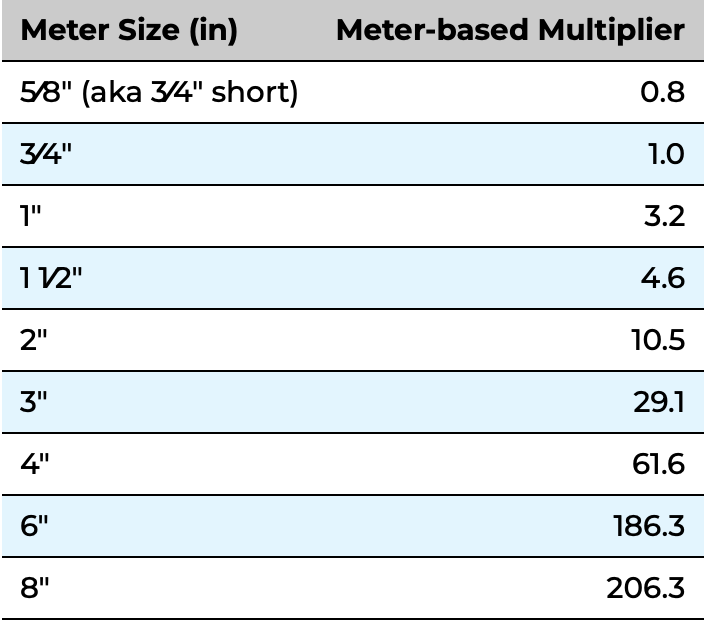
Under the new system, the billing multiplier for all three building types will be based on the size of the building’s water meter.
Meter sizes differ across the buildings in the district’s service area, ranging from five-eighths of an inch to 8 inches. The size of the meter determines the minimum and maximum rate at which water can reach the building.
The larger the meter, the more quickly a larger amount of water can come out, making the meter a good equivalent for a property’s impact on the water district or authority’s system.
The district keeps track of each account’s meter size, making it a more equitable way to calculate a bill compared with square footage, which can be subjective. Even across residential buildings, meter sizes differ. Under the district’s system, 41% are 1-inch, 38% are three-fourths of an inch, 14% are five-eighths of an inch and the remaining 7% are bigger.
Under the new rate structure, a meter measuring three fourths of an inch has a multiplier of one, while a 1-inch multiplier has a multiplier of 3.2, and a 2-inch meter has a multiplier of 10.5.
Each account is also subject to base service charges and is placed into a tier for its amount of water use, in increments of 8,000 kilogallons of water, where more water use means a bigger charge.
“Does it come out perfectly? No. But it’s equitable as we’re doing this adjustment to the fundamental flaw in both buckets — the use and base,” said David Norris, the district’s director of business administration.
Why will people see different changes in their bills?
While the new rates are not intended to cause big changes in water use, they may mean altered bills for some customers.
Norris said in May that it’s possible some customers will see a 50% increase in their water bills. “Do I also think that there are (accounts that will see) negative 50%?” he said. “Really, yes.”
The amount of change customers may see is tied most closely to the age of their building, as when the earliest accounts were installed (mostly in Vail), they were often given the largest possible water meter under the justification that they would have access to the largest amount of water. Under modern construction guidelines, water meter size is closely correlated with anticipated use.
“There’s a decision point when development happens on what size meter they should be putting in,” Norris said.
As a result, newer commercial accounts that are closer aligned to the allotment of water based on meter size and base service charges will likely see a slight decrease in their bills, and others that are less aligned may see an increase.
The water district offers an online bill forecasting tool to customers wishing to see how their bill might change with the new water rate structure, and how modifying their water use might change that charge.
Water district customers interested in identifying their account type can log into their WaterSmart account or look in the “account type” section of their customer bill.
Those with questions can contact the water district’s customer service department at 970-477-5451.