A forgotten town
ALL |
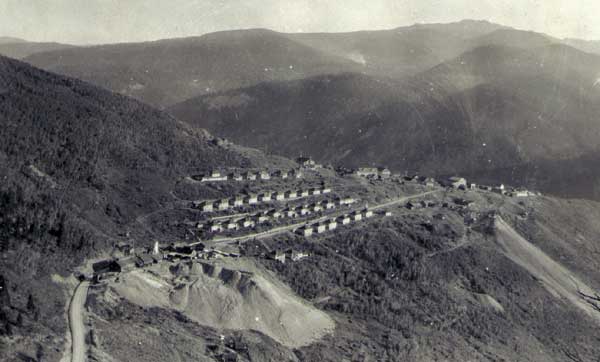
It’s quite possible to miss the abandoned town that is perched precariously on the side of Battle Mountain, just a few miles south of Minturn. The steep and windy road that curves above and around Gilman usually warrants a driver’s zealous attention.
There’s not much to see these days, anyway. Worn, modest homes, painted in orange, green and blue sit on a rocky hillside. Dirt roads snake between the homes. The graffiti-covered buildings and glass-strewn empty streets are a testament to what Gilman has become since the miners finished their last shift, 21 years ago.
Gilman is modern-day ghost town and has a history that is mysterious to most. And as with most things enigmatic, myths abound. The rumors that have circulated – that people began getting sick from the mine tailings and that one day they just had to pick up and leave, that upon peeking in a house or two you might glimpse a table set, waiting for a family that never returned – don’t tell the true story either.
There are people, however, who can tell true stories about Gilman. They are people like Ella Burnett, who worked there, cared for the residents when they were ill, and witnessed the last day the miners worked. Or people like former Minturn mayor Ernie Chavez, who was born in Gilman and worked in the mines alongside his father.
A developer, The Ginn Company, has purchased thousands of acres that include Gilman. If the company’s plans to build a private ski resort and golf course community are successful, even the physical reminders of the town will cease to exist all together.

Support Local Journalism
But for those who lived Gilman’s past, the town is more than a memory. It was home, it was work, it was a place to raise kids and above all, it was a community.
The area was first settled in the 1860s by miners in search of gold and silver. Instead of the more precious metals, they came upon a sulfide ore body, rich in both lead and zinc. In 1879, the town of Clinton, (now Gilman) was formed. Seven years later, the town was renamed after Henry Gilman, superintendent of the Iron Mask Mine, one of the small independent mines that operated in the area until the Empire Zinc Company consolidated the private mining claims to form the Eagle Mine at Gilman in 1912.
Ella Burnett grew up a few miles from Gilman in the small, then-lively town of Red Cliff. She stole away to nursing school in Denver, but returned to help her mother care for her eight siblings after her father passed away. She was hired by New Jersey Zinc, which owned the mine at that point, to work as a nurse at the hospital in town. A year after she began working at the mine, in 1948, Burnett married a friend of her sisters, a mine employee and Minturn native by the name of Pete Burnett.
“That’s when I made the big move over the hill,” she said.
And Burnett hasn’t moved away from Minturn since.
In Gilman’s seven-bed hospital, Burnett tended to the ill miners, their pregnant wives, and many other county residents, including railroad workers and civilian employees from Camp Hale. Gilman was home to the only medical facility in the county for many years. And though the hospital there employed a few different doctors over the years – Morgan, Kehoe, Stanley and Steinberg – Burnett’s face was steadfast.
During her time at Gilman, Burnett delivered babies, assisted on surgeries and even helped save a German WWII P.O.W. that had tried to escape from a train transporting him nearby. The soldiers shot the prisoner and he was brought to the hospital in Gilman with a gunshot wound to the abdomen.
During another winter she remembers getting snowed-in in Gilman for three days.
“It started snowing and both sides of the highway slid, it even went down and took railroad cars off of the track,” she said.
Geography and weather may have isolated the town from time to time, but it lead to a closeness among residents. Ernie Chavez, who lived in Gilman until he was four and worked in the mines as an adult, remembers above all the sense of community he felt in Gilman.
“They had a bowling alley and every Wednesday night they used to have a movie in the gym – I think it was 5 cents to get in.”
He attended school in the small company town until the fourth grade. After spending four years in the Navy after high school, Chavez returned to his hometown and took a job at the mine in Gilman, a place his father worked for 43 years. Chavez himself worked in the mill, refining the ore the miners extracted, preparing the ore to ready it to load in the boxcars at Beldon, the nearest trainstop. For four years, from 1962 to 1966, Chavez worked in every department in the mill.
Out of the many years Burnett served the community at the hospital in Gilman, she doesn’t remember very many severe accidents and can only recall two deaths. She remembers a particular car accident quite vividly.
“(The volunteer fire department) called one day and said there was an automobile accident,” Burnett said. “This fella had gone over the mountain up there and he was dead.”
Dr. Stanley told them they could go ahead and bring the body up to the hospital until the county coroner could be found.
“They come in the door with the man on the stretcher and he opened his eyes up and looked at me and I about fainted,” Burnett said.
For recently retired teacher Susana Miranda, living in Gilman was quite a change from where she lived before. She moved to Colorado from Texas. She lived in one of the apartments in the town set aside for teachers employed by the Eagle County School District. Each day she would commute to Minturn to the kindergarten class she taught. “I was young and open for adventure, and to me, living in Gilman was an adventure,” Miranda said.
Though Miranda can’t remember the exact years she lived in Gilman, she does remember the town being relatively quiet. There weren’t many families left in town when she moved to Gilman. The hustle and bustle of the company town had quieted since the boom days when it employed nearly 700 people.
There was just one telephone line, she remembered, and everyone shared it. Though the mine wasn’t running nearly at the capacity it once had (Miranda remembers fewer than 100 people living in the town at the time she was there), she said she didn’t feel isolated. When her family members came to visit one Christmas and asked her why in the world she was choosing to live on the top of the mountain, she remembers telling them simply that she loved it there.
“Out of my bedroom I could look over and see the mountain peaks,” Miranda said. “There was God and no one else.”
There were challenges, though, from the treacherous roads she had to travel daily (“I just crossed my fingers and hoped I’d make it”), to the lime green building that she lived in and the coal she shoveled to heat it.
Gulf and Western Industries purchased the Eagle Mine from New Jersey Zinc in 1966 and ran it until they closed the doors in the late ’70s. According to a timeline on Minturn’s website, the mine shut down on Dec. 16, 1977, laying off 154 miners. Soon after the mine was bought by Battle Mountain Mining Company, which ran the mine with a skeleton crew until 1984, when it shut down for the final time.
Burnett was the last nurse employed at the Gilman hospital when the mine closed down and the miners walked out of the town for the last time. She remembered feeling sad.
“I’d been there so long, it was like losing my second home,” she said.
For people like Burnett and Chavez, who saw the now-abandoned town during its heyday, it’s difficult to see the crumbling state of Gilman today.
“When you grow up someplace and then it falls into such disrepair, well, it’s sad to drive by and see what’s become of it,” Chavez said. “I wouldn’t say that’s progress.”
Later, after the mine closed, Gulf and Western changed its name to Paramount Communications Inc. Eventually the company merged with telecommunications giant Viacom International, the company that was held responsible for the mine clean-up after the Eagle Mine was declared a federal Superfund site. The clean-up, which began in 1988, is still not completely finished today.
Last December the Ginn Co. purchased 5,317 acres on Battle Mountain and nearby Bolt’s Lake, which includes 90-acre Gilman, for more than $32 million. The company plans to build a private ski resort and golf course community, with between 1,400 and 1,700 homes.
Ginn wants to build the first phase of the development near Bolt’s Lake. The development of Gilman will most likely follow shortly after, said Cliff Thompson, communications director for the company. Nothing is set in stone, however, Thompson admitted. “Development plans are very fluid, we’re not being evasive, it’s just that things change very fast in this business.”
The current plan is calling for condos or townhomes where Gilman now is, he said.
“We want to demonstrate that we will do this development right and it’s a very visible piece of property, which everyone is aware of,” he said.
Thompson said the company would bury the mine waste and build on top of it.
“It’s been done every where – Butte, Montana for one …,” he said. “It’s nothing new, but you certainly need to be careful how you go about it and we certainly will do that.”
For people like Chavez, Burnett and Miranda, and other local Minturn and Red Cliff residents who had strong ties to the town of Gilman, the idea of a bunch of luxury houses and condos replacing the ghost town we see today is causing mixed emotions.
Burnett said she is nervous about the development and the effects it will have on the entire county, but she’s also hopeful about what it can do for Minturn.
“If it’s done right, (the development) could be good for Minturn,” she said. “And I would hope (Ginn) is on the up and up and will do things right for us.”
Chavez is interested to see how things pan out over the next few months.
“It’s going to change this valley completely,” Chavez said. “It hasn’t been very long and I can already see what’s happening to Minturn and Red Cliff, they’ve already started to change. It’s a lot of the old timers that were there, moving out, and I don’t blame them, they’re getting good prices for their places and they’re moving on.”
So is Chavez. He’s moving to Grand Junction in December, leaving the small towns he’s lived in his whole life, behind.
Caramie Schnell can be reached at cschnell@vailtrail.com.