Bryan Woods wins race to become Eagle’s next mayor while Gina McCrackin leads Town Council vote

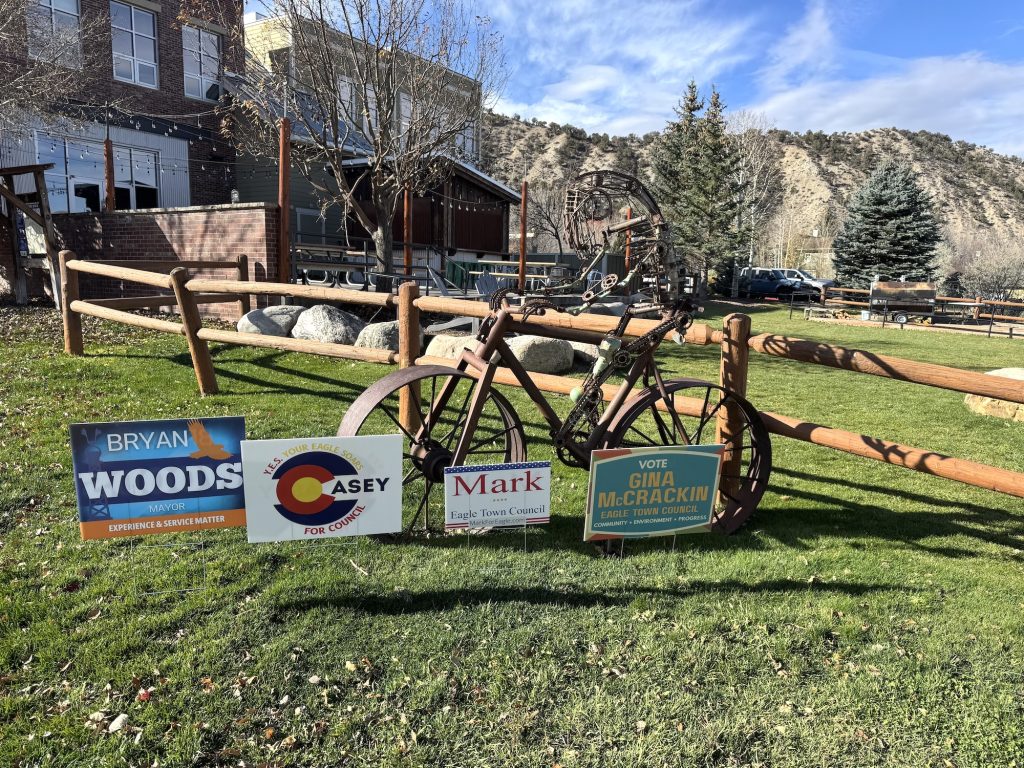
Nate Peterson/Vail Daily
A vision for Eagle’s future emerged Tuesday night as vote totals rolled in following a testy, crowded race for the mayor’s seat and four Town Council seats.
Bryan Woods, a current Town Council member, easily defeated Tom Olden to become the town’s next mayor, according to unofficial results. As of the last vote count early Wednesday morning, Woods captured nearly 62% of the vote — winning by 1,509 votes to 931.
“Relief and exhalation are the two words that come to mind,” Woods said when reached Tuesday night at his watch party in downtown Eagle at Slope & Hatch. “This is as clear a result as we could have hoped for.”
A coalition of Town Council candidates aligned with Woods — incumbent Geoff Grimmer and newcomers Casey Glowacki, Gina McCrackin and Scott Schreiner — also secured council seats. McCrackin was leading all council candidates with 1,418 votes — nearly 16 percent of the vote — followed by Schreiner (1,224) Grimmer (1,192), and Glowacki (1,097).
McCrackin said she cried when she saw she was the top vote getter when early returns came in.

Support Local Journalism
Mark Bergman, another candidate aligned with Woods, McCrackin, Grimmer, Schreiner and Glowacki, finished in fifth with 828 votes. Brian Kunkel, who owns local businesses in town, including the popular Second Street Tavern, was in sixth with 804 votes, followed by Robert Dagostino (662), Todd Morrison (645), Tania Jordet (577) and Scott Davison (539).
“It felt like the culmination of a lot of work, of campaigning on top of a full-time job on top of other responsibilities,” she said. “As my other fellow candidates know, it’s incredibly tiring and there were days where I questioned if it was worth it. If the work that I was putting in would have results, so to see those numbers put tears in my eyes and made me feel incredibly humbled and honored to be recognized by the people of the town of Eagle as somebody that they want to represent them.”
Early on, Dagostino, Jordet and Davison had formed a coalition with Olden, with yard signs for all candidates appearing together throughout town.
Tuesday’s results bring to a close an election season in Eagle unlike any other in recent memory — with candidates dropping out, factions being formed and partisan politics infiltrating a nonpartisan vote.
Jason Cole, one of three mayoral candidates, suspended his campaign in mid-October to endorse Woods, citing a shared vision for Eagle’s future. Similarly, Timothy Haley, a council candidate, also suspended his campaign to back Woods and Glowacki, McCrackin, Grimmer, Schreiner, and Bergman.
There was also a campaign sign controversy involving Glowacki, who admitted to pulling one of Olden’s signs on a property owned by Morrison — after claiming his signs had repeatedly been pulled. Glowacki faces a misdemeanor tampering charge.
Differing visions for Eagle
Woods, who moved to Eagle five years ago, and Olden, a resident for the last 24 years, each offered distinct visions for the town’s direction. Woods touted his council experience and said he wanted to be a facilitator for all the ideas that will come from a new-look council. He argued that his familiarity with town government and existing plans will allow him to effectively manage Eagle’s growth and address pressing issues.
“I felt strong the whole time. The feedback from the community had been overwhelmingly positive,” Woods said. “People in town just want to make it better.”
Olden, on the other hand, said at a candidate forum that he ran to help local businesses succeed, but that he is not a fan of growth just for growth’s sake. He was also a staunch critic of the town’s approach to economic development, suggesting ideas such as turning the town hall into a boutique hotel to generate tax revenue. He also voiced concerns about the town using eminent domain to widen U.S. Highway 6, where he owns a couple of properties.
The council race featuring 11 candidates became a little less crowded after Haley dropped out, with the 10 remaining candidates offering voters a diverse range of perspectives and priorities on managing growth, creating affordable housing, streamlining processes for new businesses and reducing red tape.
Kunkel, in a Facebook post shared Monday, lamented that local politics had turned partisan and that candidates formed coalitions.
“Regrettably, what was supposed to be a nonpartisan, small-town election has split into two slates of candidates with very similar views. For those who haven’t yet cast your ballot, please remember, diversity of thought keeps both our town and our democracy healthy. When too many elected officials share the same perspective, they become blind to flaws in their own thinking, and we all suffer …”
Woods echoed that sentiment.
“I was deeply disappointed from the beginning when I saw people picking teams. It started very early on when you saw the same yard signs showing up over and over together,” he said. “And I really hope we can have a discussion with the town on campaign rules so we can prevent this sort of partisan interference in nonpartisan elections in the future.”