Nearly 100 Colorado businesses have left or scaled back operations since 2019, report finds
Colorado companies blame factors like excessive regulations and costs for why they’ve shifted operations to other states, according to a Colorado Chamber Foundation report


Kelsey Brunner/The Aspen Times archive
A new report from the Colorado Chamber Foundation suggests the state’s weakening competitiveness is driving businesses out of state. Companies are blaming factors like increasing regulations and cost of living for why they’re choosing to leave.
Roughly 98 companies relocated or moved business operations to other states between 2019 and 2025, resulting in the loss of over 13,600 jobs from Colorado, according to the Colorado Chamber Foundation’s Relocations Tracker. Twenty-seven of these occurred in 2025.
The tracker, released in April, compiles data on corporate decisions to reduce operations in Colorado or to relocate or expand operations out of state. This can include relocating the company’s headquarters, moving critical facilities and scaling back Colorado investment in favor of other states.
While the tracker cannot include every single company that has left Colorado, the report authors say the data — taken from public reports like corporate press releases and quarterly financial statement filings — provides a big picture of movement trends in the state.
“While Colorado has significant strengths as a state, we are also becoming increasingly vulnerable in our competitiveness and are seeing a slow burn of companies looking elsewhere to invest and grow,” Foundation Executive Director Rachel Beck said in a news release. “This report highlights that certain policy approaches are creating a less favorable business climate in Colorado, and we’re starting to see this become a factor in corporate relocation and expansion decisions.”

Support Local Journalism
Texas is by far the largest recipient of Colorado businesses, attracting 21 companies for expansion or relocation over the past six years, and seven companies in 2025. One company, Teachers Insurance and Annuity Association of America, moved roughly 1,000 jobs to Texas in the last three years.
California has acquired the second largest number of Colorado companies, 10, followed by North Carolina and Arizona with six companies each.
The chamber’s analysis of federal financial reports also found that Colorado has experienced a net loss of 34 public company headquarters since 2022. In 2025, Colorado claimed its fewest public company headquarters in the last six years.
While the annual number of business relocations out of Colorado dipped slightly from 14 in 2019 to six in 2022, it spiked to 27 per year by 2025, according to the report.
Of the companies that have sought opportunities in other states in 2019, 54.5% have left the state completely, leaving 33.3% with some presence in the state, even if those companies moved their headquarters or facilities out of state. The other 12% were lost due to a lack of corporate attraction.
“We now have 34% (of businesses) indicating they are not likely to make investments in Colorado — this is up from 25% last year. Among those already working in other states, this hits 41%,” Colorado Chamber Pollster Pat McFerron wrote in the report.
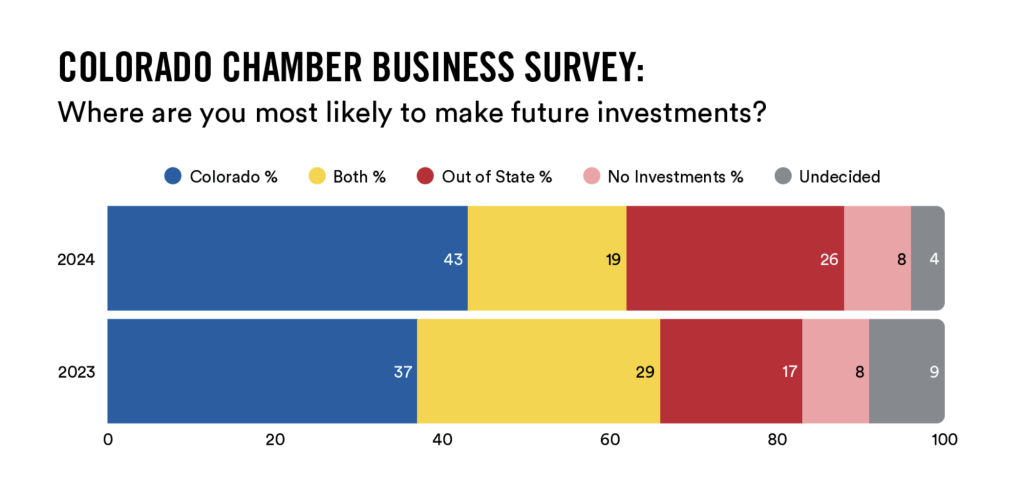
Companies leave for more favorable business climates
In 2022, the Colorado Chamber of Commerce released a Colorado Competitive Landscape Report, which found that state-level policies have driven this corporate exodus.
Concerns over excessive regulations were further confirmed by a 2024 study, which identified Colorado as the sixth most regulated state in the country, with more than 205,000 regulations on businesses.
The Colorado Chamber’s priority legislation, Senate Bill 137, would create more robust standards for how state agencies review existing regulations. The bill, characterized as an avenue to restore some of the state’s competitiveness, had its second reading in the Senate on April 10.
“This data confirms much of what we’ve been hearing from the business community; our regulatory climate is becoming increasingly burdensome and driving companies out of state,” Cynthia Eveleth-Havens, chief strategy officer and senior vice president of communications for the chamber, said in the release. “These trends present a real risk to our workforce strength, future job growth, capital investment and Colorado’s overall economic vitality.”
Further research from the chamber revealed that, on top of the impacts of overregulation on the state’s competitiveness, other business metrics like the cost of doing business and cost of living have also hurt Colorado’s appeal to companies and investors. Companies largely blamed a combination of tax and regulatory policies, talent pool availability and other states having more favorable business climates.
Matt Joblon, CEO of BMI Investments, told the chamber in their 2022 Competitive Landscape Report that the cost of living on the Front Range has driven some of its potential workforce to move out of state, making it more difficult for businesses to find qualified candidates to employ.
“More and more people are leaving metro Denver because of the cost of living,” Joblon said in the report. “This is causing the talent pool to tighten as people and quality talent are driven out of the state. The next shoe to drop is corporations leaving because they cannot find the talent to support their businesses.”