Arkansas River outfitters report steady flow of customers, despite low flows on the river
While flows are expected to be lower than normal, outfitters are hopeful that a strong El Nino pattern will deliver rain to help river flows

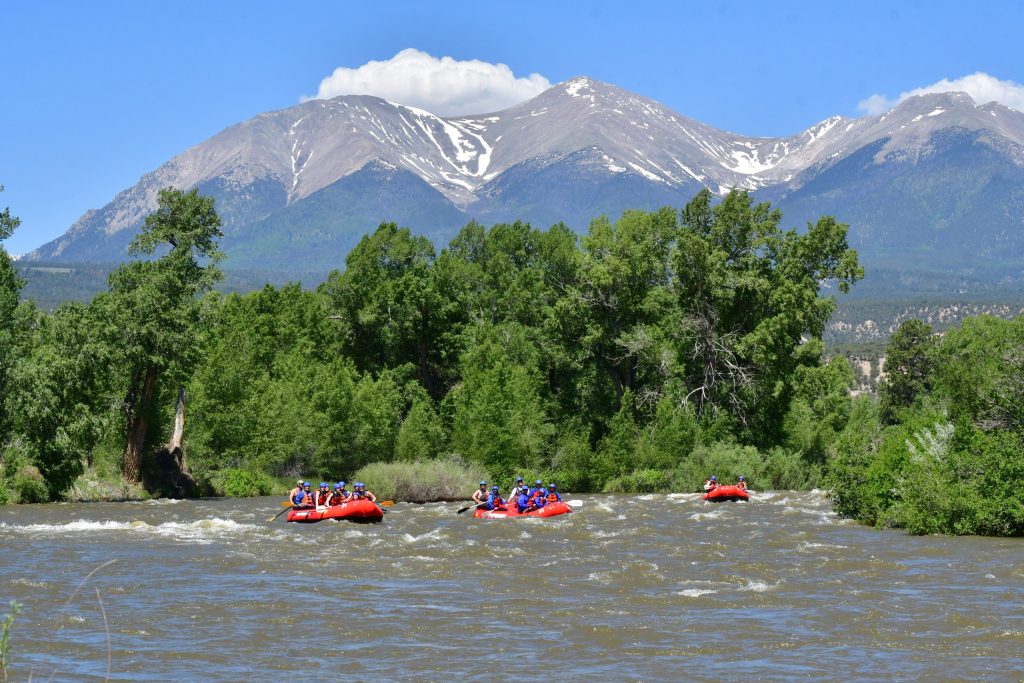
Arkansas River Outfitters Association/Courtesy photo
Colorado rafting and angling guides are reporting a steady flow of customers, despite low stream flows, as the summer recreation season kicks off on the Arkansas River — one of the most popular whitewater destinations in the state.
The Arkansas River Outfitters Association, a trade group representing guiding companies, said in a news release that outfitters are open, staffed and planning to operate through the entire summer season.
“While flows will be lower than in a typical year, the Arkansas River still delivers an incredible experience,” said Travis Hochard, the association’s president. “Low water creates a different kind of adventure — clear water, more technical rapids and a chance to slow down and take in the canyon.”
In Colorado, the Arkansas River offers over 100 miles of whitewater rafting with a variety of difficult levels. One of the most popular stretches of the river is Browns Canyon, which offers scenic views as well as whitewater rapids.
Mark Hammer, the owner of The Adventure Company with locations in Buena Vista and Breckenridge, said that “reservations are strong” despite a record-low snowpack and predictions that stream flows will be well-below-normal for much of the summer.

Support Local Journalism
According to Hammer, rafting outfitters are making adjustments to what sections of water they plan to raft based on conditions — and this year is no different. While the water may be lower in years past, he said there’s still plenty of fun to be had.
“Every year, we operate at low water, early and late season, and we are used to making the appropriate adjustments at those times to ensure the quality of the experience for our guests,” Hammer said. “Whether it’s rafting or fishing, us Arkansas River outfitters, we know how to adjust, and the fortunate thing is we have an incredible resource on the Arkansas River.”
This season, Hammer said a lot of uncertainty remains as to exactly how much water will flow through the Arkansas River, especially since a strong El Nino pattern is developing over the Pacific Ocean. Hopefully, the El Nino will bring rain to help with widespread drought conditions and river flows, he said.
The low water could mean that companies offer fewer advanced and expert whitewater trips this year, including on a section of the river known as The Numbers, Hammer said. But it’s “kind of a common misunderstanding” that low water is “mellow or easy,” he said.
“Every piece of water is different, you can’t generalize for the entire river or even a certain rapid,” Hammer said. “Depending on its structure, depending on the things that create the whitewater, whether it’s a constriction or a bend in the river or a drop — it’s going to react differently.”
In low water, rafting can be more technical because there are more obstacles, and features like “drops” can be bigger because there is less water to smooth out the feature, Hammer said. For those who are looking for a thrill, he noted that rafting companies like his are often pointing customers towards inflatable kayaks.
While hardcore whitewater enthusiasts may not see the same splashy waves of previous seasons, Hammer said that, for most people, rafting is about the experience of being outside. Especially with above-normal temperatures expected this summer, he added that it can also be a great way to get away from the heat.
“Water level is really low on the list of priorities for most — not everybody — but most,” Hammer said. “Usually if they’re traveling to Colorado, or even if they live in Colorado, they want to get outdoors. That’s the most important part of their experience.”