Colorado wolves are traveling more as the summer begins, with one crossing I-25 near southern Front Range
A collared wolf crossed east of Interstate 25

Colorado Parks and Wildlife/Courtesy Photo
For the first time since beginning the reintroduction of gray wolves, Colorado Parks and Wildlife confirmed a wolf traveled east across Interstate 25.
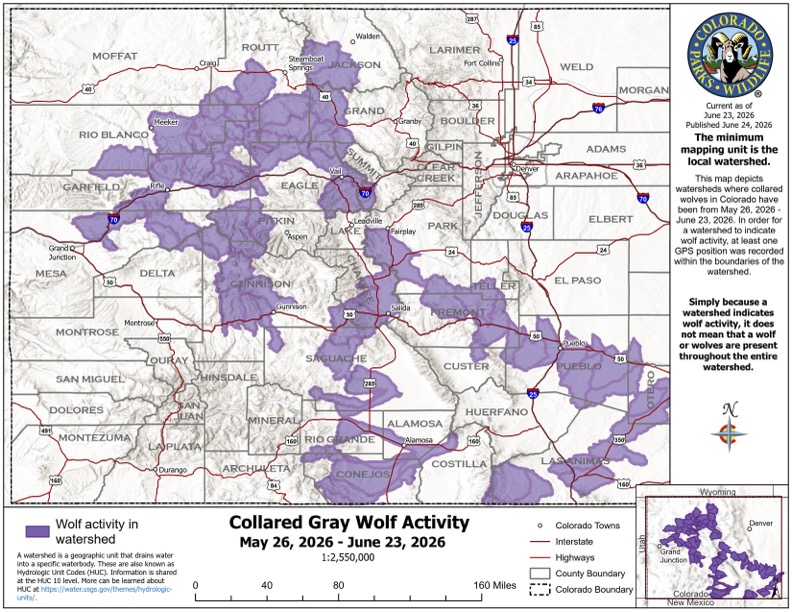
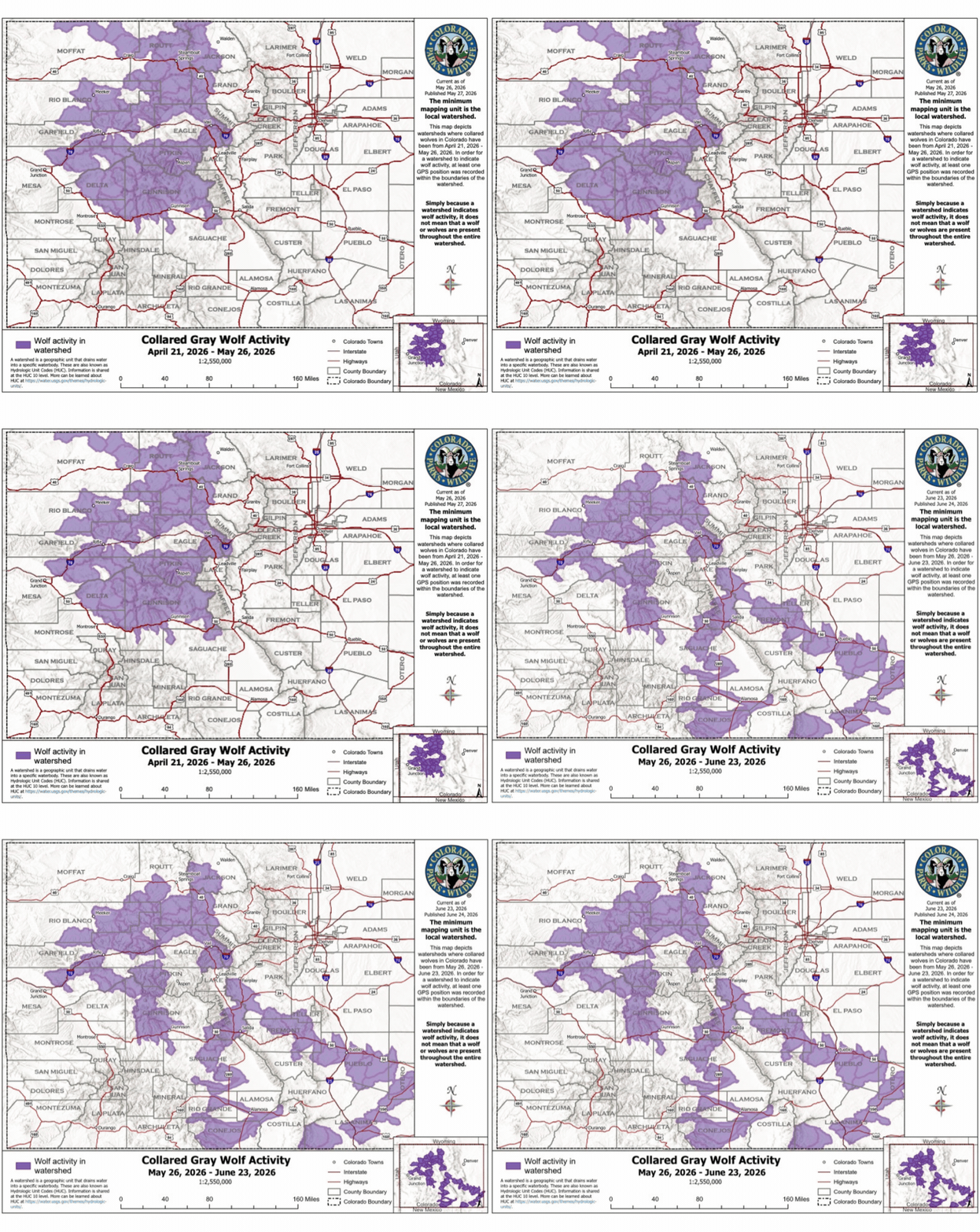
The collared wolf’s trip was captured in the latest wolf activity map, which illustrates the watersheds where Colorado’s collared wolves were located between May 26 and June 23. According to Parks and Wildlife, the wolf only traveled east briefly into watersheds in Pueblo, Otero and Las Animas counties before heading back west across I-25.
In a news release, the agency said this activity “highlights the broad movements made by dispersing wolves,” adding that it has been “in active communication with producers who have known wolf activity near their operations and is coordinating access to conflict minimization resources.”
If a watershed is highlighted, it means that at least one GPS point from one wolf was recorded in that watershed during the 30-day period. GPS points are recorded roughly every four hours.
While the latest map shows Colorado’s collared wolves moving more broadly to the east and south than the previous couple of months, there also continues to be activity condensed in the northwest where the state’s four confirmed wolf packs are located. This includes presence within watersheds across Eagle, Summit, Grand, Jackson, Routt, Rio Blanco, Fairfield, Mesa, Pitkin and Gunnison counties.

Support Local Journalism
Parks and Wildlife has only confirmed four packs in the state: the Copper Creek Pack in Pitkin County, the King Mountain Pack in Routt County, the One Ear Pack in Jackson County and the Three Creeks Pack in Rio Blanco County. All but the Copper Creek Pack originally formed in spring 2025. The agency has not yet confirmed whether additional dens or packs formed this spring, with denning season for wolves spanning from mid-March through May.
With the latest map, Parks and Wildlife said it is monitoring the state’s wolves “for the formation of additional packs and indication of successful reproduction.”
Colorado’s nascent wolf population is still a large mix of pack wolves and dispersing wolves — lone animals traveling broadly in search of a mate and quality habitat. Parks and Wildlife estimated there were at least 32 wolves in Colorado this past winter, including 18 adults and 14 pups.
The state wildlife agency killed a nearly 2-year-old wolf on June 12. The uncollared wolf — born to the Copper Creek Pack in spring 2025 but separated from the group in September 2025 — was tied to attacks on at least 22 sheep in Rio Blanco and Routt counties since 2025. This was the fourth wolf death this year, following a one still under investigation in January and the death of both breeding adults in the King Mountain Pack. The matriarch died in March and, according to a public statement made to the U.S. Fish and Wildlife Service, was shot by a ranch hand in Eagle County, purportedly while attacking cattle. The patriarch died during a Parks and Wildlife collaring operation in January.
What are wolves up to in the summer?
By June and July, any new pups born will begin to explore 100 to 200 yards outside their den, according to a talk given in April at a range rider training by Brenna Cassidy, the wolf monitoring and data coordinator for Parks and Wildlife. Pups start to leave the den gradually, but remain “super, super tied to a location,” Cassidy said of the pups during these months.
“When the pups are weaned, the female goes straight back out and is hunting with the rest of the pack; she usually doesn’t spend that much more time than any other wolf at the den,” she added.
Weaning, according to the International Wolf Center, begins when wolves are around five weeks and can last until they’re about ten weeks old.
As the summer progresses and the pups are weaned, Cassidy said many packs will move the pups out of dens, often in mid-July, and to “rendezvous sites,” where they will often stay for the remainder of the season. She described these sites as “a safe area … and it could be one spot over the summer. It could be two, could be three, could be four. It just all depends on what’s going on in that area.”
By early August, most wolf pups in the Northern Rockies hit around 40 pounds, Cassidy said. As fall begins, she said the pups are likely traveling more broadly and going on excursions within their territories with other pack members.
Regardless of what the packs are up to, the dispersing wolves will continue to make large exploratory movements — as seen in June’s map — until finding mates and settling into their own packs.