Eagle County’s Early Head Start program is working through challenges posed by federal changes
Program removes all language related to diversity, equity, inclusion, accessibility from 2026 grant application


Family Learning Center/Courtesy photo
A number of federal changes to the Office of Head Start this year are having local impacts.
The federal Head Start program provides early childhood education and wraparound services to qualifying pregnant women and children from birth to age 5 at no cost. Early Head Start services, administered by Eagle County, are available to pregnant women and children up to age 3. The Eagle County School District offers Head Start services for children from ages 3 to 5.
Eagle County’s Head Start and Early Head Start programs are overseen by the federal Office of Head Start, which has undergone significant changes since the Trump administration entered office in January.
Federal changes to Head Start
Under direction from the Trump administration, the federal Office of Head Start has reduced its workforce by 70%, consolidated half of its regional offices and asked programs to stop using language related to diversity, equity, inclusion and accessibility.
Many of those changes have had impacts on a local level.

Support Local Journalism
Kendra Kleinschmidt, Eagle County’s program director for Early Head Start, presented a summary of Early Head Start’s work and the program’s 2026 grant application for approval from the commissioners on Sept. 23.
“There has been an increase in stress and uncertainty that is applicable to our local staff but also to our federal partners,” Kleinschmidt said.
The Office of Head Start provides local programs with five-year grants but requires each program to submit a yearly application for continued funding. Eagle County just finished the first year of its most recent five-year grant, which means the program is gearing up to submit its 2026 grant application. Eagle County’s Early Head Start program currently receives $1.2 million in federal funding to provide its services, supplemented with $300,000 in county funding and volunteer time.
“I feel pretty secure (about funding) over the next five years,” Kleinschmidt said. “When we get to the point where we apply for the next five-year cycle, I think there will be a lot more stress and worry.”
This year’s grant application will not include language about diversity, equity, inclusion or accessibility, though Eagle County’s Early Head Start programming is still federally required to ensure 10% of the population it serves has a disability.
“We were instructed to remove specific words from all of our grant documents and grant applications,” Kleinschmidt said.
The program was also instructed to stop work related to dual language learners. In Eagle County, “the vast majority of the children in our program are learning two languages at the same time,” Kleinschmidt said.
Eagle County Early Head Start expects to receive the same amount of funding in 2026 that it did in 2025, meaning for the first time, there will be no 3-5% cost-of-living adjustment.
With federal consolidation, the county is also working with different federal employees.
“All of the people who are in the background to support you and to help with coaching and professional development and guidance on all of these … they’re all gone, and there isn’t this outcry from our local community the way there was when our Forest Service was decimated with the federal cuts,” said Commissioner Jeanne McQueeney.
While Eagle County’s programs should have funding for another four years, the federal government still has the ability to claw back or stop Head Start funding.
“It’s not as secure as we want it to be,” Kleinschmidt said.
Significant policy changes that have been recommended at the federal level but not implemented, including designating Head Start and Early Head Start as a “federal public benefit,” could have the biggest impact on Eagle County’s program, Kleinschmidt said.
“That would change the way that we are operating our program. However, with the pending lawsuits that are happening at that level, we have been instructed to await further guidance, to continue operating our business as usual,” Kleinschmidt said.
“I think the Office of Head Start has set us up in the best way possible with all of the research that we’ve done over the years,” Kleinschmidt said. “We do have good outcomes in Head Start and Early Head Start, and that’s what we can lean on, I think, when we face the criticism.”
Early Head Start shows success, still has work to do
School readiness is “the heart of the (Early Head Start) program,” Kleinschmidt said. This means “helping young children to grow and develop on track so that they have the skills necessary when it comes time to enter kindergarten.”
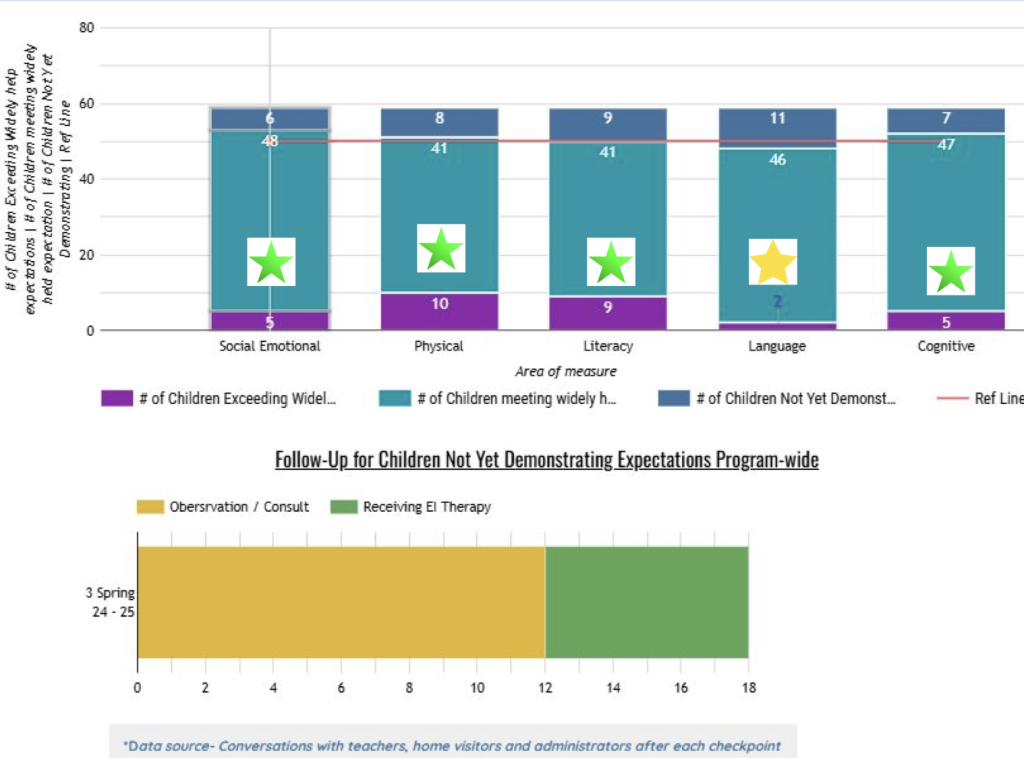
Eagle County Early Head Start sets achievement standards for its students in cognitive, language, literacy, physical and socioemotional development. In 2024, the program upped its goal to 85% of enrollees meeting the standards.
A spring term assessment showed the program was meeting its goals in every category except language (84%), perhaps due to most students being dual language learners (English and Spanish).
In a self-assessment conducted this spring,100% of Eagle County Early Head Start parents reported satisfaction with their child’s growth and development.
Early Head Start operates under a rolling enrollment system, which means that as children turn 3, they age out of the program and younger children are enrolled. From August 2024 through July 2025, the program served 110 children.
Eagle County’s Early Head Start programs have the capacity to serve up to 74 infants, children and pregnant women. There are currently 62 individuals enrolled in the program, 19 in center-based programming, 41 in home-based programming and two are pregnant women.
There are 109 families on the county’s Early Head Start waitlist.
Early Head Start is currently engaged in a full enrollment initiative as the program is underenrolled due to a lack of available center-based slots.
“We are optimistic that we will successfully complete that process,” Kleinschmidt said
The program may “face some financial ramifications” if it does not reach full enrollment capacity, Kleinschmidt said.