How nature-inspired design can guide architects to use sustainable materials
Peerapat Wimolrungkarat
Nature has inspired humans in myriad ways from the beginning of time, but one of the relatively untapped applications of how nature can improve building structures comes in the form of architectural biomimicry. The Greek-derived word “biomimicry” combines “bio,” meaning “life,” and “mimicry,” meaning to imitate.
While true biomimicry hasn’t been employed much in residential settings in this region or throughout the nation, it holds great potential. Nature can guide architects to employ sustainable, efficient materials more and more in the future.
Campbell Frey, architect, AIA and NCARB at Shepherd Resources, Inc. in Edwards, studied at the Biomimicry Institute for a year, earning a certificate in 2013. He focused on product design, specifically a backpack that naturally charged devices while hiking.
“It comes down to efficiencies — taking the load off of mechanical systems,” he said. “Bioutilization (is about) using nature to do a task.”
“It’s a way of approaching problem solving: Here I have a tricky problem; how would nature resolve what I can’t figure out?” Campbell Frey, architect, AIA and NCARB at Shepherd Resources, Inc
Various industries have incorporated the concept. For instance, hospitals use surfaces that bacteria can’t grow on in operating rooms. These surfaces were partially inspired by sharks’ skin, upon which bacteria doesn’t grow.

Support Local Journalism
Lotus leaves, butterfly wings and moths’ eyes also employ tiny bumps positioned to repel water, dirt and bacteria. Meanwhile, humans usually deal with dirt and bacteria by using toxic chemicals or a lot of water and other resources. But scientists at Fusion Bionic have developed a way to nano-texture surfaces through a process called directed laser interference patterning, which generates textures that mimic nature’s surfaces and can be used on all types of materials, including metals, polymers, ceramics, coatings and glass that can be employed on solar panels, furniture and other products.
While biomimicry hasn’t taken off in the residential world, it has been embraced in larger projects, from farms and ranches to commercial buildings. Indeed, the design of buildings to mimic how nature functions “is limitless, since nature has no bounds,” according to Parametric Architecture’s website, a media company that researches art, architecture and design to envision better environments based on biomimicry.
For example, high-rise buildings may employ a specific coating that humans can’t see but birds can, so that birds don’t fly into the windows. The technology was inspired by spider webs, which birds tend not to fly into, Frey said.
Another simple example involves carpet squares. In 2001, Interface, one of the largest flooring companies, asked: How would nature design a carpet? The research team noticed that forest floors don’t abide by exact patterns; rather, diverse organisms are randomly distributed on the ground. So the company produced a carpet called Entropy, installed using random tile patterns. As a result, if a portion of the carpet becomes stained, one or two tiles can be replaced without worrying about matching a specific overall pattern.
A classic example of biomimicry involves how termite mounds ventilate to keep it cool, which can be applied in buildings, resulting in less fossil fuel, or energy, use.
“It’s a way of approaching problem-solving: Here I have a tricky problem; how would nature resolve what I can’t figure out?” Frey said.
Still, he admits it’s so far been “difficult to apply in residential (structures) daily — you need the right problem to solve and the right client.”
Architects like Shepherd Resources have incorporated biomimicry in early design phases of ranches and other organizations of buildings on properties by taking into account gravity and natural water flow on land, as well as light and shadows to orient buildings for energy efficiency.
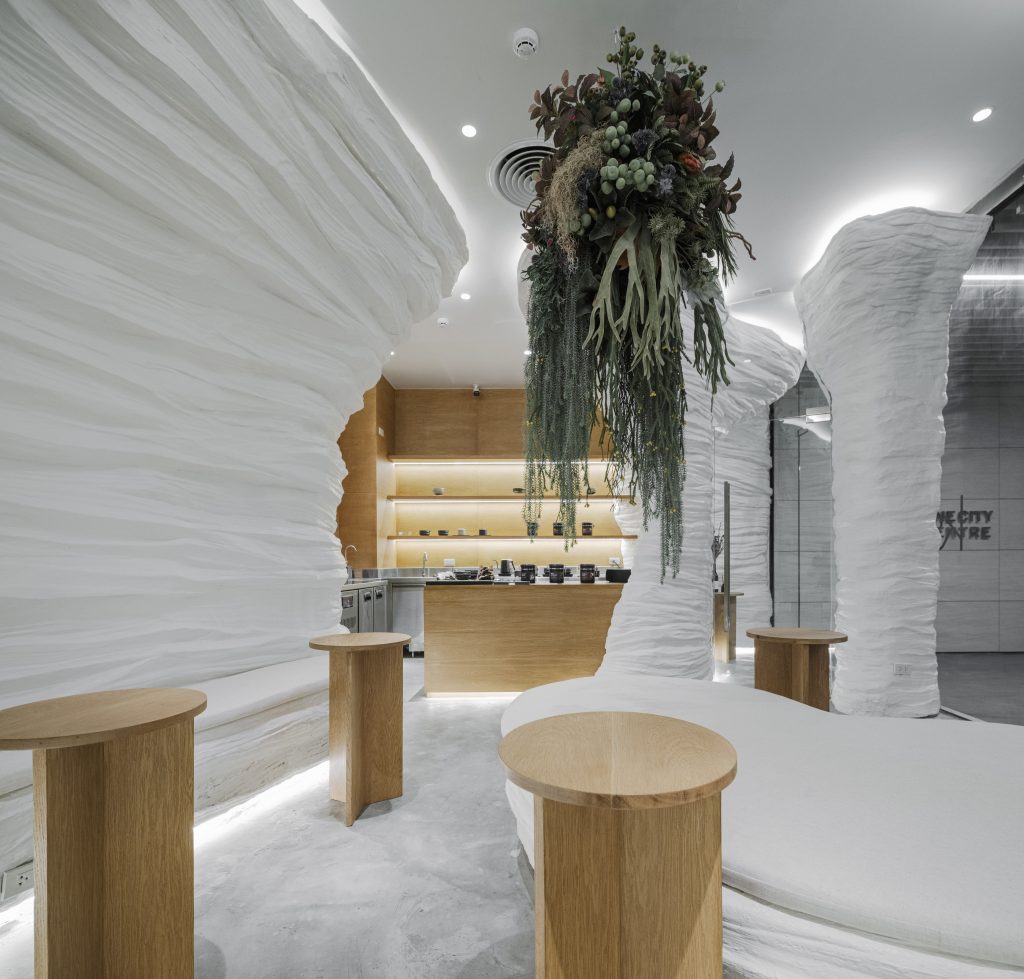
One architectural example of mimicking nature’s efficient systems took shape in a home for a family of 14 in Jaipur, Ahmedabad. The circular dwelling features a great room in the center, which provides plenty of light and ventilation, while bedrooms and the kitchen are situated around the verandah to support thermal comfort by controlling sunlight and providing adequate ventilation. Another example came in the form of the KSANA Tea House in Bangkok, Thailand. Its design mimics low-sloped cave chambers to present a private, minimalist atmosphere within a crowded city.
“The biomimicry application in design often involves looking at the nanoscale to see how things are put together,” he said. “This is not a scale we regularly work at in residential architecture, but the products and materials that are derived from biomimicry can be used within the buildings.”

Generally speaking, heat exchange systems can be credited to how nature and biology works, particularly the pressure exchange in the organs of deep diving birds. Additionally, the concept can be extended to energy transfer within a building, or multiple buildings, just like energy transfers from resource levels in a hierarchical food chain.
“The biological strategy that allows birds to dive deep into the ocean is very similar to the heat exchange systems we employ in buildings all the time,” he said. “We cool hot air by blowing it over coils of cold water, just as these birds use a complex network of vasculature to create a ‘pressure exchange.’ Giraffes use the same organ, the rete mirabile, to regulate their blood pressure when they lower and raise their head.”
Of course, architects in the Vail Valley and throughout the nation have incorporated the very most basic form of biomimicry in architecture: Just think about the adobe homes throughout New Mexico or, locally, how roof lines blend into the mountain environment. But, that’s not true biomimicry, Frey points out, because it doesn’t use nature’s innovative methods to solve a “true” problem (other than soothing eyesores of homes that stand out like neon signs in natural environments). Still, it’s a step in humans studying — and listening to — nature to build a better tomorrow.
“(Biomimicry) will influence the future course of technology fundamentally — completely new and unexpected paradigms will be created not only for synthesis of materials and how they are put together but also how they are processed,” wrote Herbert Waite, a professor of molecular cell and developmental biology at the University of California, Santa Barbara, on MIT Technology Review. “The true value of these bio-inspired strategies lies in the depth of our understanding of such systems. We have to conduct more research at a fundamental level.”