The cost of a Colorado program providing health care to undocumented immigrants ballooned. Now, lawmakers are eyeing cuts.
Cover All Coloradans, which extended Medicaid coverage to children and pregnant women regardless of their immigration status, has seen its costs increase more than 600% beyond its original estimate

Robert Tann Follow

Chris Dillmann/Vail Daily
When Colorado lawmakers passed a bill in 2022 to grant Medicaid coverage to pregnant immigrant women and children, regardless of their immigration status, they did so under the assumption that it would cost the state roughly $14.7 million in the program’s first full fiscal year.
In reality, Cover All Coloradans, which launched in 2025, will end up costing the state over $104.5 million for the fiscal year that began on July 1 and runs through June 30, a more than 600% increase over its original estimate.
Now, the program faces cuts as lawmakers prepare to close a roughly $1.5 billion shortfall in the upcoming state budget, including an enrollment cap and benefit reductions. It’s among a list of health care cuts proposed by the Joint Budget Committee, a bipartisan panel of lawmakers that crafts the state’s annual spending plan.
Colorado House Speaker Julie McCluskie, D-Dillon, who was a lead sponsor of the 2022 bill to create Cover All Coloradans, said she was “pained by the cuts” that were included in the budget committee’s spending plan, which the legislature will soon need to pass and send to Gov. Jared Polis to become law.
Still, McCluskie believes the proposals represent “responsible, if not very difficult, action” by budget writers.

Support Local Journalism
“My hope is that we are able to continue to provide this program as best we can for years to come,” McCluskie said.
For Republicans, the ballooning cost is a glaring example of what they’ve long argued: That Democrats have spent big on programs the state can no longer afford, which they say has contributed to the current budget crisis.
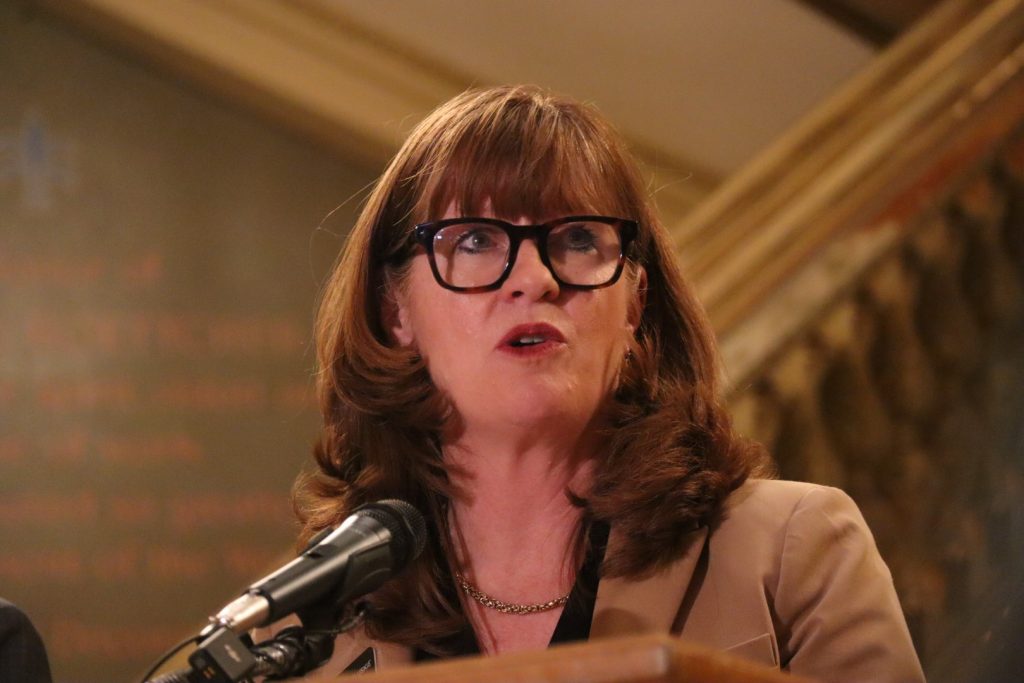
“We can’t afford to keep overspending on programs that are not core to our government, core to what we are supposed to be doing as legislators here at the state Capitol,” said Sen. Barbara Kirkmeyer, R-Brighton, one of two Republicans who sit on the budget committee, and a candidate for Colorado governor in 2026.
Alex Sanchez, President and CEO for the Glenwood Springs-based immigrant advocacy group Voces Unidas, said rollbacks to Cover All Coloradans will hit rural areas particularly hard. Mountain resort communities are home to large immigrant populations and already see some of the highest uninsured rates in the state.
Sanchez said less preventative care through programs like Cover All Coloradans will drive up expensive emergency services, like hospital visits and transfers.
“Colorado will have to learn the hard way that it will cost us more long-term by reducing proactive, preventive programs like the ones that we’re cutting now,” he said.
Miscalculations and incorrect assumptions
There are several factors behind why cost projections for Cover All Coloradans were so far off.
That includes an underestimation of how many new immigrants would come to Colorado and be eligible for coverage, according to the Colorado Department of Health Care Policy and Financing, which oversees the state’s Medicaid program.
The program only covers pregnant women and children under the age of 19 who don’t qualify for Medicaid because of their immigration status, including those who are undocumented. Originally, the program was expected to serve a few thousand people in its first year. But as of February, enrollment was around 28,000 people, about 20,000 of whom were children.
“This is a population that is very hard to estimate,” the department wrote in response to emailed questions. “Subsequent to the passage of the legislation, we had the largest migration into the U.S. since the late 19th century.”
Fiscal analysts also failed to accurately predict the cost of providing services to children, having assumed that they would be relatively healthier compared to the rest of the state’s Medicaid child population. Those assumptions were based on early data from a similar program in Oregon, but children enrolled in Cover All Coloradans ended up having similar costs to children on traditional Medicaid, according to the health department.
Colorado is one of 14 states that provide state-funded health care coverage to low-income immigrant children, and one of 24 states that cover pregnant women, regardless of their immigration status, according to the Kaiser Family Foundation.

To curb costs, the Joint Budget Committee approved a cap of 25,000 children for the 2026-27 fiscal year, which begins on July 1, and lowered the cut-off age from 19 years old to 18 years old. There would not be a cap for pregnant women.
The budget committee also included roughly $12.9 million in cuts for the program, recommended by the state’s Medicaid agency, including a cap on dental benefits and an end to long-term care services for new enrollees, though children currently receiving that care would be grandfathered in.
Some of the benefit cuts wouldn’t go into effect until Jan. 1, midway through the 2026-27 fiscal year.
Lawmakers are currently debating the budget, and will have the opportunity to bring amendments that the budget committee will either accept or reject. After that, the budget faces one more procedural vote in the House and Senate before it can be sent to Polis to become law.
‘A very serious value challenge’
The program’s future continues to divide lawmakers, with Democrats remaining committed in their support while some Republicans, who’ve largely opposed the program since its inception, want to see it end.
When making spending decisions, budget committee member Rep. Rick Taggart, R-Grand Junction, said the issue becomes more nuanced.
“I think it’s easy for people to take a position on one extreme versus another,” said Taggart, one of two Republicans on the Joint Budget Committee. “It’s a very serious value challenge to me.”
Taggart said he is sensitive to the argument made by many of his Republican colleagues that the program is providing state-funded health care to immigrants who may be undocumented, when that money could instead be going to Colorado citizens. Funding for children in the program comes from state dollars, although the state does use some federal funding to cover pregnant women.
Taggart said he has to balance that argument against two other factors.
“One is: These are human beings,” he said. “I can’t ignore that these are human beings, and when it comes to children, they didn’t make the decision to immigrate to our country; it was their parents.”
The other concern for Taggart is that if the program were eliminated, it would further stress hospitals, particularly in rural parts of the state, which would have to absorb more uncompensated care from immigrants who don’t have health coverage.
He said the cost-control measures the budget committee approved were “the best solution.” But the decisions haven’t been easy.
“I didn’t sleep,” Taggart said, “while I was trying to work this through in my mind: ‘What could we do that was fair to these families, but at the same time was fiscally responsible?'”
Cuts come after years of spending growth
The cuts being proposed by lawmakers this year have further fueled a debate over government spending.
A key driver of the state’s $1.5 billion shortfall is Medicaid, which recently eclipsed K-12 education as the single-largest budget item in the state’s general fund.
A state-commissioned report last year found that Medicaid spending had increased nearly 60% since fiscal year 2018. That’s almost double the rate of overall state spending growth allowed under the Taxpayer’s Bill of Rights, or TABOR, a 1992 voter-approved amendment to the Colorado Constitution that limits government revenue to the rate of population growth plus inflation.
Democrats have largely focused on the revenue cap as the reason for the budget shortfall, arguing that TABOR has artificially constrained the state’s ability to keep up with increased needs, such as more long-term care services for older Coloradans.
Republicans say money mismanagement and increased spending are the main culprits of the state’s budget woes. State Medicaid officials have come under scrutiny after recently revealing that they mistakenly overpaid certain providers for years, costing the state hundreds of millions of dollars. The state’s top Medicaid official, Kim Bimestefer, resigned this month amid criticisms of her handling of the health care agency.
And while increased utilization of expensive services, like long-term care, has driven up costs, lawmakers have also added hundreds of millions of dollars in increased expenses through the creation of new programs, like Cover All Coloradans.
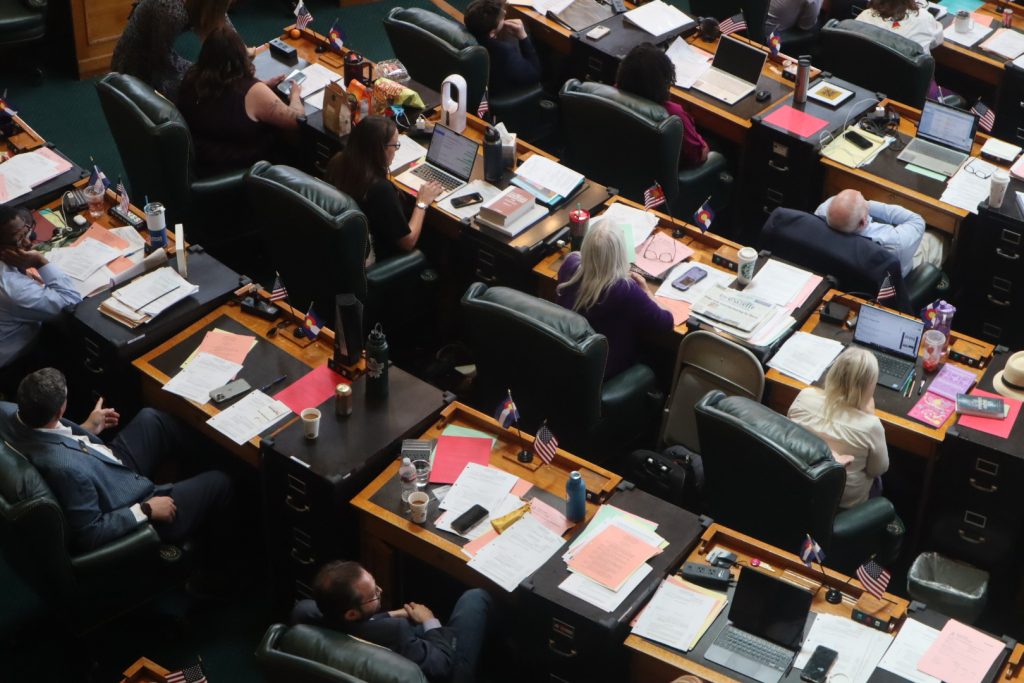
A February report by the Common Sense Institute, a think tank focused on promoting free enterprise policy, found that between 2019 and 2025, the Colorado legislature had enacted 182 new health care laws. Those measures, which the report says “created new bureaucracies, expanded covered services, and added regulations on public and private providers,” totaled at least $858 million per year in new state spending.
Now, lawmakers are preparing to vote on a budget that would pare back Medicaid spending across several areas, including a 2% cut to reimbursement rates for Medicaid providers, a cap on billable hours for at-home caregivers, and an increase to the waitlist for adults with developmental disabilities who need 24/7 care.
Kirkmeyer said an enrollment cap for Cover All Coloradans is a “good first step,” but feels that spending on the program has forced cuts to other essential services.
“I’m saddened by the fact that we have cut funding to those individuals who are the poorest of the poor that are among us and medically fragile and U.S. citizens,” she said.
McCluskie remained steadfast in her support for the Cover All Coloradans program, saying she still would have championed its passage in 2022 even if she had known then what its true costs would be.
“I have yet to talk to anyone who would say that a pregnant woman or a child is undeserving of care,” McCluskie said. “If we don’t provide this program upfront, then individuals … will wait until that child needs to be seen in an emergency room. The system is better for this program; overall, health care costs are better for this program.”
She added, “We have a lot of problems in the (health care) system, but fighting for this program is right.”