Colorado employers would need to commit to measures to protect workers from extreme heat and cold, under Western Slope lawmaker’s bill
A similar bill died last year in its first committee hearing

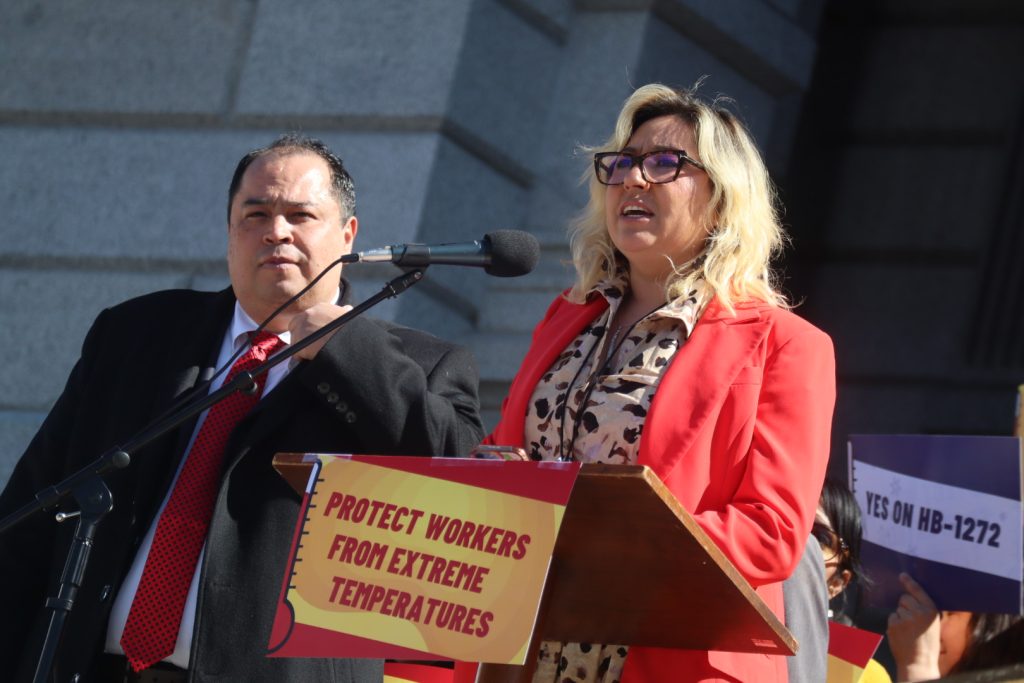
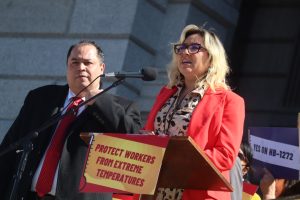
Robert Tann/Vail Daily
A state lawmaker representing rural and resort areas of Colorado’s Western Slope is reviving a bill to ensure workers are protected from extreme heat and cold after a similar measure failed last year.
Rep. Elizabeth Velasco, D-Glenwood Springs, said her latest measure, House Bill 1272, comes in response to severe temperatures that have become increasingly common under climate change.
“When we talk about climate change, working people know about climate change, because we experience it every day,” Velasco said Wednesday during a news conference outside the state Capitol.
“When workers are safe, that is good for industry, because we are able to produce more, we’re able to do our job, we’re able to not have injuries at work,” Velasco continued. “So this is a win-win.”
HB 1272 is also sponsored by Rep. Meg Froelich, D-Englewood, and Sens. Lisa Cutter, D-Littleton, and Mike Weissman, D-Aurora.

Support Local Journalism
Under the bill, the Colorado Department of Labor and Employment would be required by January of next year to collect data on workplace injuries related to extreme temperatures and develop standards for employers to help prevent such injuries.
By January 2028, the department would need to develop a model plan for preventing temperature-related injuries and illnesses, and employers would need to submit their own site-specific plans to the state by September of that year, which would be subject to approval by the labor department.
The labor department would also be required to create training standards that employers would need to use for workers who are exposed to extreme temperatures. Employers who don’t comply could face civil penalties.
The bill is supported by more than two dozen progressive groups and labor organizations, including Voces Unidas, a Glenwood Springs-based immigrant advocacy group that operates across the Western Slope.
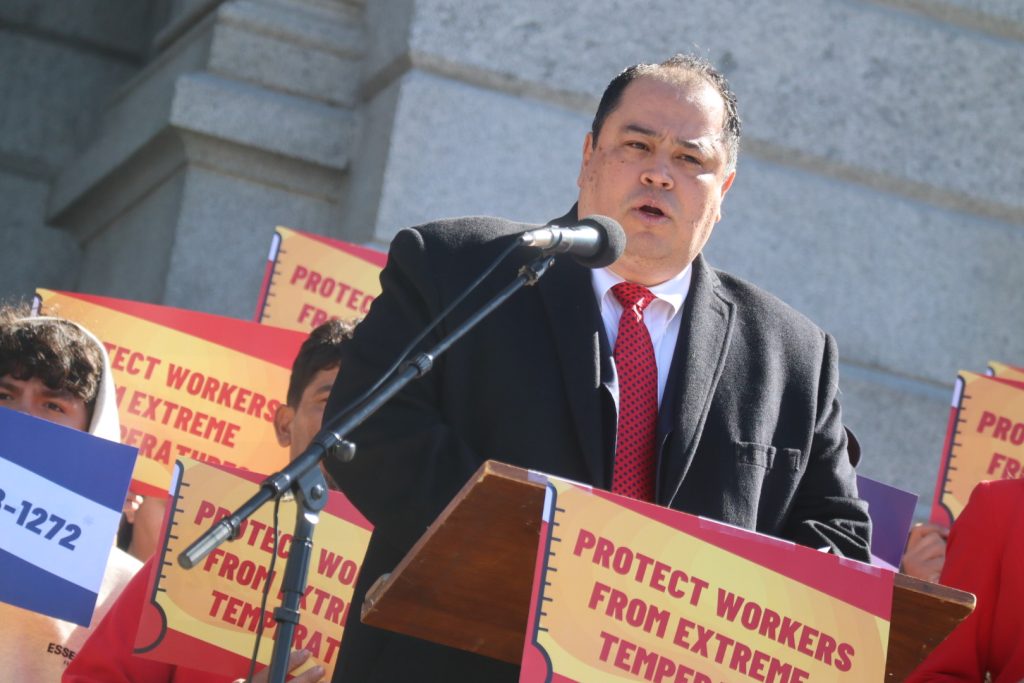
Voces Unidas President and CEO Alex Sanchez, speaking during Wednesday’s news conference, said Latino workers and other workers of color are overrepresented in jobs that can expose them to extreme temperatures. That includes work in warehouses, construction, landscaping and agriculture.
“But this bill is about protecting all workers in Colorado,” Sanchez said. “…This bill helps make sure basic worker protections are not optional.”
Sanchez said extreme temperatures impact indoor and outdoor workers across many sectors. He shared stories of workers he’s heard from, including a landscaper who Sanchez said suffered heat stroke due to lack of water and breaks, a snow removal worker who spent hours in the cold during a major snowstorm and lost a finger to frostbite, and a housekeeper who was forced to move from warm indoor spaces and freezing outdoor winter temperatures while still sweating from physical labor, which Sanchzes said damaged her health.
“People are getting sick. People are getting hurt. And too often, they’re being expected to just keep working,” Sanchez said.
HB 1272 is modeled after a bill that Velasco introduced last year, but which failed to advance out of its first committee amid pushback from businesses.
Last year’s bill was more sweeping in scope and would have imposed specific mandates on employers whose workers are exposed to extreme temperatures, including providing access to shade, air conditioning and heated indoor spaces, providing water for each worker and allowing workers a 15-minute paid break every two hours when temperatures are high.
In response to concerns she heard from employers about last year’s bill, Velasco said she worked to make HB 1272 less prescriptive. She said different industries have their own practices for keeping workers safe from extreme heat and cold, and wanted to ensure those could be reflected in whatever standards and plans the state creates.
“If they’re able to share with us, ‘What are those safety practices that are in place to protect workers?’ we definitely think that that is a good thing,” Velasco said. ” … We want these guidelines to apply across the board, and we know that there’s specificity to each industry, so we did want to make it more flexible.”
The bill’s cost, however, could pose a challenge.
A fiscal analysis by the nonpartisan Legislative Council Staff shows the bill could cost the state $448,000 for the 2026-27 fiscal year, and over $5 million annually through the 2029-30 fiscal year.
Legislative staff wrote in their analysis that much of that is likely to be driven by the cost of compliance from other state agencies whose employees may be exposed to extreme temperatures, including the departments of agriculture, local affairs, military and veterans affairs, natural resources, public health and environment, public safety, and transportation and higher education institutions.
Those agencies would have to develop and submit prevention and safety plans, which may require “additional staff, equipment to mitigate employee exposure to extreme temperatures, or other expenditures to otherwise comply with the bill,” legislative staff wrote.
Lawmakers are currently working to close a roughly $850 million deficit in the next fiscal year’s budget, which begins on July 1, and legislative leaders have warned their colleagues that bills that increase state costs are effectively dead on arrival.
Velasco said she plans to introduce an amendment to the bill during its first committee hearing aimed at reducing its fiscal impact. Velsco didn’t share specifics about the amendment but said she hopes to “minimize the fiscal note” by finding a way for departments to work with existing resources when complying with the bill.
HB 1272 is scheduled to be heard in the House Health and Human Services Committee on March 18.