Column | Big Pivots: Essential books about the Colorado River
Big Pivots
Courtesy photo
Editor’s note: This is an abbreviated version. The full column is available on bigpivots.com.
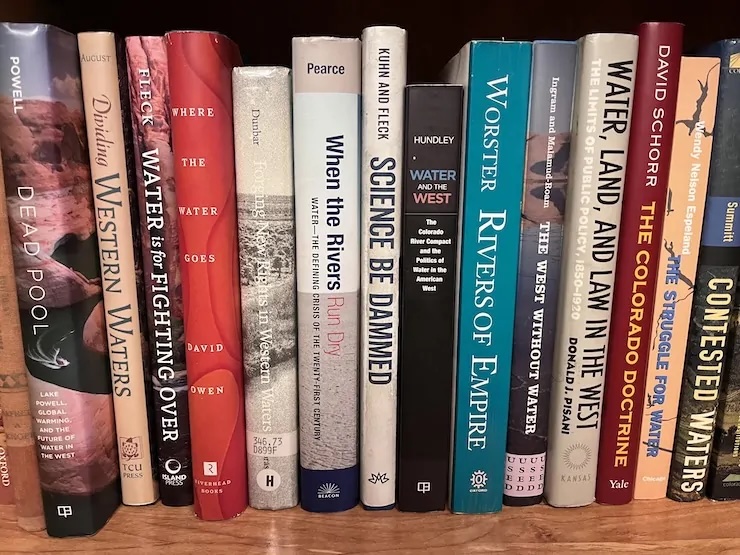
I like books. No, make that stronger. I treasure books, particularly those about the Colorado River and, more broadly, water in the West.
Scores of books have been published over the years, and more yet will arrive as climate-driven aridity strengthens its grip on the Southwest, shrinking the Colorado River even more. The seven states that rely on water from the Colorado River are at loggerheads, each blaming the others for the impasse preventing a long-term agreement on sharing the river’s waters. They all interpret the laws, historical agreements and particularly the Colorado River Compact of 1922 in ways that favor their own positions.
In reading comments from the myriad reports and posts on this issue, it’s clear that many people who are now concerned about the river have scant knowledge about the law, the history and the cultures that have shaped use and management of the river during the past 100-plus years. Perhaps the most common and incorrect belief is that California is stealing our water. They aren’t.
For those who really would like to learn more, here are some suggestions.

Support Local Journalism
For the Colorado River Compact, the foundation of what is known as the Law of the River, no book beats Norris Hundley Jr.’s “Water and the West: The Colorado River Compact and the Politics of Water in the American West,” second edition. A historian, Hundley detailed what caused the seven states to pursue a compact for sharing, the process of its creation in 1922, and the subsequent political squabbles until its final ratification in 1928. The book’s first edition came out in 1975, but the second edition, with a new preface, updates much of his thinking.
This one book is essential for understanding how the river’s waters were divided over 100 years ago. Hundley dives into the contentious politics of the time, which aren’t so different from today. For a document that is only four pages long, the compact carries a lot of baggage.
The 1922 Colorado River Compact is at the heart of all the subsequent agreements and arguments about the river. Hundley explains the complexities well with both depth and eloquence.
The second must-read is “Science Be Dammed: How Ignoring Inconvenient Science Drained the Colorado River,” by Eric Kuhn and John Fleck. In this 2019 book, Kuhn and Fleck examine the history of the compact and its aftermath through the lens of hydrology, the flow of the river itself. They explain how the creators of the compact chose to divide the waters based on optimistic, and incorrect, flow measurements and projections for the future despite having more realistic numbers at hand. Our current problems were born by this hopeful fantasy. The dreams of the old booster mentality remain very much alive, premised in these 100-year-old miscalculations.
Frank Waters’ “The Colorado” provides insights into the early history and culture of the Colorado River. Published in 1946, the book is a series of stories about the river, the lands it flows through and the people who lived along it, from the headwaters to the sea. Waters’ stories come from his personal experiences in a world of the river that no longer exists. He also wrote with a perspective from Native America that was unusual for that time. One chapter covers a trip down the river from Yuma, Arizona, to the Gulf of California on a regularly scheduled steamer. That hasn’t been possible since the river was first dammed in the 1930s. The book may be a bit dated, but it’s a delightful read about the river, its landscape, its history and its people.
Other recommendations
- Philip Fradkin’s “A River No More”
- Marc Reisner’s “Cadillac Desert”
- Donald Worster’s “Rivers of Empire: Water, Aridity, and the Growth of the American West”
- Daniel McCool’s “Command of the Waters” and “Native Waters”
- Eric Perramond’s “Unsettled Waters”
- Wallace Stegner’s “Beyond the Hundredth Meridian”
- Frederick S. Dellenbaugh’s “The Romance of the Colorado River”
- Melissa Sevigny’s “Brave the Wild River” and “Mythical River”
- Kevin Fedarko’s “The Emerald Mile”
- Katie Lee’s “All My Rivers Are Gone”
- Edward Abbey’s “Down the River”
- Zak Podmore’s “Life After Dead Pool”
Ken Neubecker has spent much of his adult life following — and participating in — the discussions about the future of the Colorado River and its tributaries in both personal and professional capacities. One measure of his devotion is how many times he has rafted the Colorado River and its tributaries from the Grand Canyon to its headwaters. He has, for example, rafted the Yampa River through Dinosaur National Monument around 20 times.