Core Transit employees’ unionization effort stalls
Amalgamated Transit Union, Core Transit management disagree on who should be included in potential union

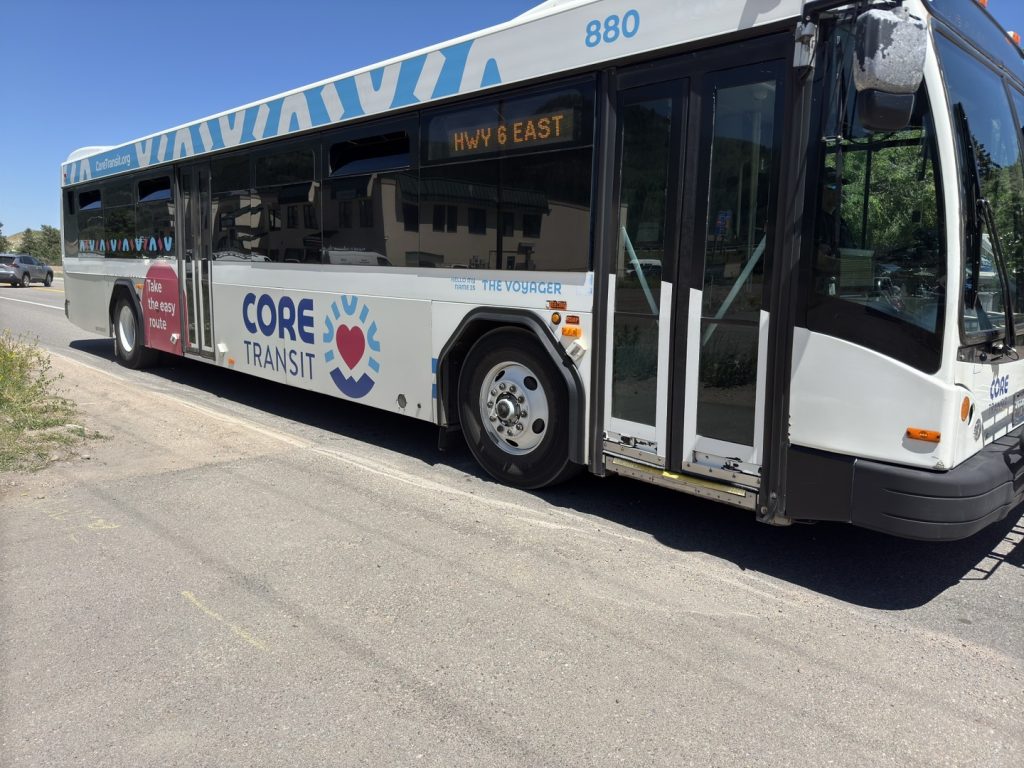
Chris Dillmann/Vail Daily archive
Some Core Transit frontline workers are trying to unionize.
But the unionization effort has temporarily stalled as Core Transit management and the Amalgamated Transit Union dispute which workers should be included in the union.
Union advocates argue that the group of employees represented by Core Transit’s union — its bargaining unit — should include its bus drivers (operators), customer service representatives and fleet maintenance workers. Core Transit management’s position is that the bargaining unit should solely consist of operators.
As union organizers work toward holding a vote amongst workers to decide whether there will be a union, a pre-election meeting between the Amalgamated Transit Union and Core Transit management scheduled for last week was postponed after Core Transit management contested the proposed community of interest — the workers that would make up the union.
“All these delays are making it harder for us to get to an election,” said Mike Harms, a representative for the Amalgamated Transit Union. “People are losing hope that we can win an election.”

Support Local Journalism
Core Transit Executive Director Tanya Allen dismissed those claims.
“It is absolutely not a stalling tactic to protest the election,” she said. “It’s the first step in a state-regulated process to move forward with a union election. It’s a step in every process. The petitioner files for that bargaining unit that they would like to see, and then the employer has the opportunity to discuss whether that’s the appropriate bargaining unit.”
Core Transit management objected to the proposed community of interest because many facets of the customer service representatives and the fleet maintenance technicians, including compensation, supervisory structure, job duties and job location, differ from those of operators.
“It’s important for the employees in that bargaining unit to make sure they are represented appropriately,” Allen said. “If you have a bargaining unit that is made up of multiple different types of jobs that are very different, at some point, when the union is working on that bargaining agreement, there is going to have to be some give and take between who gets what and why.”
What matters in your community, delivered daily.
Sign up for our morning newsletter at VailDaily.com/newsletter
Core Transit management and the union are discussing which employees will make up the bargaining unit. Once that is resolved, the state-organized election will proceed.
If Core Transit management and the union cannot agree on the makeup of the bargaining unit, the state will make the final decision.
“They’re going to review everything,” Allen said. “They’re going to say, ‘this is the appropriate group. You’re going to move forward with this group.’ And then they’ll help us schedule the election, notice the election and carry out the election according to the procedures.”

Why are Core Transit workers considering a union?
Core Transit is somewhat unique in that it does not have a union. The Roaring Fork Transportation Authority in the Roaring Fork Valley and Summit Stage in Summit County have been unionized for years.
“ATU (Amalgamated Transit Union) is really common across the country in a lot of transit agencies, so there’s really no surprise that there would be a union drive here, particularly as we’re undergoing a period of change in organization, going from being a county department to a transportation-specific organization,” Allen said.
The first version of Core Transit was born with the approval of the Eagle Valley Transportation Authority in November 2022. The organization grew when ECO Transit and the Eagle Valley Transportation Authority merged in August.
In April, Core Transit frontline workers brought Harms to Eagle County to begin meeting with their coworkers about the option for a union.
“When we started this discussion about unionization, I believe that operators and frontline staff felt like they were being thrown a lifeline,” said Stephanie “Sunshine” Samuelson, a former Core Transit employee. “We were met, initially and still are, with a very eager operations frontline staff.”
Harms and Core Transit’s union advocates were able to get the required 50% of frontline workers to sign cards indicating they were interested in there being a unionization vote.
Core Transit’s frontline workers are primarily considering unionization to increase organizational transparency and collaboration, and feel safe in their jobs, Harms said.
“They want the chance to have a voice, and a real voice, on issues that affect them … The fact that they’re at-will employees — they can be fired for any reason or no reason whatsoever,” Harms said. “People are really looking for the protection of a group of people that have the same common interest.”
Samuelson, who worked for ECO Transit for 10 years before it was absorbed by Core Transit in August, said she noticed a distinct difference in the workplace culture of the two organizations.
“Core management really made a huge emphasis on a corporate structure, with the brand voice being at the forefront,” she said. “Nothing wrong with that, but what operators had been doing and what frontline staff had been doing didn’t change.”
As a customer-facing customer service representative based at the Vail Transportation Center, “I didn’t have tools to do my job to help the customer, and when I expressed that is when I was called negative and unprofessional,” Samuelson said.
Samuelson’s employment was terminated by Core Transit in May.
“What I experienced, personally, was the inability to speak openly and honestly with my superiors and be able to ask questions,” Samuelson said. “I felt more as though I was being talked to instead of with.”
Though no longer a Core Transit employee, Samuelson continues to organize the unionization effort.
“I may not be working directly with (Core’s frontline workers), but I will work for them,” Samuelson said. “They are my family.”

Allen, who worked as the regional transportation director for ECO Transit for three years before leaving to become Core Transit’s first employee in July 2023, said the difference in culture between the two organizations has been deliberate, if complicated.
“When we started out with Core, we used to talk about ourselves as a start-up, because we were, in those first few months,” Allen said.
At the beginning of August 2024, the Eagle Valley Transportation Authority had about a dozen employees. On Aug. 4, the rebranded organization grew to over 100 employees.
“We’re seeing something that looks a lot like a business merger in a lot of ways,” Allen said. “We’re trying to build a system that can be scaled … and that takes some time. Building those kinds of transparent, easy to read, very legible procedures that you can move through a large organization is difficult.”
Core Transit management, union advocates vow to work together
Samuelson said that while unionization was briefly discussed under ECO Transit, a driver committee was established instead, on which she served as the chairperson for two years.
“We had the ability to bring concerns and voice discrepancies with management, and that’s a little shaded at this moment,” she said.
The driver committee — a group of frontline workers elected by their coworkers who advocate for frontline workers’ issues — still serves its original purpose, but enough workers have shown interest in unionization that the driver committee may not be enough anymore.
“This group has been good. They stuck strong. And I am under the full impression that we are going to win,” Harms said. “We just need to get to a vote.”
When the union does go to a vote, it will need approval from 50% plus one of the participating frontline workers to pass. Both union advocates and Core management say they will happily work together if the union passes.
“It’s a different arrangement, but it’s absolutely an arrangement that we’re more than happy to work with,” Allen said. “The most important thing is that it is an informed choice that is made by the employees in our organization.”
“Hopefully, the union can pass and Core Transit will work symbiotically,” Samuelson said.