Colorado Democrats move to reverse state tax breaks for businesses, divert money to tax credit for lower-income families
The measures come in response to the One Big Beautiful Bill Act passed last summer by congressional Republicans

Robert Tann Follow

Robert Tann/Vail Daily
Colorado Democrats are advancing a package of bills in the final days of the 2026 legislative session that would end a suite of tax benefits for businesses and divert the revenue to a new tax credit for lower-income families.
Lawmakers say the measures are aimed at closing corporate tax loopholes and rebalancing the state’s tax code in the wake of President Donald Trump and congressional Republicans’ sweeping domestic policy law passed last summer.
The law, dubbed the One Big Beautiful Bill Act, created and expanded a flurry of tax breaks for individuals and corporations, while also placing new limits on social safety net programs like Medicaid and the Supplemental Nutrition Assistance Program, or SNAP. Colorado mirrors the federal tax code, meaning businesses are eligible for state-level versions of the federal benefits.
Democrats are now moving to end those benefits at the state level, as well as others that existed before the federal law, and use the money instead to fund tax relief for families. The Democrats’ four bills, all of which cleared the House on a nearly party-line vote on Monday, May 4, sparked hours of debate with Republicans.
“I know that our tax code is rigged,” said Rep. Yara Zokaie, D-Fort Collins, during a preliminary vote last week on her bill to limit corporate deductions for executive salaries. “It is rigged to favor the ultrawealthy and giant corporations, and that is able to happen because the middle class and the working class subsidize wealthy and corporate interests.”

Support Local Journalism
Zokaie said the “problem has now exacerbated” under the One Big Beautiful Bill Act.

Rep. Chris Richardson, R-Elbert County, said Democrats’ tax policies are threatening businesses’ ability to operate in Colorado. Many will end up leaving as a result, he added.
“We are killing our revenue streams, slowly and steadily, but more and more apparently,” Richardson said.
All four bills now go to the Senate for further action.
Decoupling Colorado from the federal tax code
House Bill 1222 would end state tax breaks that were automatically created or expanded following the passage of the One Big Beautiful Bill Act.
The bill largely applies to provisions that allow businesses to claim up to 100% of their deductions within the same tax year, rather than having to spread their deductions out over time. That includes deductions for manufacturing-related buildings and equipment, research and development and interest paid on debt.
Reversing those tax benefits is expected to generate $189.9 million for the state for the 2026-27 fiscal year and $329.2 million the following fiscal year. HB 1222 would use that money to fund an expanded tax credit for families making up to $95,000 per year.
Democrats say that a new tax credit is needed after families lost the ability for the 2026 tax year to claim the family affordability tax credit, which is only available when the state has a revenue surplus above the limit set by the Taxpayer’s Bill of Rights, or TABOR.
Several factors have caused state revenue to fall below the TABOR surplus this year, including slowing economic growth and a roughly $1.2 billion reduction in corporate tax revenue as a result of the One Big Beautiful Bill Act.
Democrats say the family affordability tax credit, which provided up to $3,200 per child under the age of 6, and $2,400 for children under 16, has been crucial for working families. The benefit helped drive a 37% decrease in child poverty in 2025, according to a study by researchers at Washington University and Appalachian State University in North Carolina.
“We do not want to reverse that progress,” said Rep. Karen McCormick, D-Longmont, a sponsor of HB 1222, during last week’s debate.
Other sponsors of HB 1222 are Rep. Lorena Garcia, D-Adams County, and Sen. Cathy Kipp, D-Fort Collins.
Democrats defended the bill as consistent with TABOR, which mandates voter approval for measures that increase tax rates and raise state revenue. Since the bill is not increasing tax rates, and is redirecting money to a tax credit rather than to the state’s general fund, lawmakers say it can be done through legislation.
Richardson said the state’s revenue problems are not due to federal action, but rather self-inflicted policies, such as overspending and excessive economic regulations, that have hindered the economy.
“To stand here repeatedly and blame a decision of the federal government for our current economic problems is easy, but it is wrong,” he said.
Limiting corporate deductions
Another measure, House Bill 1221, would close what Democrats call a tax loophole that allows businesses to deduct the salaries of their highest-paid employees — up to $1 million each — and claim them as operating expenses. Democrats say the provision benefits corporate executives such as CEOs.
The bill would limit deductions to $250,000 of an executive’s salary and cap deductible net operating losses at no more than 70% of taxable income, down from 80% currently. The measure is expected to generate $62.9 million for the new family tax credit in the 2026-27 fiscal year and $124.1 million in the following fiscal year.
The bill’s sponsors are Zokaie and Rep. Emily Sirota, D-Denver, and Sens. Judy Amabile, D-Boulder, and Katie Wallace, D-Longmont.
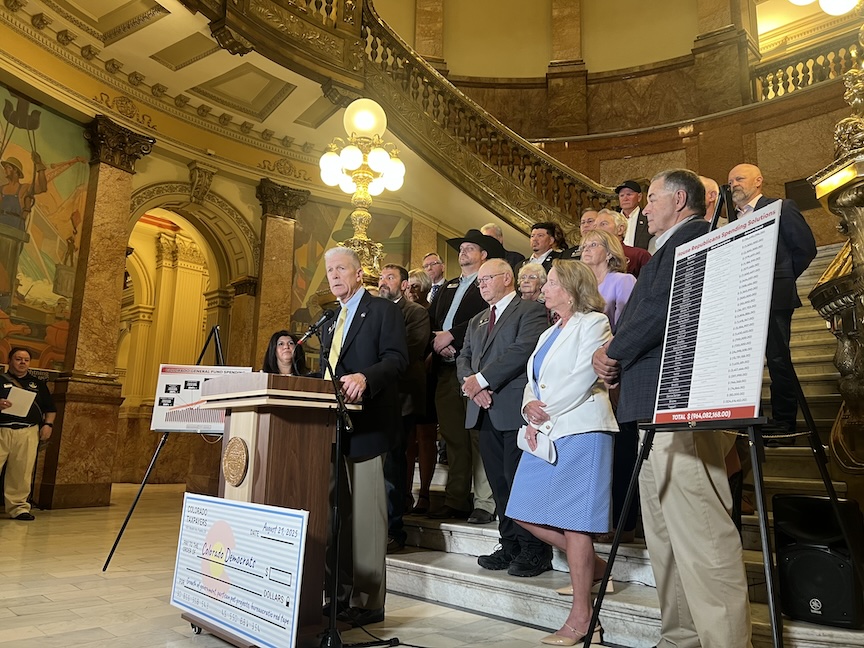
Rep. Rick Taggart, R-Grand Junction, a longtime businessman who served as the CEO for Marmot Mountain Works and Swiss Army Brands, said he felt discussion on the bill had demonized business leaders. Taggart said companies like the ones he led create jobs and contribute to Colorado’s economy.
“I understand the need to help families with a tax credit,” Taggart said. “What I take very personally, though, is when we as CEOs or companies that are profitable are thrown under the bus when in discussion.”
Other tax tweaks
Two other measures, House Bills 1223 and 1289, would tweak the state’s existing tax code by eliminating some benefits while expanding others.
HB 1223 would repeal a state sales tax exemption for most downloadable software, which is expected to generate $44.4 million for the new family tax credit. The bill’s sponsors are Reps. Andrew Boesenecker, D-Fort Collins, and Steven Woodrow, D-Denver, and Sens. Dylan Roberts, D-Frisco, and Matt Ball, D-Denver.
HB 1289 would narrow and eliminate certain tax benefits and use that money to fund the expansion and creation of new tax credits. Provisions that would be eliminated include vendor fees for cigarette and tobacco products, which allow sellers to retain a percentage of the sales tax they collect and send to the state, as well as a sales tax exemption for property used for space flight.
Tax credits that would be created or expanded include those aimed at small food retailers and family farms, renewable energy, wildfire mitigation and business rehabilitation projects.
The bill’s sponsors are Garcia and Rep. Kyle Brown, D-Louisville, and Sen. Mike Weissman, D-Aurora.